Showing posts with label Hard Rock. Show all posts

Tuesday, 3 February 2026

The 500 - 123 - Run DMC - Raising Hell

I was inspired by a podcast called The 500 hosted by New York-based comedian Josh Adam Meyers. His goal, and mine, is to explore Rolling Stone Magazine's 2012 edition of The 500 Greatest Albums of All Time.


Album #: 123
Album Title: Raising Hell
Artist: Run DMC
Genre: Hip Hop, Rock Rap
Recorded: Chung King Studio, New York, New York
Released: May, 1986
My age at release: 19
How familiar was I with it before this week: Quite
Is it on the 2020 list? Yes, at #209, Dropping 86 places
Song I am putting on my Spotify Playlist: Walk This Way
Album cover for Run-DMC's, Raising Hell.
Raising Hell was the third record from American Hip-Hop pioneers Run-DMC. It became their second of two records to make The 500 chart. Their self-titled debut at #242, and I wrote about it in October, 2023. In that post, I shared some information about their history and my earliest exposure to the hip-hop genre.
Album cover for Run DMC's self-titled first release.
Although Run-DMC had been recording since 1983 and began releasing albums the following year, my friends and I remained unaware of the trio until they swamped our radars with their genre-bending re-make of Aerosmith’s 1975 hard‑rock song Walk This Way. To say Run-DMC’s version took over the summer and early fall of 1986 would be an understatement. It was unavoidable. The track blasted from car radios and battered cassette decks slung over the shoulders of high-schoolers and pre-teens. It seemed to air on Canada’s MuchMusic television station almost hourly, becoming indelibly stamped on my memory. To this day, when I hear it I am transported back to 1986 when the song  became a significant piece of my mental soundtrack.
Album jacket for the single, Walk This Way, by Run DMC
With time and maturity, I can emphatically declare I now prefer the Run‑DMC version over the original by Aerosmith, although as teenagers my friends and I weren’t nearly so generous. We mistakenly believed the hip‑hop trio from Queens was “stealing” the earlier riff we loved.

As self‑styled rockers growing up in the predominantly white city of London, Ontario, we were generationally and geographically removed from hip‑hop. We didn’t recognize it as a rising art form, nor did we understand the concept, or legality, of borrowing and interpolating riffs and samples from the works of others.

As we edged toward our twenties, I think we felt a bit threatened, even left behind, by this new sound. To us, the song seemed as though Run‑DMC was trying to cash in on a great piece of someone else’s achievement. We considered it wrong and unfair. However, I would later learn that the “borrowing” is permissible and compensated.
A screen capture from the Walk This Way video. In the shadowy
background is Jason, "Jam Master Jay" Mizell. At front, from left
to right are Joseph "Run" Simmons, Steven Tyler, Darryl "DMC"
McDaniels and Joe Perry on guitar.
Truth be told, the picture does not reveal the whole story about the recording. Two members of Aerosmith – singer Steven Tyler and guitarist Joe Perry – actually needed a Walk This Way collaboration far more than Run-DMC. It would serve to revitalize their careers. In 1986, Aerosmith was struggling. Badly. By the mid‑’80s, the group were starting to be seen as washed-up, "has-beens". They were battling declining sales, internal instability, and addiction issues. Their recent albums were underperforming, they had lost cultural relevance, and the band was no longer a major commercial force.
Aerosmith's 1985 release, Done With Mirrors, was a commercial
failure for the once reliable group.
Conversely, Run‑DMC were entering 1986 on the verge of a historic breakthrough. They were already hip-hop’s hottest group, and culturally ascendant. They had strong sales from their first two albums – the aforementioned debut and King of Rock from1985 - had made them a global hip-hop phenomeno. Their third album, Raising Hell, was already shaping up to be a major success. Run‑DMC did not need rescuing and, rumour has it, they nearly declined the opportunity to record the Aerosmith cover.
Members of Run DMC and Aerosmith in the studio, on
March 9, 1986, when Walk This Way was recorded.
I've been trying to figure out why I now like the Run-DMC version of Walk This Way better, and I think it comes down to the guitar playing of Perry and the incendiary solo that finishes the five-minute song. Comparing the guitar solo in Aerosmith’s 1975 Walk This Way to Perry’s re-recording for Run‑DMC’s 1986 crossover smash is a bit like comparing two eras of music history.
Joe Perry (1986)
The original Perry guitar solo on Walk This Way, found on Aerosmith’s Toys in the Attic (#229 on The 500) is longer, looser, and unmistakably rooted in the band’s  blues‑rock swagger. It has a raw, improvisational grit typical of their mid‑’70s peak. By contrast, Raising Hell producer Rick Rubin has said  the Run‑DMC version needed a tighter, more streamlined solo. It had to be "one that could live inside a hip-hop arrangement without derailing its rhythmic momentum."
Album cover for Aerosmith's Toys In The Attic record. (#229 on The 500).
And that intentional refinement wasn’t accidental. Rubin pushed Perry hard during the 1986 session. As Rubin recalled, Perry’s first attempt didn’t cut it. Rubin told him directly that he didn't think it was great. Punctuating the criticism by saying; "I feel like you could do better!’’ It was only after that blunt assessment that Perry delivered the final take, one that was shorter, sharper, and engineered to serve Rubin's radically new context.
Rick Rubin (1986).
From Perry’s perspective, the collaboration was far more than a re‑recording session. He later described the remake with Run-DMC as “a high point” for Aerosmith and an artistic sparkduring a period when their career had stalled. Perry’s solo wasn’t just a performance; it was part of a cultural moment that helped relaunch Aerosmith and blasted hip-hop into the mainstream. Well, not the mainstream of my teenage circle of friends. It would be some time before we came around to accept...and now love...the collaborated version between two future Hall of Fame groups.


Tuesday, 1 April 2025

The 500 - #167 - Master Of Puppets - Metallica

I was inspired by a podcast called The 500 hosted by Los Angeles-based comedian Josh Adam Meyers. His goal, and mine, is to explore Rolling Stone Magazine's 2012 edition of The 500 Greatest Albums of All Time. 


Album: #167
Album Title: Master Of Puppets
Artist: Metallica
Genre: Thrash Metal
Recorded: Sweet Silence Studios, Copenhagen, Denmark
Released: March, 1986
My age at release: 20
How familiar was I with it before this week: Fairly
Is it on the 2020 list? Yes, at #97, rising 70 spots
Song I am putting on my Spotify Playlist: Master of Puppets
In the summer of 2024, I penned a lengthy post about Metallica's Black Album (#255 on The 500) in which I sketched out a brief history of heavy metal -- from its founding in late-’60s heavy blues, through its commercially successful glam rock phase in the ‘80s and into the arrival of Metallica in 1984.
In that post, I recalled my introduction to Metallica in 1987 when I was working at Fluffy's Pizza with a devoted headbanger named James Fast. James worked in the kitchen and, at first, I was a delivery driver. We both worked late into the night, especially on weekends, often finishing our shifts at 3:00 a.m. Those long hours were ballasted by caffeine, cigarettes and music. The stereo system in my car (a 1981 Chevette) was in overdrive, and James had his portable cassette player blasting away at the back of the kitchen.

We quickly connected over a shared love of Rush, Iron Maiden, Queensryche and Judas Priest; however, my tastes skewed toward more progressive rock sounds (Genesis, Peter Gabriel, Marillion, Yes) and James liked his sound louder and heavier. Among his favourite bands were the Danish Black Metal band Mercyful Fate and Metallica.
Metallica in 1987 (l-r) Kirk Hammett (lead guitar), Lars Ulrich (drums),
Jason Newsted (bass) and James Hetfield (guitar, vocals).
James tried hard to make me a Metallica fan, sharing stories of their epic performances and regularly sharing cassette tapes of their albums. These included their most recent work, Master Of Puppets, which I could listen to  during deliveries. I didn't mind the music. The songs were high energy and aggressive and that helped keep me awake as I drove around, squinting for street names and house numbers during late night deliveries. In a time before Satellite navigation and on-screen mapping apps like Waze, I relied on a well-worn map that I kept stuffed in the glove compartment. It had been folded and unfolded so many times it was hard to read the street names obscured in the creases.
The approximate delivery area I served, with Fluffy's Pizza Springbank located
on the map with a red star.
Despite James' best efforts, Metallica didn't stick – just another band that I "didn't mind" but too indifferent to commit time or money. Eventually, though, I was won over and Metallica songs are now scattered through my workout playlists.
I have to give Metallica and James their due. Master Of Puppets is an important record and considered by fans and music critics to be a highwater mark for Thrash Metal -- hailed for its strong lyrics, technical excellence and influence on the genre. The guitar riffs are relentless and the lyrics tap perfectly into teen-age anger, conspiratorial curiosity, rebellion and angst.

A 500 Podcast guest and Metallica fan, Joe Manganiello, aptly described the record as containing "muscular poetry", touching on themes of addiction, anti-war, religious corruption and corporate exploitation. It also delivered  a powerful instrumental inspired by H.P. Lovecraft's cosmic horror series, The Call of Cthulhu. In view of those laudatory comments I wonder why the teen-age version of me didn't like the record more.

Cthulhu (The Old One) creature from H.P. Lovecraft's mythos.
Perhaps I'll check in again with my friend "Jimmy Quick", as I like to call him. We have remained in touch over these past 40 years. He works as a sound engineer on television productions and is still a fan of Metallica. I'll have to let him know his late night, oven-side persuasions finally worked.


Monday, 10 March 2025

The 500 - #170 - Live At Leeds - The Who

I was inspired by a podcast called The 500 hosted by Los Angeles-based comedian Josh Adam Meyers. His goal, and mine, is to explore Rolling Stone Magazine's 2012 edition of The 500 Greatest Albums of All Time. 


Album: #170
Album Title: Live At Leeds
Artist: The Who
Genre: Rock, Hard Rock
Recorded: University of Leeds Refectory, West Yorkshire, England
Released: May, 1970
My age at release: 4
How familiar was I with it before this week: Very well
Is it on the 2020 list? Yes, at #327. dropping 157 spots
Song I am putting on my Spotify Playlist: Magic Bus
Album cover for Live At Leeds by The Who.
Well documented in this blog series is the first Rush record I purchased – their 1976 live release, All The World's A Stage. I bought it when visiting my dad in my future hometown of London, Ontario, during March Break in 1980. It was a job change and dad was setting up house in advance of the family move from Kingsville on the shore of Lake Erie.
Album cover for All The World's A Stage -- Rush.
In order to listen to this double record, I coaxed an attendant at the Central Library to allow me to borrow headphones and use a music listening booth. What I heard, blew my fourteen-year-old mind. How could three musicians create such a big, full sound? I understood that studio recordings could be enhanced with layers of multiple tracks for guitars, bass, vocals and drums, but this was a live recording...by a trio! Additionally, there were moments when the three of them seemed to be soloing at the same time, effortlessly switching between complex time signatures and melodic phrases. This was not straightforward 4/4 time rock and roll – at the time I thought of it as "orchestral rock" or "symphonic metal"?
Rush performing live in 1976.
Not surprisingly, Rush players Geddy Lee (bass/vocals), Alex Lifeson (guitars) and Neil Peart (drums) have cited several bands on The 500 as influencing their sound -- chief among them is The Who. In a July, 2020, article in Rolling Stone Magazine, Lee named The Who’s John Entwistle as the greatest rock bass guitarist of all time, saying:
"He was one of the first gods to me. Gods of rock. [Laughs] Ever since I first heard (The Who's) My Generation, it was like, “Who is that?” His was a name I needed to know."
It's easy to spot the influence on Rush when you listen to The Who's 1970 record Live At Leeds. It is equally hard to imagine that The Who’s four members made such a heavy, complex sound. Throughout Live At Leeds and much of The Who’s classic catalogue, Entwistle's bass work is riveting. One of his nicknames, Thunderfingers, is apropos Those digits of his dance up and down the fretboard with purpose and confident melodic authority. He is a master of the oft-overlooked instrument.
Entwistle in 1970.
Throughout their careers with The Who and Rush respectively, Entwistle and Lee were not content to serve as simple rhythmic bricklayers. Instead, they played their instruments more actively, finding engaging melodies that supported the piece while making it far more interesting. There’s truth in the observation that Lee and Entwistle play the bass as if it is the lead instrument. Perhaps, unsurprisingly, both began as guitar players and played trumpet in school. Their understanding of melody and counter-melody certainly informed their songwriting and bass playing.
John Entwistle surrounded by his many bass guitars.
It was at my high school friend Brent Murray's home that I first heard Live From Leeds. We were likely skipping school and hanging around at his mom's apartment while she worked. I was gobsmacked. It sounded so raw and real, as if I was standing in the crowd at the Refectory (cafeteria) at Leeds University in West Yorkshire on February 14, 1970, when the concert was recorded.
A 2019 picture of the small stage in the Refectory at Leeds University.
The extended version of the song Magic Bus, which concludes the record, remains one of my favourite Who performances, so it was an easy choice for adding it to my personal, ever-growing, 500 Playlist. However, Entwistle has called Magic Bus one of his least favourite songs to play because the bass part is so simple –  for the most part, a single note (a low A) played repeatedly. Conversely, Who guitarist Peter Townsend has termed it a favourite because of the rhythm. The song Such is the fate for even the greatest rock bassist. It was a staple of their live performances for decades. Alas, sometimes, even the greatest rock bassist of all time has to accept the role as a rhythmic bricklayer for the benefit of the band.

Sunday, 26 January 2025

The 500 - #176 - Rocks - Aerosmith

I was inspired by a podcast called The 500 hosted by Los Angeles-based comedian Josh Adam Meyers. His goal, and mine, is to explore Rolling Stone Magazine's 2012 edition of The 500 Greatest Albums of All Time. 


Album: #176
Album Title: Rocks
Artist: Aerosmith
Genre: Hard Rock, Heavy Metal
Recorded: Wherehouse, Waltham, Mass. and Record Plant (New York City, N.Y.)
Released: May, 1976
My age at release: 10
How familiar was I with it before this week: Very
Is it on the 2020 list? Yes, at #366, dropping 190 spots
Song I am putting on my Spotify Playlist: Back In The Saddle
Rocks was the second record from Boston-based, hard rock band Aerosmith to appear on The 500 list. In January, 2024, my appreciation for the group was made evident in a post about their third record, Toys In The Attic, which also made the list. Most of my high school chums were devotees of the quintet, which comprised Steven Tyler (vocals), Tom Hamilton (bass), Joey Kramer (drums), and guitarists Joe Perry and Brad Whitford.
Aerosmith (1978) (l-r) Tyler, Hamilton, Perry, Whitford and Kramer
Both records were in regular rotation at house parties I attended, as was their Greatest Hits collection, released in 1980. Enjoying critical and commercial success while selling out arenas across North America, it seemed that "The Bad Boys of Boston" were riding high on a wave of good fortune that would carry them comfortably through the eighties. However, behind the scenes, things were falling apart. Guitarist Perry summed it up well in his 2014 autobiography and in many interviews, saying;  "Originally, we were musicians who dabbled in drugs. By the early ‘80s, we were drug addicts who dabbled in music".
In early 1982, stories began circulating among my friends about the group's disastrous decline -- failed marriages, drug busts and even riots at concerts when the group was too drunk or high to play. There were even rumours that Hamilton was so drunk at a show in Cleveland that he fell off the stage and knocked himself out cold. By the time the group released their seventh record, Rock In A Hard Place, in August, 1982, Perry and Whitford had quit the band. The group that had often been called, "America's Greatest Rock and Roll Band" became a joke to me and many friends.
Rock In A Hard Place album cover (1982).
In retrospect, we could have been kinder and understood that the five musicians were struggling with addiction. However, we were, like many teenagers, more interested in making each other laugh than concerning ourselves with the personal problems of other people. My buddy, Paul Dawson, and I would try to outdo each other by singing parodies of their lyrics and creating satirical titles for classic Aerosmith songs whenever they entered our purview.
  • Back In The Saddle became "Back On The Bottle", 
  • Draw The Line was modified to "Draw The Line, So I Can Snort It",
  • Walk This Way featured us pantomiming a member stumbling drunk and falling flat on his face. 
Paul was far better at these ridiculous bits of satirical improv than I, often reducing me to tears with his comedy chops. His clever word play on our shared digital messenger thread still makes me chuckle.
My favourite photo of Paul from the
early 80s. He always found (and still finds)
the comedy in everything.
Fortunately, there was a glorious third act waiting for Aerosmith when they became sober in the mid-eighties. They released an impressive string of multi-platinum-selling albums and chart-topping hit singles that began with Permanent Vacation in 1987. Perry and Whitford had returned to the line-up and the band employed songwriters with "pop music" sensibilities. It was the right decision for them, as they amassed a new generation of fans. Their pop-metal and syrupy ballad sound was not for me, though.
Album cover for Permanent Vacation (1987).
Even Saturday Night Live took the mickey out of the band when the comedy ensemble satirized Aerosmith’s mid-’90s hits in a sketch featuring Adam Sandler as Steven Tyler and Jay Mohr as Joe Perry. In the skit, presented as a faux-commercial for a 1990-1994 Greatest Hits Record, Sandler poked fun at the familiar and formulaic sound of the songs Cryin', Crazy and Amazing -- eventually, pitching "new" songs including the ridiculously titled, Crazy Amazing Cryin-Amazacrazy. The video can be seen here.
Sandler as Tyler and Mohr as Perry in the 1994 SNL sketch.
In May, 2023, the group announced a Farewell Tour. However, after 74-year-old Tyler suffered vocal chord damage in September, the shows were postponed for a year. In August, 2024, it was announced that all shows would be cancelled and the band retired. It seems that Father Time had caught up with the leather-lunged Tyler (aka The Demon of Screamin'), and he was unable to recover from his throat injury.
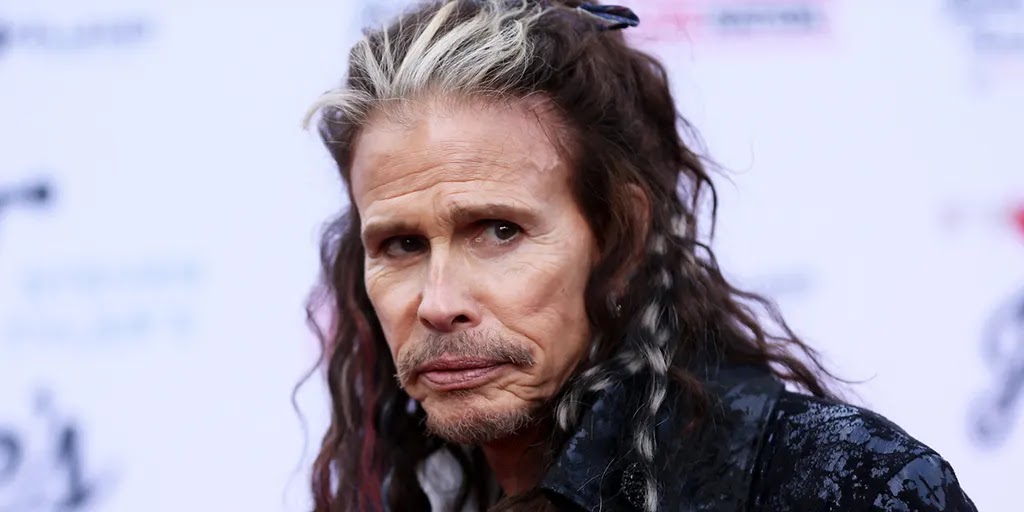
Steven Tyler in 2023.
I regret not seeing Aerosmith perform live despite many opportunities. In 1990, a group of friends invited me to join them at a concert at Toronto's Skydome and support the band’s tenth record, Pump. Looking back, I am surprised I declined because I didn't mind the album and had it on CD for years. Still, it never measured up to those early records, including this week's album, Rocks.


Sunday, 4 August 2024

The 500 - #201 - The Downward Spiral - Nine Inch Nails

I was inspired by a podcast called The 500 hosted by Los Angeles-based comedian Josh Adam Meyers. His goal, and mine, is to explore Rolling Stone Magazine's 2012 edition of The 500 Greatest Albums of All Time. 


Album: #201
Album Title: The Downward Spiral
Artist: Nine Inch Nails 
Genre: Industrial Rock, Industrial Metal
Recorded: Three Studios, Los Angeles, U.S.A.
Released: March, 1994
My age at release: 28
How familiar was I with it before this week: Fairly
Is it on the 2020 list? Yes, at #122, moving up 79 spots
Song I am putting on my Spotify Playlist: Piggy
Album cover for The Downward Spiral from Nine Inch Nails.
It was a line cook named Jeff Nisbet who first pushed a cassette copy of The Downward Spiral into my hands following a busy dinner shift at a London, Ontario, restaurant in the spring of 1994.

"You gotta hear this! It is incredible," he exclaimed.

Granted, he said that about a lot of music. Jeff was prone to superlatives when it came to his love of music and hockey. The two of us had bonded quickly around those two topics when I was first hired at the restaurant six months earlier. That, and the fact that he was, like me, born in St. Catharines, Ontario. Well, technically, he was from Thorold, -- a village that was incorporated into the Greater Niagara Region, including St. Catharines. Jeff was quite proud of being a classmate and friend of Thorold's best known citizen, Owen Nolan, who was drafted first overall into the 1990 National Hockey League by the Quebec Nordiques. Jeff proudly wore a Nolan Nordique jersey when we played pick-up hockey three times a week.

The only pictures I have of Jeff were scanned from
an old photo album -- notice his Nordiques jersey 
playing pick-up hockey.
I took the Nine Inch Nails cassette home and played it in the basement stereo of the townhouse I shared with two high school chums. I wasn't sure what I was hearing. I can't say I didn't like it. There were elements of hard rock that I appreciated; but there was something darker, grittier and more sinister about the sound. Of course, I'd heard about industrial music and could name a few bands that played the style, although I was less than enthusiastic about it. This record, the second from Nine Inch Nails, was essentially my initiation into the genre.
Industrial music was defined by the AllMusic database and website as "the most abrasive and aggressive fusion of rock and electronic music." It is a genre  that draws on, as the name suggests, harsh, mechanical and industrial sounds, blending them with avant garde experimental electronic noise. The pioneers of this provocative and transgressive cacophony was  the British group Throbbing Gristle, which coined the term along with the release of its first full-length record, The Second Annual Report, in 1977.
The Second Annual Report album cover from Throbbing Gristle
Although influential, Throbbing Gristle and other bands inspired by the industrial movement appealed to a niche audience and, unsurprisingly, their jarring, unconventional work did not enjoy mainstream success. However, that changed in the early 1990s with the hybrid genre of industrial metal and the emergence of bands that included Ministry, Rammstein, Marilyn Manson, Rob Zombie and Nine Inch Nails. Each had platinum-selling discs.
A collage of band logs from successful industrial metal bands of the 90s.
The Downward Spiral from Nine Inch Nails (often abbreviated to NIN, with the second N stylistically reversed) was by far the most successful record of its type. It was certified 3x platinum in Canada (300,000 units sold) and 4x platinum in the United States (four million sold).
The Downward Spiral was a concept record, detailing the protagonist's self-destructive plummet from misanthropic despair to suicidal ideation. The concept of a "downward spiral" was, prior to the album's release, an established clinical phenomenon in psychotherapy. It occurs when "negative emotions narrow one's attention and cognitive understanding of life's circumstances. This, in turn, initiates a spiral of emotional and physical changes which alter an individual's perception of their reality."
In a way, the “spiral” is an example of perpetual self-fulfilling prophecy. An individual loses his job and is unable to provide for his family. Understandably, he feels useless and inadequate. These feelings impact his ability to sleep, eat and socialize, consequently impacting his ability to secure gainful employment. Pushed deeper into depression, he begins to withdraw from friends and family. The cycle can persist without professional intervention and suicide is possible.

Suicide is a permanent solution to a temporary problem. If you experience such feelings,

contact a professional (Dial or Text 9-8-8).

I'm not sure why the ‘90s featured so many depressing and tragic themes in pop culture. Industrial metal was only one form of entertainment rife with themes of nihilism, angst and hostile social critique. It was a time of grunge music and the ironic thrift store "anti-fashion" mentality that was spawned. Even the most popular movies were bummers as they tackled grim disaster themes (Titanic, Twister); the holocaust (Life Is Beautiful, Schindler's List); mental breakdowns (The Fisher King, Girl Interrupted, Fight Club); social lassitude (Slackers, Clerks); and crazed serial murders (Kalifornia, Natural Born Killers). Regardless, I watched every flick -- sometimes more than once.
The soundtrack to Natural Born Killers featured the song Burn from
Nine Inch Nails.
I suspect there were many factors – political, economic, technological and cultural –that contributed to the general sense of disillusionment that many people felt toward mainstream institutions as the millennium drew to a close. I'm sure sociologists have examined the causes far better than I could here. However, I admit getting caught up in that general malaise. Perhaps it was  a byproduct of transitioning through my late-twenties into my early thirties.

Me aged 29 in the summer of 1994 , at a road hockey tournament

in Victoria Park, London, Ontario.

When I think back on who I was at that time, it feels less like nostalgia and more like imagination. I'm really not sure who that guy was -- the one who worked in a bar, lived with roommates and borrowed industrial metal cassette tapes from kitchen chums. Relistening to The Downward Spiral certainly brought back a few emotions, fortunately, they were a mix, and some were even jovial -- particularly remembering Jeff Nisbet and his unabashed enthusiasm for music and hockey.