Showing posts with label Dance. Show all posts

Sunday, 27 April 2025

The 500 - #163 - 1999 - Prince

I was inspired by a podcast called The 500 hosted by New York-based comedian Josh Adam Meyers. His goal, and mine, is to explore Rolling Stone Magazine's 2012 edition of The 500 Greatest Albums of All Time. 


Album: #163
Album Title: 1999
Artist: Prince
Genre: Dance Pop, Art Pop, Minneapolis Sound, R&B, Funk
Recorded: Kiowa Trail (Prince's Home Studio), Chanhassan, Minnesota; and Sunset Sound Recorders, Hollywood, California
Released: October, 1982
My age at release: 17
How familiar was I with it before this week: Fairly
Is it on the 2020 list? Yes, at #130, elevating 33 spots
Song I am putting on my Spotify Playlist: 1999
"You know that feeling you get on a roller coaster, when you are slowly climbing to the top...and it seems to take forever? That's turning 30. You'd better look around...because the rest of the ride is damn quick."
Those astute words by my pal, Paul Dawson, were uttered at the time we were entering our thirties. Paul has always been a clever wordsmith and I laughed off his amusing hyperbole. However, as I prepare to turn 60 this summer, I'll admit that the last 30 years came and went with alarming speed.
Paul Dawson, at his 30th birthday party.
The first time I heard the debut single 1999 from Prince's album of the same name, was in late autumn, 1982. I was a passenger in the car of another pal, Rob Cummings, when it came on the radio. Oddly, I can even remember the road we were on. The music wasn't my cup of tea at the time, but the lyrics sure got me doing some mental math:  "How old will I be in 1999...and what will I be doing? Will I be married? Have kids? What job will pay my bills?"
The idea of being 34 seemed like the stuff of science-fiction to my 17-year-old brain. Besides, as Paul later put it, I was still slowly climbing the first hill on the roller coaster. Now, with that birthday a full 26 years behind me, it feels like contemporary history. Such is our strange perception of time, a topic I tackled in my January, 2025 blog post about The Definitive Collection, from ABBA.
However, the wonderful thing about revisiting music from my youth, especially after a long hiatus, is that it can rekindle some of those vibrant, emotional feelings. There is something about the sound of 1999 that evokes such powerful nostalgia for me. It is likely the distinctively ‘80s "synth and electronic drum" sound that permeates so many of the tracks. That sound reminds me of how much I loved being 17. It was a time of great freedom and discovery. I had money, limited responsibility and incredible health. I didn't know how lucky I was. The curmudgeonly man on the porch in It's A Wonderful Life was right when he lamented to George Bailey and Mary Hatch. "Youth is wasted on the wrong people".
My friendships were also fantastic, including the time I spent with Rob and Paul. I am still in contact with Paul...we've actually been texting about the NFL draft as I write this piece. However, Rob and I drifted apart after high school. After listening to this record, I decided to try to find him through social media. He worked in construction, as a bricklayer, in the early ‘90s, and I found a website for Rob Cummings Contracting Company. I sent a message...we'll see what comes of that.
The album 1999 was the fifth studio production from the multi-talented and influential musician/songwriter Prince. On the strength of three hit singles, it propelled the flamboyant, androgynous entertainer to stardom. Consequently, it is not surprising that 1999 was the first song of his I heard.  In fact, for many years, I assumed this was his debut record and that he was an overnight sensation.
Prince, in his video for Little Red Corvette, the second single from 1999.
Released as a double record on vinyl in 1982, 1999 set the stage for Prince's meteoric rise to superstardom. Two years later, The High Priest of Pop released the landmark record Purple Rain, which also served as the soundtrack to his 1984 film of the same name, at which point he  became one of the biggest artists in the world – rivalled only by The King of Pop, Michael Jackson. Purple Rain appears at #76 on The 500 list. That is 87 weeks away...but on this roller coaster ride that will be here, in the words of Paul Dawson, "damn quick".


Sunday, 19 February 2023

The 500 - #277 - Rhythm Nation 1814 - Janet Jackson

I was inspired by a podcast called The 500 hosted by Los Angeles-based comedian Josh Adam Meyers. His goal, and mine, is to explore Rolling Stone Magazine's 2012 edition of The 500 Greatest Albums of All Time. 


Album: #277

Album Title: Rhythm Nation 1814

Artist: Janet Jackson

Genre: Pop, R&B, New Jack Swing

Recorded: Flyte Time (Minneapolis, Minnesota)

Released: September, 1989

My age at release: 24

How familiar was I with it before this week: Quite

Is it on the 2020 list? Yes, at #339 (dropping 63 places since 2012)

Song I am putting on my Spotify Playlist: Black Cat

Janet Jackson was the tenth-born and youngest member of the famous Jackson family. Born in 1966, she was16 years younger than the oldest member, Maureen and her mega-famous brother, Michael, was eight years her senior. In fact, Michael was already performing with his four brothers in The Jackson 5 in 1964, two years before Janet was born.
Promotional poster & photo from Jackson 5 (1965)
Janet made her entertainment debut in 1976, appearing on the weekly variety television program, The Jacksons, with her multi-talented family. She went on to appear in many other television roles in the late ‘70s and early ‘80s, including Diff’rent Strokes, The Love Boat and Fame. However, it was the program Good Times that brought her to my attention.
Janet Jackson in varous television roles (70s & 80s)
Good Times was an American situational comedy that ran from 1974 until 1979. Developed by legendary producer Norman Lear (All In The Family, Sandford & Son, One Day At A Time, The Jeffersons), it was a spin-off from another Lear project, Maude.
Norman Lear Television Programs from the 70s
Good Times aired during when my friends and I were discovering, and ravenously devouring, prime time television (ages 8-14). The previous evening's television was the “water-cooler topic” at my school playground and being out of the loop on the latest plots, dialogue and catch-phrases of ‘70s TV could socially isolate you, making you a pop-culture pariah. By today’s metric, missing a new episode of popular television would be the equivalent to being oblivious to the latest viral TikTok trend or lacking knowledge of the hippest meme lingo.
“Meme man” with stocks intentionally misspelled was required knowledge
among my 7th graders a few years ago. (
Know Your Meme history here)
Good Times was a dramatic comedy (dramedy) set in a poor, black housing project in inner-city Chicago. The series centred on the Evans’ family who collaborated to overcome the social challenges faced by many African American families in the 1970s – poverty, job loss, inflation, crime, gang activity, pregnancy, sexually transmitted diseases and drug use.
The Evans Family from Good Times 
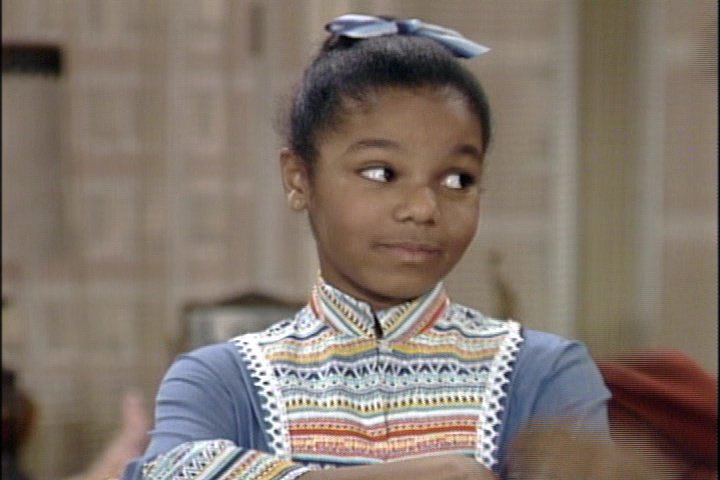
Janet Jackson joined the cast in Season Five (1977), playing the role of Millicent “Penny” Gordon, an abused girl who was abandoned by her mother and, eventually, adopted by the Evans’. The addition of adorable, 11-year-old Jackson as a sympathetic character was intended to re-energize the show following the departures of veteran actors John Amos (James Evans) and Esther Rolle (Florida Evans).
Jackson as Millicent "Penny" Gordon
Introducing a new, cute and younger child to a cast is often called “The Cousin Oliver Strategy”. The term references the addition of cousin Oliver to the cast of The Brady Bunch in their fifth season. In both cases, by bringing in (Cousin Oliver and the adopted Penny Gordon), series producers were hoping to reverse declining ratings and connect each series with a younger audience.
Cousin Oliver (centre) between the two youngest Brady kids
In both cases, the casting was short-lived and both series were cancelled within two years. I was never a fan of Cousin Oliver, but I really liked Jackson’s Penny – not just the precocious, funny, sympathetic character, but also Jackson who was charming and pretty. Granted, I was 12 going on 13, I think I had a crush on nearly every female aged 12-30 on television.
Rhythm Nation 1814 exploded onto the music scene in fall of 1989. It was Jackson’s fourth studio album but only the second since she became an adult and wrested control of her artistic image and sound from her manipulative, abusive and controlling father, Joe. Three years earlier, Janet had teamed up with producers Jimmy Jam and Terry Lewis to release her third studio album, Control, an unconventional record that fused R&B, rap, funk, disco and synthesized percussion. The aptly named Control was a massive success, going to the top of multiple charts and selling 10 million copies worldwide.
Album cover for Control (1986)
For obvious reasons, record executives hoped that Rhythm Nation 1814 would simply replicate the chart-busting formula of Control and the seven hit-singles it generated. However Jackson and producers Jam and Lewis had different plans. Much like the storylines on Good Times, Jackson's fourth project a concept album with overarching themes of social justice and equality weaved throughout. Jackson drew inspiration from the tragedies of poverty, racism and substance abuse in contemporary news stories, and presented the sociopolitical utopia of a "Rhythm Nation" as an alternative.
Chorus of Rhythm Nation - the second single from the album
When asked about the concept of a Rhythm Nation, Jackson said: 
"I thought it would be great if we could create our own nation." She added that it would be "one that would have a positive message and that everyone would be free to join." She based the idea on the prevalence of various youth groups and organizations that are formed as a means of creating a common identity. The number "1814" represents the year the U.S. national anthem, The Star-Spangled Banner, was written. Some noticed that "R" (Rhythm) and "N" (Nation) are the eighteenth and fourteenth letters of the alphabet, though Jackson said this was a happy coincidence. (Pity, I would totally have taken credit for that bit of cleverness).
Jackson in the Rhythm Nation video
The video that accompanied the title track was a critical and commercial juggernaut and can be seen here. Shot in black and white, it featured 23-year-old Jackson decked out in stylistic, unisex military garb performing a mesmerizing choreographed dance sequence in what is best described as a post-apocalyptic warehouse setting. 

The video went on to receive two MTV video music awards for “Best Video” and “Best Choreography”, as well as a Grammy for “Best Long Form Video”. It is also cited as an influence by numerous contemporary artists, including Lady Gaga, Britney Spears, Beyonce, Pink and Rihanna.
Rhythm Nation video
Rhythm Nation 1814 also received numerous award nominations and, because it dominated the charts from August, 1989, to March, 1991, it was the first album to produce number one hits on the chart in three calendar years. Jackson also became the first woman to be nominated for a Producer of the Year award by The Grammy Awards committee.
Jackson cleaned up at the 1990 Billboard Music Awards
I did not purchase this record, but it was omnipresent for two years and certainly part of the soundtrack of my life in my early twenties. At the time, I was 24 and investigating a career as a restaurant manager. A cassette version of RN-1814 was a staple on the kitchen sound system, especially early in the morning when the prep-team was hard at work. Revisiting it this week was a delight. I was amazed at the number of lyrics I still knew from memory. It also reinforced my sentiment that, despite Michael’s massive global fame and impressive musical catalogue, Janet is still my favourite Jackson. After all, adolescent crushes have staying power.

Thanks for reading -- all the blogs can be found here (just scroll down).

Wednesday, 7 July 2021

The 500 - #363 - Substance - New Order

I was inspired by a podcast called The 500 hosted by Los Angeles-based comedian Josh Adam Meyers. His goal, and mine, is to explore Rolling Stone Magazine's 2012 edition of The 500 Greatest Albums of All Time. 

Monday, 23 November 2020

The 500 - #395 - Sound of Silver - LCD Soundsystem

I was inspired by a podcast called The 500 hosted by Los Angeles-based comedian Josh Adam Meyers. His goal, and mine, is to explore Rolling Stone's 2012 edition of The 500 Greatest Albums of All Time. 

Album # 395

Album Title: Sound of Silver
Artist: LCD Soundsystem
Genre: Dance Punk, Electronica, Indie Rock
Recorded: Long View Farm, Massachusetts
Released: March, 2007
My age at release: 41
How familiar was I with it before this week: Not at all
Song I am putting on my Spotify Mix: Someone Great 

Sound of Silver Album Cover - LCD Soundsystem

In music, the term Electronica casts a wide net over many styles. It is a genre that is difficult to define and one that comes with many labels, including ambient, house, techno, jungle, dub, chill and trance. Sound of Silver, is no exception. The sophomore release from LCD Soundsystem has been described by critics as dance-rock, art-rock, alternative-dance, and even post-punk-revival. Perhaps, it is best experienced and not labelled at all.

LCD Soundsystem was the brainchild of Brooklyn-based multi-instrumentalist and songwriter James Murphy. Formed in 2002, the band has become a performer's collective, recruiting a diverse group of musicians and producers to help create their unique sound. 
LCD Soundsystem performing in 2016
However, the core members include Murphy, drummer Pat Mahoney and guitarist/bassist Tyler Pope, as well as Nancy Whang and Ranya Russom providing keyboard and vocal support.

Typically, music from the world of electronic dance relies heavily on beat and melody. Lyrical content is often sparse, or simple and repetitive. After all, dance music is for dancing.
James Murphy - LCD Soundsystem
Sound of Silver, however, offers something different. Murphy was an English major. He even turned down a job as a scriptwriter for the seminal television program Seinfeld. Additionally, his musical influences include an eclectic assortment of new wave, punk and art rock acts, including The Talking Heads, The B-52s, David Bowie, Brian EnoThe Velvet Underground, and even the progressive rock band Yes. Consequently, mixed into the rhythmic electronic sound of this record are lyrics that are poignant and thought provoking.

In preparing to write this entry, I posted a picture of the record cover on my social media accounts with a simple question: "Any fans out there?"
A fellow educator, Viki Kotarba, responded, celebrating her love for the track Someone Greata song full of tantalizing contradictions. It is both sleek and uncomfortably peppy. It bounces rhythmically while delivering a message that, although it seems to be about loss and grief, is ultimately inconclusive. 
"I wake up and the phone is ringing
Surprised, as it's early
And that should be the perfect warning
That something's a problem
To tell the truth I saw it coming
The way you were breathing
But nothing can prepare you for it
The voice on the other end."
At times, the speaker seems to be telling only part of a story. Consequently, there is plenty of room within the hypnotic music for the listener to fill in the blanks from their own experiences. Much like the genre of electronica, it's a song that defies simple labels. 

Over the past week, I have played this record many times. I've invested time with the lyrics, but I enjoy it most when I simply let it play in the background -- washing over me as I busy myself with everyday life.