Showing posts with label Sampledelia. Show all posts

Sunday, 15 June 2025

The 500 - #156 - Paul's Boutique - Beastie Boys

I was inspired by a podcast called The 500 hosted by New York-based comedian Josh Adam Meyers. His goal, and mine, is to explore Rolling Stone Magazine's 2012 edition of The 500 Greatest Albums of All Time. 


Album: #156
Album Title: Paul's Boutique
Artist: Beastie Boys
Genre: Hip Hop, Sampledelia
Recorded: 3 Studios in Los Angeles, U.S.A.
Released: July, 1989
My age at release: 24
How familiar was I with it before this week: Quite
Is it on the 2020 list? Yes, at #125, rising 31 spots
Song I am putting on my Spotify Playlist: Shake Your Rump

In January, 1996, I was rumbling alone along a remote Northern Ontario highway in my weathered 1990 Chevrolet Cavalier. To the right, under the quiet gleam of the winter moon, rose the Canadian Shield -- a timeless sweep of granite and snow, like something lifted from a Group of Seven canvas. The earth’s ancient bones jutted through drifts of white, stoic and scarred.
Franklin Carmichael's Mirror Lake (1929).
To the left, glimpses of Lake Superior’s frozen shoreline appeared now and then between dark ranks of boreal pine, each sighting brief but breathtaking. I'd left London, Ontario, the day before and was heading back to Lakehead University in Thunder Bay after the Christmas break – 1,400 kilometers northwest, deeper into winter’s grasp.

A familiar route between my home in Southwestern Ontario to

 Lakehead University

My companion on the long drive wasn’t just the road -- it was the pile of cassette tapes scattered across the passenger seat. Among them were familiar favorites that had seen me through many a stretch of this 15-hour journey: Naveed, the debut from Toronto's Our Lady Peace; Superunknown by Soundgarden; Radiohead’s The Bends; Purple by Stone Temple Pilots; Pearl Jam's Ten; and the soundtrack to Kevin Smith’s slacker cult classic, Mallrats.

But there was one newcomer in the mix -- a cassette I’d borrowed from my Teachers College roommate, Randy. It was Paul’s Boutique by the Beastie Boys, and as I switched from cassette to cassette shortly after passing Wawa, Ontario, I had no idea just how weird, and stressful, the ride was about to get.
Some of my favourite listens from 1995.
As I mentioned in my March 2024 blog post about the Beastie Boys' debut album, Licensed to Ill (#219 on The 500), it took me some time to appreciate the group's clever approach to hip-hop. Initially, I dismissed them as brash, frat-boy rock with a misogynistic edge. But over time, I began to understand their humor and artistry, quietly becoming a fan -- though never to the point of buying their records.

That changed when Randy played Paul's Boutique in the college townhouse we shared with two other Teacher College students, Craig and Brendan. From the first listen, I knew something was different. The band had dramatically evolved their sound, and while I didn’t yet grasp the full extent of their creative journey, I recognized that this was something entirely new -- something that piqued my curiosity.

Beastie Boys (1989) (l-r) Michael "Mike D" Diamond,
Adam "MCA" Yauch, and Adam "Ad-Rock" Horovitz
In the three years since the release of License To Ill, the group had matured. They had moved from New York to Los Angeles, intent on making a record with more creative depth. Paul's Boutique embraced a more sophisticated, sample-heavy production style. They collaborated with production duo The Dust Brothers to create a layered, funk-driven sound. The result was a record that was built around more than 100 music samples, taken from jazz, rock, soul and disco. Their lyrics had evolved too. While Licensed to Ill leaned into juvenile humor and rowdy anthems, Paul’s Boutique showcased more intricate wordplay and storytelling.
The Dust Brothers (l-r) Michael "E.Z. Mike" Simpson
and John "King Gizmo" King in their studio (2005).
I can’t recall which cassette was playing as I piloted my Chevy Cavalier along an isolated stretch of the Trans-Canada Highway near Terrace Bay, Ontario. But I do remember the sudden, unmistakable sound of a flat tire, flapping against the snow-covered asphalt like a rubber death rattle. I pulled over, stepped out into the biting cold, and made my way to the rear. The driver’s side, back tire had blown. With numb fingers, I began emptying the trunk, shifting my belongings, destined for my campus townhouse, just to reach the car jack and spare tire buried underneath. I worked quickly, hoisting the car into position, pausing briefly to breathe warmth onto my frozen fingers.

There is only one thing worse than a flat tire. That’s two simultaneous flat tires, in the dead of night, stranded in winter on a remote Ontario highway. And that was my fate, with two flats on the rear axel of my car. In the 4 a.m. frigid blackness, it was a nightmare scenario. I had only one spare, and it had been a while since a vehicle had passed me. In a time before cell phones, I was stranded, truly alone.
A gray, 1990 Chevrolet Cavalier, similar to the one I owned in 1995.
I lowered the car onto its rims and climbed inside, wrapping myself in the comforting warmth of the cabin. A dozen minutes passed in graveyard silence as I watched snow sweep indifferently across the highway. Suddenly, headlights appeared in the rearview mirror. I stepped out, my hazard lights flashing, desperately hoping to catch the attention of this passing motorist.  A mini-van slowed and pulled onto the shoulder. The passenger window rolled down, and after a brief explanation, I found myself onboard with a family of four and their dog. The children slept soundly in the back while the husband and wife told me they were returning to Edmonton, Alberta, after spending Christmas in Toronto with relatives. A short time later, they dropped me at a Husky Service Station, where, thankfully, I was able to call the Canadian Automobile Association (CAA) to arrange for a tow-truck, my membership proving invaluable.
The Husky Service Station near Nipigon, Ontario.

Relistening to Paul’s Boutique in preparation for this blog tugged me back to that ill-fated, cross-province journey -- a trip I hadn’t mentally revisited in years. The details coalesced into a memory as vivid, as if it had just happened. Funny how music works. No matter how much time passes, the Beastie Boys’ second record remains forever linked to that highway event as if etched into the soundtrack of that frosty and wind-swept stretch of highway.

Looking back, it all feels far less nightmarish than it did in the moment -- less an ordeal and more an unexpected, youthful adventure. As they say, time plus tragedy usually equals a "funny" story, and with enough distance, even the worst frights become tales worth telling.


Addendum
In the summer of 2018, while visiting New York City with my wife, we found ourselves near the corner of Rivington and Ludlow streets, the original location used for the Paul’s Boutique album cover. It was actually a fictional store. The band had hung a sign over an existing clothing shop called Lee’s Sportswear. Excited, I snapped the photo below. It wasn’t until later that I realized I had photographed the wrong corner – the actual location is partially visible to the right, across the street. Doh!


Sunday, 31 July 2022

The 500 - #306 - Odelay - Beck

I was inspired by a podcast called The 500 hosted by Los Angeles-based comedian Josh Adam Meyers. His goal, and mine, is to explore Rolling Stone Magazine's 2012 edition of The 500 Greatest Albums of All Time. 


Album: # 306

Album Title: Odelay

Artist: Beck

Genre: Alternative Rock, Sampledelia (yeah, I'll explain that one)

Recorded: Four Studios in the Los Angeles area

Released: June, 1996

My age at release: 30

How familiar was I with it before this week: Quite

Is it on the 2020 list? Yes, 424 (Dropping 118 spots)

Song I am putting on my Spotify Playlist: Where It's At

Album Cover - that's a dog, in case you were wondering.

Sampledelia, sometimes called Sampledelica, is a style of music that repurposes and manipulates portions of sound from previous recordings (samples) in order to create something new. Usually, audio techniques that include looping, chopping or stretching the sound are done by an electronic musical instrument called a sampler.
An AKAI MPCX sampler, one of many on the market
Simon Reynolds, in his book Energy Flash: A Journey Through Rave Music and Dance Culturewrote that "sampledelic music abandoned 'naturalistic' recording practices in favor of using studio-based techniques and effects to create sounds that could not be achieved through live performance."
Odelay is the fifth record by American musician “Beck” (David Hanson) and it leans heavily into the world of sampledelic music. This was a departure from his first four releases which are best classified as alternative rock and lo-fi (low fidelity) electronica.
An accurate (and humorous) definition of Lo-Fi.
British-Ghanian author and theorist Kodwo Eshun has offered an interesting take on sampledelia, suggesting that: 
"the sounds have detached themselves from their original sources and (when manipulated cleverly by the sampling artist) induce an experience of "synthetic defamiliarization." 
In other words, the listener enters a auditory world where sounds that may have been familiar transform into something vaguely recognizable and aesthetically appealing.
Kodwo Eshun and his book More Brilliant Than The Sun:
Adventures in Sonic Fiction
Learning about this reminded me of a poetry lesson I have presented to my Grades 7 and 8 students called "The Cut-Up Technique". It is an aleatory (random choice) literary technique developed by the Dadism Art movement of the 1920s, and was brought to popularity by William S. Burroughs, a beat poet popular in the early 1960s.
Burroughs postulated that words from two different sources could be cut up and pushed together to become something uniquely distinct -- perhaps beautiful, alarming or, at least, thought-provoking.
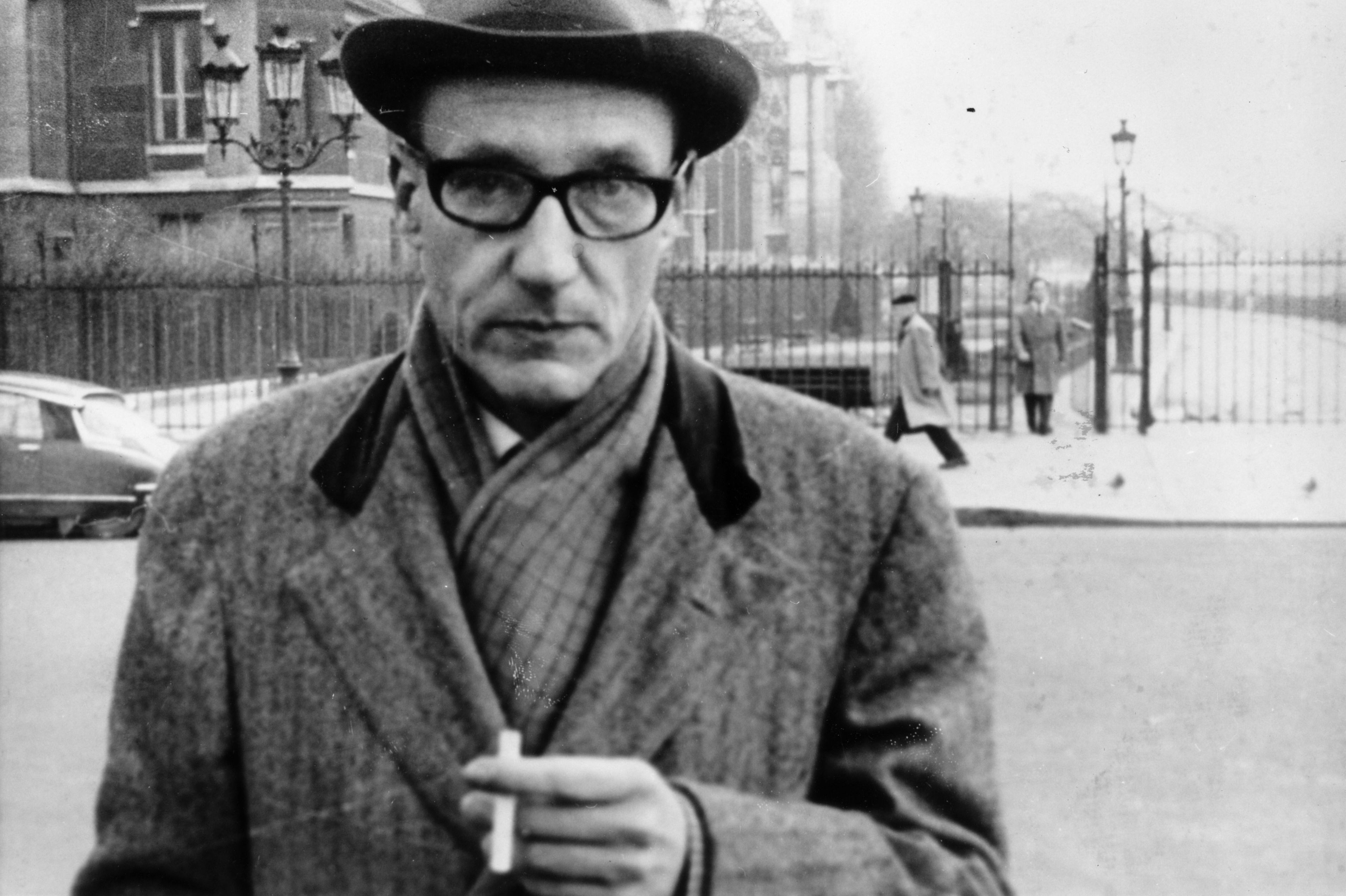
William S. Burroughs (Beat Generation Author & Visual Artist)
He felt that this technique was a way of “freeing words from the straitjacket of language…to create something fresh, interesting and evocative.”

It is not dissimilar to creating a portmanteau, cutting up two words to coin a new word. “Brunch” is an example, combining “breakfast” and “lunch”. “Motel” is another, combining “‘motor” and “hotel”...or even "blog" a portmanteau of "web log"

For sampledelia teaching purposes, I ask my students to print out songs they know containing rich lyrics and, if possible, end with rhymes -- that is, poetry/lyrics that rhyme on the last syllable(s).
I also print song lyrics with which I have experienced success during this activity in the past. For instance, the song Born To Run from Bruce Springsteen (the same name of the album at #18 on The 500 has proven particularly useful.
Once the students have selected two songs (pieces of poetry) they are tasked with dissecting  each line somewhere near the middle. I often suggest they look for a place where they see a natural break. For example, the first lines of Born To Run could be cut as follows.
Once they have physically cut chunks from each song, they "smash" them together to create something entirely new and, as Burroughs suggested over 50 years ago, the effect is "fresh, interesting and evocative". Here is an example using Born To Run and the song Subdivisions by lyricist Neil Peart of Rush.
As you can see, not every line works perfectly. However some, such as...

"Growing up it's a suicide machine,
Opinions all provided while we're young,
The future pre-decided, we were born to run"

...capture the spirit of a disenfranchised and discontented teen.

Once students have finished their avant-garde submissions, I invite the bold among them to perform their "literary sampledelia" live for their classmates -- beatnik style, with groovy jazz playing softly as a backdrop.
The student audience shows approval by snapping their fingers instead of conventional applause, as if we are in a mid-60s coffee house in Greenwich Village, New York. When teaching went virtual during the pandemic lockdown, students developed their own sampledelias by using Google Forms, which  can be found here.
If you have not heard sampledelic music, Odelay by Beck is a wonderful place to start. I'd direct you to the title track, Devil's Haircut, which features samples from such diverse performers:
  • Irish group Them, featuring a young Van Morrison (1966) and
  • Hall of Fame Funk Drummer Bernard Purdie (1968).
Alternately, consider the track Where It's At, which has samples from 
  • Pop-soul singer Lee Dorsey (1966),
  • Electro-funk, hip-hop trio Mantronix (1985) and
  • Wisconsin alternative-comedy-rock duo, The Frogs (1989).

Much like Cut-Up Poetry, Odelay can sometimes be beautiful, evocative or alarming but it is certainly thought-provoking.