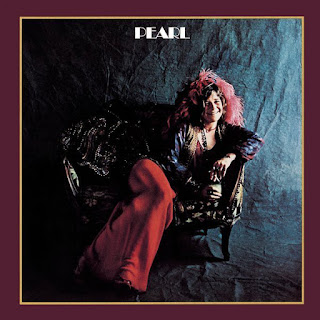
I was inspired by a podcast called The 500 hosted by New York-based comedian Josh Adam Meyers. His goal, and mine, is to explore Rolling Stone Magazine's 2012 edition of The 500 Greatest Albums of All Time.
Album: #125
Album Title: Pearl
Artist: Janis Joplin
Genre: Blues Rock, Soul Blues
Recorded: Sunset Sound, Hollywood, California
Released: January, 1971
Kristofferson may have been cribbing from their works when he penned Me and Bobby McGee and wrote that powerful thought-provoking lyric that I still work to fully understand.
Sartre wrote; “Man is condemned to be free; because once thrown into the world, he is responsible for everything he does.” The narrator, like us, is responsible for every choice he makes. He can not blame gods, fate, society or circumstance for his life and his (and, by proxy, our) freedom is inescapable and terrifying..jpg) By contrast, Camus reflected on freedom through the lens of absurd nihilism in his play Caligula. To him, a man becomes completely free when he recognizes that "life has no higher purpose, the universe is indifferent and any longing for meaning will not be resolved". The titular 'Bobby' is free because he/she carries nothing -- no money, no obligations and, most importantly, no expectations. The narrator, after losing Bobby, inherits that absurd freedom; however, it is a freedom soaked in grief – a "terrifying burden" of true liberation for the first time.
By contrast, Camus reflected on freedom through the lens of absurd nihilism in his play Caligula. To him, a man becomes completely free when he recognizes that "life has no higher purpose, the universe is indifferent and any longing for meaning will not be resolved". The titular 'Bobby' is free because he/she carries nothing -- no money, no obligations and, most importantly, no expectations. The narrator, after losing Bobby, inherits that absurd freedom; however, it is a freedom soaked in grief – a "terrifying burden" of true liberation for the first time. Like I said earlier, Me and Bobby McGee is one of many songs that contain a lyrical gem that has taken up residence in my brain...and refuses to pay rent. It'll probably be there until those synapses stop firing and, as Camus postulates, its meaning, like my many questions about life, will never be resolved.
My age at release: 5
How familiar was I with it before this week: Several tracks
Is it on the 2020 list? Yes, at #259, dropping 134 spots
Song I am putting on my Spotify Playlist: Me and Bobby McGee There are certain lyrics and fragments of poetry that have stayed with me from the moment I encountered them. They drift through my mind at unexpected times and, like familiar memories, return again and again. When they do I turn them over in my brain, pondering new layers of possible meaning. Somehow the words always offer more. Sometimes it is a nuance I missed, or an idea I hadn’t picked up on…perhaps because of my youth.
A handful have come from the lyrical mind of Neil Peart, whose lines were etched in my consciousness as a teen. Other examples have arrived courtesy of Bruce Springsteen, The Beatles, Leonard Cohen, and the sharp insights of poets T.S. Eliot and Robert Frost. Of course, Ol' Billy Shakespeare has a few nuggets cloggin' my noggin'. After all, who else writes words that can shadow you for a lifetime and still feel startlingly alive each time they surface?
Another lyric that sporadically runs laps through my head comes from Kris Kristofferson's pen. I was first introduced to his writing through the scorching vocals of Janis Joplin on Pearl, her second and last solo record. Her 1971 hit, Me and Bobby McGee, is a compact narrative. It follows two drifters, the narrator and the free-spirited Bobby McGee, as they sing their way across the American South. Hitching a ride from a truck driver, they wind their way west to California. Somewhere near the Monterey County town of Salina, the pair part ways, and the narrator is left alone, with the aching melancholy and regret that only a powerful song can instill.
Because the name “Bobby” sits comfortably in the gender‑neutral middle ground, the tune has been recorded by an impressive cast of artists over the years, including Gordon Lightfoot, Roger Miller, Jerry Lee Lewis, Charley Pride, Olivia Newton‑John, The Grateful Dead, Dolly Parton, Johnny Cash and Pink. Each performer shifts the emotional centre of gravity just a little, proof that a memorable story can find new interpretations with different tellings.
Kristofferson’s penetrating refrain, "Freedom's just another word for nothing left to lose" occurs at the end of the first verse and repeats throughout Me and Bobby McGee.
How familiar was I with it before this week: Several tracks
Is it on the 2020 list? Yes, at #259, dropping 134 spots
Song I am putting on my Spotify Playlist: Me and Bobby McGee

A handful have come from the lyrical mind of Neil Peart, whose lines were etched in my consciousness as a teen. Other examples have arrived courtesy of Bruce Springsteen, The Beatles, Leonard Cohen, and the sharp insights of poets T.S. Eliot and Robert Frost. Of course, Ol' Billy Shakespeare has a few nuggets cloggin' my noggin'. After all, who else writes words that can shadow you for a lifetime and still feel startlingly alive each time they surface?
 |
| One of several Peart quotes I have evaluated differently over the past 38 years. |
.png) |
| Record label for the single of Me and Bobby McGee by Janis Joplin. |
 |
| Gordon Lightfoot had a #1 hit in Canada in 1970 with Me and Bobby McGee. |
Typically associated with celebration and liberation, freedom can also result from the loss of everything -- possessions, relationships, obligations and expectations. It is a paradoxical form of liberation. It is a double-edged sword of liberty, cleaving you from all things, but leaving you alone.

Existentialist philosophers, such as Jean Paul Sartre and Albert Camus, wrote extensively about freedom, loss and what remains of self when all things are stripped away.
Kristofferson may have been cribbing from their works when he penned Me and Bobby McGee and wrote that powerful thought-provoking lyric that I still work to fully understand.
Sartre wrote; “Man is condemned to be free; because once thrown into the world, he is responsible for everything he does.” The narrator, like us, is responsible for every choice he makes. He can not blame gods, fate, society or circumstance for his life and his (and, by proxy, our) freedom is inescapable and terrifying.
.jpg)

On a cheerier note, my research into this incredible Joplin record revealed that the backing musicians who support her, The Full Tilt Boogie Band, hail from my neck of the woods. Five of the band's six members are from Stratford and Woodstock, Ontario -- both fewer than 60 kilometers (40 miles) from my hometown of London. The band comprises John Till (guitar); Richard Bell (piano); Brad Campbell (bass); Ken Pearson (organ); and Clark Pierson (drums). Only Pierson is not from Southern Ontario, being a Californian.
 |
| Back cover of Pearl, featuring The Full Tilt Boogie Band. |