I was inspired by a podcast called The 500 hosted by Los Angeles-based comedian Josh Adam Meyers. His goal, and mine, is to explore Rolling Stone Magazine's 2012 edition of The 500 Greatest Albums of All Time.
Album: #212
Album Title: Crooked Rain, Crooked Rain
Artist: Pavement
Genre: Indie Rock, Alt-Rock
Recorded: Random Falls Studio, New York & Louder Than You Think Studio, CaliforniaReleased: February, 1994
My age at release: 28
How familiar was I with it before this week: Not at allIs it on the 2020 list? Yes, at #434, dropping 222 spots
Song I am putting on my Spotify Playlist: Range Life This week, I am excited to welcome a new guest blogger. Although I have never met T.J. Gillespie in person, we have connected over a shared love of music and The 500 podcast. T.J. is a regular reader of my blog and is always kind enough to respond on social media -- often quoting his favourite line from my weekly post. He lives in Abington, Pennsylvania, a short drive north of Philadelphia. He is a high school English teacher, has two daughters (Lucy and Elizabeth), a cat and a rabbit. When I saw the Pavement record coming up on the 500 list, I remembered seeing T.J.'s post about attending their concert during their 2022 tour. As I was unfamiliar with the band, I reached out to see if he was willing to "pinch hit" for me. A day later, the following, wonderful essay arrived in my email. I am sure you will enjoy it as much as I did.
 |
| Guest blogger T.J. Gillespie in his Pavement T-shirt. |
The sound of the 1990s, as is commonly reduced, started with the Big Bang of Smells Like Teen Spirit and ended in the nu-metal mayhem of Woodstock ‘99. In between, the decade seemed to move from one genre to another: grunge to Britpop to industrial to ska, with some weird swerves into electronica, trip hop, and even a swing music revival. What is unusual, looking back, is how we used one catch-all word to try to describe these disparate sounds: Alternative. I am not sure what the sounds of the Rage Against the Machine, The Cranberries, and Beck have in common except that they’d all appear on my local Alternative Radio (WDRE in Philadelphia and WHFS when I was in college in Baltimore). Originally, it was a designation to indicate artists that were alternative to the mainstream. Weezer and Tori Amos certainly seemed different from Celine Dion and Garth Brooks, but by the middle of the decade when Alanis Morrisette was selling millions of albums, the alternative was the mainstream.

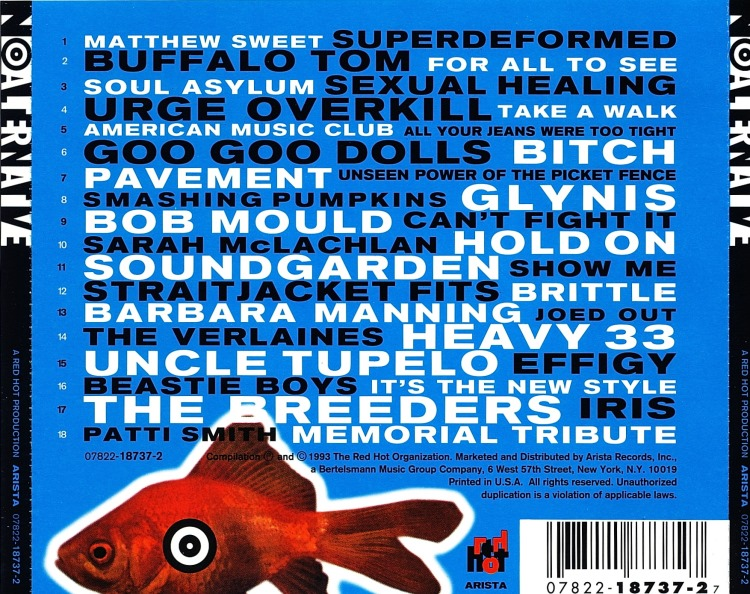
These two bands occupied two different places in modern rock. Smashing Pumpkins were on the Singles soundtrack, but they were an anomaly. They weren’t from Seattle, they didn’t play grunge, their influences were prog rock and not punk. Combining shoegaze guitar with a polished poppier sound reminiscent of arena rockers Boston, the Pumpkins played covers of Fleetwood Mac (at the nadir of their popularity) and featured virtuosic ‘70s-style solos. They weren’t ironic; they were sincere. They weren’t cheeky or arch or winking at the audience. They didn’t hide their ambitions. In other words, they were the diametric opposite of Pavement. Formed in Stockton, California, in 1989, Pavement combined the jangly guitars of early R.E.M. with the brash experimental noise of Sonic Youth. An album might have a beautiful melodic line buried in a jarring squall of feedback. After their release of their debut album Slanted and Enchanted in 1992, Pavement would become the embodiment of slacker rock; they were five guys making messy compositions seemingly without ever really trying. They had a singer known only as “SM” and a guitarist who called himself Spiral Stairs and they didn’t release any band photographs. Meanwhile Smashing Pumpkins, or more specifically lead singer, songwriter, and multi-instrumentalist Billy Corgan, was laboring as pop music’s most monomaniacal control-freak. Who but Corgan would have cello, violin, timpani, and bells(!) on a single, as he did on Disarm?In 1993, No Alternative juxtaposed these two approaches back to back, on tracks six and seven. In 1994, Pavement would release their sophomore album, Crooked Rain, Crooked Rain, and create a kind of explicit rivalry with their song Range Life. In it Steven Malkmus, the sardonic leader, sings,
“Out on tour with the Smashing Pumpkins/ Nature kids / They don’t have no function / I don’t understand what they mean /And I could really give a f---.”
Like a lot of Pavement lyrics, there is a kind of offhanded throw-away quality. There’s something barbed there, something funny, but also something inscrutable and nonsensical. But for Billy Corgan, the barb stung. The song allegedly irked Corgan so much at the time that he had Pavement removed from the Lollapalooza 1994 lineup that the Pumpkins were headlining. (I saw that show at Philadelphia’s FDR park and was so blown away by the Beastie Boys that I didn’t miss anyone else). In a world before social media, this low stakes beef barely registered in the wider cultural consciousness, but for record store obsessives and rock geeks a simmering feud was born.In terms of sales, Grammys, name recognition, MTV presence, t-shirt sales, and any other measure of popularity and cultural imprint, Billy Corgan won the war. Smashing Pumpkins sold 30 million records in the nineties, while Crooked Rain, Pavement’s most successful album, sold 237,000. But in another sense, he lost. It’s not just because we tend to root for the underdog (Pavement remained signed to independent labels throughout their career, including Flying Nun and Matador) or because we value “coolness” over hot-headed hubris, but because Corgan committed the cardinal sin of taking everything so seriously. The line nettled him and he let it be known that it bugged him. The lyric itself is a goof. What does it even mean? It’s a joke line from a much smaller band that could have been laughed off or ignored. The rock critic Steven Hyden covered the aftermath in his 2016 book on intra-band squabbles, Your Favorite Band is Killing Me, writing, “Malkmus seemed less perturbed by the supposed beef, telling NY Rock magazine in 1999, ‘I only laughed about the band name, because it does sound kind of silly. . . . I like their songs — well, most of their songs, anyway. . . . I just dissed their status.’” But for Billy Corgan, for whatever reason, “Nature kids” was personal.
The problem with reducing CR,CR to a silly rivalry is that it turns art into a tabloid narrative and takes attention away from the songs themselves. The album is on Rolling Stone Magazine’s 500 Greatest Albums list not because of a single snarky joke, but because of its DIY-style recording, because of its influence on a generation of guitar based bands, and, most of all, because of the songs themselves. There’s the radio friendly almost-hit Cut Your Hair with its catchy ooh-ooh-oohs, the almost Grateful Dead-like jams on Stop Breathin the garage rock fury of Unfair, the weirdo-jazz of 5-4=Unity and all kinds of strange experimentations which all go to show that while the band may have had the reputation of slackers making messy cacophonous songs, they were ambitious in scope and sincere in their attempts to develop sonically. Gold Soundz is as catchy and melodic as anything else on nineties radio. It would fit in perfectly next to 1979 or Today for example.
Nobody cares about selling out in 2024. Alternative died out long ago. “Indie” is more of an aesthetic, a subgenre, than it is a lifestyle, a set of rules, or a designation of record label affiliation. Nobody is making you choose between tribes. Darling, you can cut your hair. You can even shave your head. Maybe this is the lasting legacy of the alternative rock era: You don’t have to be just one thing. Slackers and perfectionists can coexist, like tracks on compilation CDs, like songs on the radio.

 This approach to writing came to mind as I researched the recording of Slanted and Enchanted, the debut record from California rockers Pavement. Created in a makeshift home studio on a shoestring budget, the band embraced a lo-fi aesthetic that favored raw energy over polish. The sessions were described as relaxed and spontaneous. Drummer Gary Young reportedly hit record on the tape machine and ran to his kit, capturing “takes” that were imperfect but authentic. The result was a landmark indie rock album, celebrated for its disheveled charm, jagged guitar riffs, and off-kilter melodies. Like a Quick Write, Slanted and Enchanted wasn’t about perfection, it was about capturing something real, unfiltered, and emotionally resonant. That spirit of creative freedom is exactly what I hope to foster in my students’ writing.


