Showing posts with label 1993. Show all posts

Sunday, 29 September 2024

The 500 - #193 - Dookie - Green Day

 I was inspired by a podcast called The 500 hosted by Los Angeles-based comedian Josh Adam Meyers. His goal, and mine, is to explore Rolling Stone Magazine's 2012 edition of The 500 Greatest Albums of All Time. 


Album: #193

Album Title: Dookie

Artist: Green Day

Genre: Punk Rock, Pop Punk, Skate Punk

Recorded: Fantasy Studios, Berkley, California; and Music Grinder Studios, Los Angeles

Released: February, 1994

My age at release: 28

How familiar was I with it before this week: Very

Is it on the 2020 list? Yes, at position #375, dropping 182 spots

Song I am putting on my Spotify Playlist: Longview

I once bought a birthday card for a friend that read: "Don't you wish you were as old as the first time you thought you were old?" It is a sentiment that lodged in my head and has stuck with me for many years.
The first time I felt old, I was turning 25 in 1990 – certainly the result of life choices. Foolishly, I had left my university studies to take a job as a restaurant manager. I presumed a career in the service industry would lead to financial and emotional satisfaction. That was dead wrong. Instead, I found myself living in a boring townhouse in Mississauga, Ontario, commuting through heavy highway traffic to Toronto six days a week so I could work long, frustrating hours earning less money than I'd made as a bartender and server. The only plus was that I worked with fantastic people who regularly made me laugh. Our softball team even made it to the finals of the North Toronto restaurant league and I fondly remember those warm, summer nights on the schoolyard diamonds of Thornhill, Willowdale and North York.
Tucker's Tornados - I'm #17 on the right.
Fast forward three years and I'd left the management world to return to university. By then, I had completed my baccalaureate degree but was still working in restaurants, slinging cocktails in my hometown of London, Ontario. However, I was making buckets of money and continuing to  play  restaurant league softball with a different group of fantastic people. I was in the best shape of my life. It was a great situation -- but I knew it was unsustainable. I knew I needed to figure out a permanent career and, with the big 3-0 looming, that had to be sooner than later.
Sidelines of a London, Ontario Restaurant League game with the
Kelsey's South crew. (I'm behind the camera on this shot).
Then, in 1994, Green Day came along with their third studio record, Dookie, and triggered my age anxiety. The album marked the start of a pop-punk revival and I was around for the original wave of this melodic, up-tempo sub-genre of music. To me, the reprise felt like it should have been the music of the next generation -- and I was working alongside them at the restaurant. With each passing year, more of my contemporary co-workers moved on with their chosen paths, while the cooks, servers and support staff got younger. I started to feel ancient.
Bussing a table at Kelsey's restaurant in September, 1994.
The song Basket Case from Dookie was charting in the Top 10.
However, feeling old didn't stop me from purchasing the Dookie album on CD. I made a cassette copy and it accompanied me to the gym throughout the summer of 1994. It, along with the Rage Against The Machine debut record and Soundgarden's BadMotorFinger, got me through many cardio workouts. However, the lyrics on Dookie weren't doing my mindset any favours. The songs address themes that include anxiety, apathy, panic attacks and failed relationships. At the time, my future wife and I were working our way through a rough patch that threatened to end our relationship. The lyrics to the Dookie's tenth track, When I Come Around, seemed custom made to reinforce my insecurities and amplify my melancholy.
Album cover for the single When I Come Around
Time passed and life sorted itself out. By 1995 I was in Teachers College and working toward a fulfilling career that I have now loved for nearly 30 years. My wife and I navigated the choppy waters of our late-twenties and, for a little while, I stopped feeling old. When I re-listened to Dookie ahead of this post, the emotional effect it had on me  in 1994 simply wasn’t there. It's just a record of catchy, up-tempo pop-punk that, it turns out, was part of my generation after all.

Addendum:

Former guest blogger, Steve "Lumpy" Sullivan, was also one of those terrific people I worked with in 1993 at Kelsey's Restaurant. In fact, he hired me. He recently attended the Green Day show in which they played Dookie in its entirety. He shared one of his trademark "Big Head" shots with me and I think this post is made better because of it.


Sunday, 1 October 2023

The 500 - #245 - All Killer, No Filler, The Anthology - Jerry Lee Lewis

I was inspired by a podcast called The 500 hosted by Los Angeles-based comedian Josh Adam Meyers. His goal, and mine, is to explore Rolling Stone Magazine's 2012 edition of The 500 Greatest Albums of All Time. 


Album: #245
Album Title: All Killer, No Filler, The Anthology
Artist: Jerry Lee Lewis
Genre: Rock, Country, Rockabilly
Recorded:
 Multiple studios from 1958 - 1990
Released: May, 1993
My age at release: 27
How familiar was I with it before this week: A little
Is it on the 2020 list? Yes, at #325, dropping 80 spots since 2012
Song I am putting on my Spotify Playlist: Great Balls Of Fire

I have an idea for a podcast whose title would share the name of this record – All Killer, No Filler. Each week, I would invite a guest to discuss their favourite record on which every track is, in their opinion, top calibre without any inferior songs.

My plan was to take a three-day course this past summer tentatively offered by the Elementary Teachers Federation of Ontario (ETFO) in London, Ontario. The presenters, Chey Cheney and Pawan Wander (who go by Chey and Pav), are middle school teachers from Toronto who have been the hosts of an education podcast for several years. Initially called The Staffroom Podcast, it was recently rebranded as The Chey and Pav Show. Their latest episode, #129, is here.
Teachers & Podcasters Chey Cheney (l) and Pawan (Pav) Wander.
Their early-July session promised participants the opportunity to learn about podcasting, the equipment required and how to integrate it into a middle school classroom. In anticipation of the workshop, I approached my principal about acquiring the necessary digital tools and equipment. Alas, my good intentions were scuttled when, despite my best efforts to promote it to London-based educators, lack of interest resulted in the event being cancelled. (I could understand why - the session was the first week of July, scant days after the previous school year ended and teachers needed some time to recharge).
Promotional photo for last summer's ETFO 3-Day workshops.
Regardless, I am steadfast in my plan to obtain some podcasting equipment and initiate a new opportunity to students at our school. Eventually, perhaps in retirement, I will launch my All Killer, No Filler podcast and start recruiting friends as guests to discuss their favourite perfect records.
Speaking of All Killer, this week's record was actually released in non-digital format as a boxset anthology spanning rockabilly pioneer Jerry Lee Lewis' (nicknamed The Killer) expansive career. It features 42 tracks, with 27 of them hit songs that include his manic Great Balls Of Fire, plus Whole Lotta Shakin' Goin' On and Breathless.
Prior to my research this week, everything I knew about Jerry Lee I learned watching the 1989 biopic, Great Balls Of Fire, starring Dennis Quaid.
The film documents Lee's meteoric rise to superstardom and his equally rapid decline when the media learned that, at 22, he had married his 13-year-old cousin -- the daughter of his bass player, no less. It was his third marriage of an eventual seven...and his child bride, Myra Gale Lewis (nee Brown) later penned a book on which the film was based.
It is impractical, in a format like this, to do justice to the importance of Lewis as an architect of Rock and Roll and his wild, fascinating life. Last year, director Ethan Coen (Fargo, Miller's Crossing) released a documentary called Jerry Lee Lewis: Trouble In Mind, which I have yet to see, but I am sure will more vividly highlight the singer/pianist's tumultuous existence.
Seemingly indestructible, (unlike his torched pianos -- although that may be a bit of fiction), Lewis survived alcoholism, multiple bouts of cancer and a stroke before passing away in October, 2022. He was the last surviving member of the inaugural class entering the Rock and Roll Hall of Fame, which included Elvis Presley, James Brown, Little Richard, Fats Domino, Ray Charles, Chuck Berry, Sam Cooke, the Everly Brothers and Buddy Holly. Despite his many flaws, his impact on the genre is undeniable.


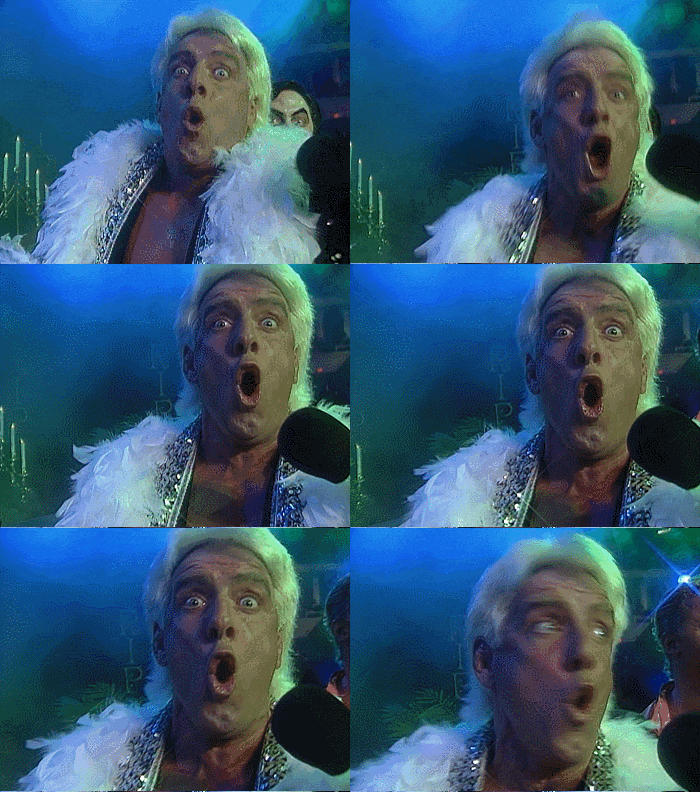
My favourite bit of trivia, however, is that professional wrestler Ric Flair developed his famous catchphrase, “Woooo”! in 1974 after he heard Lewis roar, “Goodness gracious, great balls of fire… Woo!

Sunday, 12 June 2022

The 500 - #313 - MTV Unplugged In New York - Nirvana

I was inspired by a podcast called The 500 hosted by Los Angeles-based comedian Josh Adam Meyers. His goal, and mine, is to explore Rolling Stone Magazine's 2012 edition of The 500 Greatest Albums of All Time. 


Album: # 313

Album Title: MTV Unplugged In New York

Artist: Nirvana

Genre: Alternative Rock, Grunge

Recorded: Sony Music Studio (Live) - New York

Released: November 18 , 1993

My age at release: 28

How familiar was I with it before this week: Very

Is it on the 2020 list? Yes, #279 - moving up 34 spots

Song I am putting on my Spotify Playlist: Pennyroyal Tea (Selected by my brother (in-law) and Nirvana fan, Dan


Earlier this year, the Grade 7 students and I spent some time discussing leadership. I kicked off the conversation with a fascinating, three-minute TED talk video, featuring musician, author and entrepreneur, Derek Sivers.
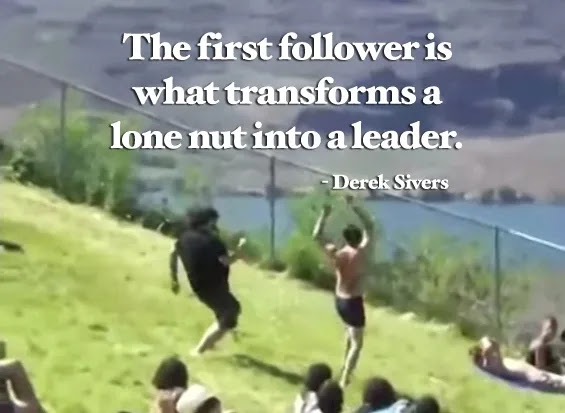
Sivers speaks on the topic of "How To Start  A Movement '', while a grainy video of a young, shirtless, dancing man begins playing on a screen behind him. Although unseen, it seems likely that the "dancing man" is at a musical performance, gesticulating wildly and comically.
Eventually, he is joined by his "first follower" and it is here that Sivers advances his notion that "the first follower is actually an underestimated form of leadership in itself. It takes guts to stand out like that. The first follower is what transforms a lone nut into a leader."
As the video continues, two more people join the duo and are immediately embraced as equals by both the dancing man and his first follower. Quickly, they are joined by four more and suddenly there is a tide of recruits. "This is the tipping point", states Sivers, "as more people join in, it's less risky. So those that were sitting on the fence before, now have no reason not to. They won't stand out, they won't be ridiculed, but they will be part of the in-crowd if they hurry."
By the end of the video, less than three minutes after being introduced to our shirtless, dancing man there are literally hundreds of people participating. Sivers makes his final point:
"Leadership is over-glorified. Yes, it was the shirtless guy who was first, and he'll get all the credit, but it was really the first follower that transformed the lone nut into a leader. So, as we're told that we should all be leaders, that would be really ineffective."
I have used this video with students for more than a decade and it provides a wonderful launching pad for rich discussions about their interpretation of, and comfort with, leadership. Invariably, a student will ask a key question:
"What do you call someone who doesn't want to lead or follow?" 
I love this moment, because it organically transitions to a conversation about "The Contrarian". Instead of framing this reluctant individual as an antagonist or adversary to progress, I instead offer examples of people who took a contrary stance that propelled them to greatness:
  • Former World Boxing Champion Muhammad Ali's decision to abstain from participation in the Vietnam War, despite its resultant heavy fine, potential jail time and a ban from boxing.
  • India’s Mahatma Gandhi's opposition to tyranny through non-violent protest.
  • Astronomer Nicolaus Copernicus risking death by contradicting the Catholic Church's 15th Century belief that the earth, not the sun, was the centre of our solar system. 
Although not on the same scale, MTV Unplugged in New York is a ready-made example of a contrarian spirit.
Nirvana guitarist and singer Kurt Cobain
In 1993, Nirvana was the biggest band in the world. The three-piece alternative rock group from Seattle, Washington, were Kurt Cobain (guitar, vocals), Krist Novoselic (bass) and Dave Grohl (drums). Their second studio release, Nevermind, (#17 on The 500) had been selling over 300,000 copies weekly since its release two years earlier. It had also transformed the world of popular music. The hair-metal and stadium rock of the late 80s had been replaced by grunge. In a nutshell, grunge is a musical sound (murky, punk-influenced, and bleak), an attitude (cynical and non-conformist) and aesthetic (loose flannels, androgynous oversized shirts often cobbled together from thrift shops).
Nirvana is typical grunge apparel ]
(l-r Cobain, Novoselic & Grohl)
MTV (Music Television) was also wildly popular in the 1990s and their Unplugged Series had enjoyed tremendous success. The popular series showcased well-known artists performing their greatest songs in a stripped-down acoustic format. These were then released as audio versions which sold briskly, generating massive profits for the network.  The biggest, Eric Clapton's 1992 Unplugged performance,  sold 26 million copies worldwide.
All this information is important context. It can't be understated how monumental the Nirvana performance was to the world and how important it was to the executives at MTV -- executives who had not factored in the difficult and contrary nature of this cynical, frustrated group, who were on the verge of breaking up permanently.
  • Cobain was struggling with a heroin addiction, and rehearsals had gone poorly. There was grave concern that the performance would not meet expectations. The day before filming, Cobain refused to play as he struggled with symptoms of withdrawal.
  • The band rebuffed executive requests to play their biggest hit, Smells Like Teen Spirit, and instead peppered their set with lesser-known songs written by other artists including an obscure Scottish alternative rock band, The Vaselines.
  • The band had teased an appearance by special guests and speculation among the fan base was rich. Would it be one of the group's famous colleagues from the Seattle music scene? Eddie Vedder of Pearl Jam or perhaps Chris Cornell from Soundgarden? No. It was another obscure band from Arizona, The Meat Puppets. Moreover, Nirvana chose to play three songs from that group's second record, Meat Puppets II, ostensibly promoting it more than their own recent release, In Utero.

Meat Puppets II by Meat Puppets
  • Although his amplifier was slightly disguised on-stage, Cobain broke with Unplugged tradition by performing the David Bowie song The Man Who Sold The World as an electric performance.
  • After being denied permission to play their controversial song Rape Me, the band slipped in an even more disturbing song, Polly. This track, from their album Nevermind, is about a 1987 incident in Tacoma, Washington, where 14-year-old was abducted, raped and tortured with a blow-torch. The unidentified girl, named Polly, but only in the song, escaped. Her captor is still serving a life sentence.
Portion of the article from the Spokane Chronicle
  • Finally, when asked to return to the stage for an encore, the band flatly refused.
However, despite their contrarian approach to this recording, the performance received critical acclaim. Tom Hibbert of Q Magazine raved about the record, saying; it "possessed a ragged glory", while Rolling Stone writer Barbara O'Dair called it "stirring and occasionally brilliant" with "spare and gorgeous spots everywhere".

It was also a commercial juggernaut, selling over 310,000 copies in its first week, a record for Nirvana. It would go on to be certified 8x platinum (8 million copies sold) in the United States, with millions more sold world wide. It received a Grammy Award in 1994 and sits on The 500, at position #313 -- the only Unplugged record to make the list. After all, sometimes a contrary stance can launch you to greatness.

Monday, 7 March 2022

The 500 - #327 - Exile To Guyville - Liz Phair

I was inspired by a podcast called The 500 hosted by Los Angeles-based comedian Josh Adam Meyers. His goal, and mine, is to explore Rolling Stone Magazine's 2012 edition of The 500 Greatest Albums of All Time. 


Album: # 327

Album Title: Exile To Guyville

Artist: Liz Phair

Genre: Indie Rock, Lo-Fi

Recorded: Idful Music Corporation, Chicago, USA

Released: June, 1993

My age at release: 28

How familiar was I with it before this week: Not at all

Is it on the 2020 list? Yes, to #56 -- moving up 271 places

Song I am putting on my Spotify Playlist: Never Said

In the fall of 1996, shortly after I had graduated from Teachers' College, I was in a funk. School boards in Ontario were not hiring. However, I was fortunate to get on the Occasional Teachers' list with the London School Board (now Thames Valley) but supply work was tough to secure and provided a limited revenue stream. I knew that I would need to return to full-time bartending to make ends meet. My $10,000 investment into a teaching degree had, seemingly, led me nowhere.
Thames Valley District School Board Logo
One of my college roommates, Brendan, was renting two floors of a large home in downtown London with members of his band, The Pedros. He let me know there was a basement room available and I jumped at the inexpensive opportunity.
One of the few pictures I have of my roommate Brendan, 
taken at his birthday party, January, 1996
One of Brendan's bandmates, and now my new roommate, was Lisa, a talented singer and guitarist. We took turns picking CDs for the communal stereo system and she acquainted us all to many contemporary female singer/songwriters, including Fiona Apple, Tori Amos, Jewel and this week's artist, Liz Phair.
Liz Phair (circa 1996)
The first Phair record I heard blasting through our sprawling, 100-year old, Victorian-era rental was Whip-Smart, the sophomore release by the Chicago-based multi-instrumentalist. It contained the song Supernova, which received significant radio play and was nominated at the 37th Grammy Awards for the Best Female Rock Vocalist Award...losing to Come To My Window by Melissa Etheridge.
Phair's second release Whip-Smart (1994)
The record that appears at position #327 on The 500 list is Phair's debut release on Matador records, Exile To Guyville. Technically, it is her fourth release. Between 1990 and 1992, Phair had self-released three cassettes under the pseudonym, Girly Sound.
Girly Sound Cassette Releases (1990-1992)
Phair acknowledges that the term Guyville was coined by Nash Kato of the band Urge Overkill on their 1992 song Goodbye to Guyville. It refers to the testosterone-fueled Chicago music scene of the early 90s -- of which both Phair and Kato belonged. 

As Kato put it:
"These were guys with an unnecessary swagger, wearing huge, gold chains...wielding Rock and Roll like some kind of power tool to get your manly feelings out. The scene was a total sausage-fest (almost exclusively male). It always seemed like a bad frat-party."
Nash Kato, left, onstage with Urge Overkill (1994)
Urge Overkill was not the only group from which Phair drew inspiration for Exile To Guyville. The album is a song-by-song reply to Exile On Main St., arguably the best record by The Rolling Stones. In fact, Main St. appears at position #7 on The 500.
Exile On Main Street
Phair has made it clear in interviews that her tracks are not a clear or obvious response to the Stones' album. Instead, she sequenced the songs on Exile in Guyville to match the song list and pacing of the Exile on Main St. On Spotify, a contributor known as STVX, has created a playlist which pairs the songs from both albums together, one after the other. It is well worth a listen. You can find it here.

As you might imagine, there is a lot to dig into with Phair's lyrically powerful record -- certainly too much for me to cover here. The production is "lo-fi" (low-fidelity), a sonic aesthetic that retains the raw, simplicity of a studio recording (warts and all). It is, as one might expect, the opposite of a "hi-fi" (high fidelity recording) -- where studio tools are used to hide imperfections and enhance sound quality. 
Phair in the studio (1998)
Phair's lyrics are also raw and forthright, bringing the role of women in music and society into sharp focus. However, to be clear, these are human stories, and many are universally relatable. This is not man-bashing from an angry, female songwriter (which, by the way, is a hack, lazy, criticism I hear far too often from some circles). 

In a 1994 interview, Phair said:
"That stuff didn't happen to me, and that's what made writing it interesting. I wasn't connecting with my friends. I wasn't connecting with relationships. I was in love with people who couldn't care less about me. I was yearning to be part of a scene. I was in a posing kind of mode, yearning to have things happen for me that weren't happening. So I wanted to make it seem real and convincing. I wrote the whole album for a couple people to see and know me."
This is a record that I will cue-up again -- probably the aforementioned Spotify version that matches it with the Stones' classic. 

It has been a long time since I saw my former roommate Lisa, and I owe her a belated thanks for being the first to put Phair on my radar.  I also still owe her about $25 for our last hydro bill. Unfortunately, she, Brendan and I lost touch with each other after moving out of the old apartment building in the spring of 1997. So, if she happens to read this, I'm still good for it, Lisa.