Showing posts with label 1975. Show all posts

Monday, 26 May 2025

The 500 - #159 - Alive - KISS

 I was inspired by a podcast called The 500 hosted by New York-based comedian Josh Adam Meyers. His goal, and mine, is to explore Rolling Stone Magazine's 2012 edition of The 500 Greatest Albums of All Time. 


Album: #159

Album Title: Alive

Artist: KISS

Genre: Hard Rock, Heavy Metal

Recorded: 4 concert venues - Detroit, Cleveland, Davenport and Wildwood

Released: September, 1975

My age at release: 10, my guest blogger was 8

How familiar was I with it before this week: Very

Is it on the 2020 list? Yes, at #305, dropping 146 spots

Song I am putting on my Spotify Playlist: Nothing To Lose

I am delighted to welcome back Glen “Archie” Gamble as a guest writer for this album. “Arch”, as he is affectionately known in his wide circle of London, Ontario friends, is a drummer, writer, world traveler and vlogger (The Gamble Ramble). He helped me out with a guest post for the first Van Halen album (#415 on The 500) way back in July, 2020. Although he is best known for his tenure with Canadian rock band Helix, he has also played with Buffalo Brothers and The Joys. However, salient to this week’s guest writing duties, he spent several years as the drummer with the KISS tribute band Alive. In that capacity, he has met and played with the original members of KISS and I knew he would have a fantastic, insider's perspective on this record. Here’s Arch!!


It was Christmas season, 1976. I know this because I was with my mother, Xmas shopping in the department store K-mart. And even though I was only eight years old, I saw something that changed my life…The Alive record from the New York rock band KISS.

KISS (l-r) Ace Frehley (guitar), Gene Simmons (bass/vocals), Peter Criss
(drums/vocals) and Paul Stanley (guitar/vocals)

Trust me, I know how silly that sounds coming from an eight-year-old. But it was legit. And very, very real. In fact, I would venture a guess, and say that the impact of the KISS Alive album had just as much to do with changing the course of my life, as it did with changing the lives of the Kiss band members themselves.


Pretty big statement, right? But it’s one I stand by. The reason being that, on my end, this album started my pilgrimage toward a love of rock ‘n’ roll. But foremost, it was the album that saved KISS’ career; it got them out of debt with the record company, saved their record deal and boosted the earnings they made from live shows. As a matter of fact the proceeds from the sales of Alive also kept their record label Casablanca Records, from going under. This album came along at exactly when it was needed. Not just for the band, but for the music industry. In a tepid pool of luke warm ‘soft rock’, including Eagles, Carly Simon and James Taylor, during the mid-seventies, KISS Alive was like a sonic shotgun blast to the face. It also helped start a trend of double live album releases that continues to this day.

KISS were known for their elaborate stage shows.
There were no soft ballads about sleeping with a girl in the desert; instead there were anthems about taking a girl backstage to C’Mon And Love Me. And this is THE album that set me on the path of becoming a musician. So not only did it incredibly alter the lives of KISS themselves, it heavily affected mine as well. I couldn’t believe the incredible energy that was pouring from the vinyl when my big brother put it on. While he enjoyed it, I was absolutely captivated. I used to come into his room and ask to listen to it. until eventually, it became mine.
A young Glen "Archie" Gamble, flanked by his brothers
 John (left) & Jim
I can recall, listening to the vinyl, sitting across like it on the floor with my headphones on, curly cable and all. And a great thing about the album was the booklet that came with it. I remember reading through the book while listening to the music and staring at these four crazy characters. Were they even human? Hey, I was eight, but it seemed to me that they had captured everything that would be exciting to a kid; hard driving, loud rock ‘n’ roll, with over-the-top theatrics and an amazing show. 
I was hooked.
Centerfold from the KISS Alive booklet.
From that moment on, KISS became MY thing. My brother, as I said, liked them but wasn’t a huge fan. But by the time I came to pick up the newest album, Destroyer, I was in-hook line and sinker. And God bless my parents, it was an obsession that they got behind. This was actually before I even started drumming. My mom would take me to the record store in the mall, and buy me copies of older KISS albums, and even allow me to hang posters in my room. In fact, around this time, we moved into our first brand new home in the suburbs. I got my very own bedroom for the first time, and went absolutely insane, covering the walls, and I mean every inch, with KISS posters, magazine spreads, newspaper articles, etc., etc., etc. My poor mother; she had just decorated this entire house; wallpaper, wood paneling, new carpet, and more. And I turned it into a rock ‘n’ roll den of sin. Well, as much as an eight-year-old can.
A young Glen Gamble in his KISS shirt.
And of course, seeing this insane cat like character on the drums, something called Peter Criss, also changed my life. Although I would later have questionable interactions with the human man himself, the God like character that was pictured on the album covers blew me away. And it was a perfect persona for him: his rhythm’s fit perfectly; primal, jungle, and just plain ferocious. And once again, I was hooked.
Peter Criss behind the drums (1975).

“Mom, can I have a drum set?”

My parents were very supportive, but cautious, about this new out of the blue hobby. Being a bit of a strange child with no interest in sports or academia. I think they were just happy to see me interested in something. Not to mention, their marriage started to go bad around this time and there was a lot of fighting. And I mean a lot. I think indulging me with Kiss and drums was a way to placate me and sort of apologize for the violence at home.

At any rate, my parents picked me up a toy drum kit from the Sears catalog. You know the type, paper drum heads, and tin cymbals. It didn’t matter, I was in heaven! My very own drum set. It’s not for me to say, as my memory is not THAT good, but people tell me that I took to it straight away. I could actually play something that resembled ACTUAL rhythms. Very quickly, I went through this drum kit, both figuratively and literally; the drum heads were actual thick paper. And you know that didn’t last long with a young rock ‘n’ roll roller, full of energy, right?
1975 Sears Catalogue Instruments.
So my parents took the next step up and got me another drum kit, from Sears again, but this one with plastic heads. By plastic, I don’t mean the plastic used in a real drumhead (which is mylar) I mean, just a thick sort of sheet plastic. Regardless, it was a step up, and I was once again immeasurably excited. And for toys they actually sounded good. They helped me learn my way around a kit, create muscle memory, and learn how to function with my hands and feet at the same time. The next step was courtesy of my big brother Jim, One day, we visited a young rock roller in our new neighborhood who played guitar, bass and drums and loved Kiss as fanatically as I did. His name was Doug Rouse -and we are friends to this day. He’s one of the people who helped chart the course of my life. And he had a real drum set; far from fancy, but real. It was manufactured by Silvertone and it was a blue sparkle kit with old, beaten cymbals. Regardless, I was spellbound.
The blue sparkle Silvertone kit from Doug Rouse.
My brother Jim, and I watched him play for a little while and then Jim asked “can Glen give them a try? He plays, too? While I was definitely appreciative of my big brother's support, I was also scared.-this would be the first time I’ve ever played outside of the home, and certainly never in front of anyone other than my family! Well, as family legend tells it, I sat down and began to play a steady four-four rock ‘n’ roll beat, amazing both my brother and Doug . Apparently I had picked up how to play from records, television and magazines: how to use the high hat, which my drum set at home didn’t have. I can’t honestly recall what happened, but Doug saw how much it meant to me and sold the drums to my brother Jim for $25.
Glen (left) and his brother Jim (2016).
That was it, I was in. And I mean for life. A progression of neighbourhood bands followed, and on a steady basis, better drum kits. Next thing you know, I was a 15 year-old playing in nightclubs. And by 17 I was playing full-time weekends. By 18, I took off to start touring full-time, the path of my destiny. There were cover bands in Canada that could work 52 weeks a year across the country. And that’s what I did for the next 4 or 5 years. Eventually, one of those cover bands, Nasty Klass, settled in London, Ontario. We eventually came off the road from full time work, as we decided to get serious about writing music and getting a record deal. We were just young musicians, scrambling for the next meal and rent. But we MEANT it.
Glen (left) with the other members of Nasty Klass (late 80s).
And along comes Alive … this time, the band. You see, there were rumours of an amazing, world class KISS tribute band that existed in our town of London Ontario. At this point, I hadn’t met these guys yet, but would see them at our shows. They were hard to miss, trust me. Dressed in black, leather, like a hand, they stood out. And all young musicians, they would go out and check out the “competition“. I can clearly recall the first time they came to see us at the local bar, Mingle’s; there were four giant halos of curly black hair back by the soundboard. The lighting was such that their faces were washed out, and it was very mysterious. In fact, it was like being visited by the real KISS….
Alive promotional poster, prior to Glen joining.
After that show that night, I talked to my good friend Tom Kouzinous (R.I.P.) who was friends with that band, and also the cousin of Alive’s “Gene Simmons” -- Spiro Papadatos. After the show, he explained to me that it was his cousin’s band we saw standing by the soundboard and that they were very impressed. Tom later explained to me that their drummer was leaving, and that they were looking for someone new. Initially, I didn’t even entertain the idea of joining, as we were so full-time in our pursuit of rock ‘n’ roll glory, I had no time. However, I did tell Tom that I knew the entire Alive album if they ever wanted to jam while searching for a drummer, just to keep from getting rusty.
Alive - Kiss Tribute Band - in full regalia.
And then one day, the call came -asking me if I wanted to jam sometime. I said yes if we set a date. When I arrived at the house of brothers Steve and Dean Georgakopoulos, I was floored; in their basement rec room, they had set up two Marshall full stacks, two Ampeg bass cabinets and a full-size Peter Criss drum set. The classic vintage equipment Kiss set up. And as I was soon to learn, they also played at 70’s vintage Kiss volume! In fact, I had to stop them as we set up and balanced sounds, and ask them to turn it down. I said ‘guys, no one rehearses this volume’ to which they replied “Kiss does!” And while I couldn’t really argue with that, I did have to let them know that being able to hear each other was paramount, otherwise we would never get better as a band… and I confess, having seen this amazing set up, I was already thinking of myself as part of it. I was IN.
Alive, with Glen in the Peter Criss regalia.
We started with the first song on Alive, Deuce, and the chainsaw guitars roared to life. I kicked in with that famous drum film, and ‘it’ was there right from the start; we locked in and gelled from the get-go. In fact, that afternoon we played the entire KISS Alive album. From side one to side four. Afterwards, we were all buzzing with adrenaline, and the guys asked me the obvious question: “would you like to play some shows with us?” I, of course, said yes, barring any complaints from my present band members. Thankfully, once I explained to my band that they would come first, they gave me their blessing. They saw how excited I was, and they were all KISS fans, themselves. Not to mention, they knew that we all needed to make money anyway we could.
A promotional flyer for Montreal bar, La Brique 
where Alive played frequently.
And off it went … several years of travel and adventure, with three of the best friends I ever had. Not only were they an amazing live KISS tribute band, they were also really great people. All three members were from immigrant Greek families, who took me in, fed me and treated me as one of their own. And after joining them, I found out about the real fanatical KISS Army world. I mean, I was considered a ‘super fan’ by most people I knew, but the circles they travelled in were full of diehard fans that knew excruciating KISS minutia and history. This really WAS a whole new ball game.
The members of Alive, out of make-up, posing with 
Ace Frehley of KISS.
Part of playing with Alive meant that we played fan KISS conventions, and fan gatherings. Which were always amazing. You could walk around and look at rare videos, as well as purchase them. You could also buy bootleg recordings, and fans were trading/selling rare KISS merchandise, and actual KISS owned costume pieces, guitars and more. It was like being in KISS heaven. We played a lot of theatres and clubs, college campuses, and outdoor shows. It was definitely a step up from what I was used to playing club-wise. Alive played a lot of the A Circuit rooms (top theatres) across Canada and America.

And then the call came …

We were officially invited to join the real KISS on their 1995 worldwide convention tour. Yes, THE real KISS. It was unbelievable; they had constructed a day for the fans that travelled around North America and Australia. They contacted the best vendors to appear as well as a few tribute bands. And Alive was asked to do more shows than any of the other tribute bands, something I’m proud of to this day. And at all these conventions, KISS brought out the big guns; they dug into their warehouse and pulled out rare costume pieces, vintage guitars, and drums, and stage pieces as well, for the fan to look at in person. The tickets were, an unheard of (at that time), $100 but more than worth it. It was an all day multimedia, immersive KISS Experience. It was also one of the best tours I’ve ever been on. We got to hang out and travel with KISS, as well as spend a lot of after-show social hours with them. It was truly an incredible experience. A super-fans dream came true-and true value for money for the punters that attended.
Looking back, I have to say that it’s funny: with the amazing buzz and response to the look back to their history, I predicted that KISS were going to get back together with the original lineup and put the makeup back on. Everyone scoffed at my suggestion, saying “they hate each other“ etc., but I could see it. By 1995 their non-make up career had hit, pardon the pun, “rock-bottom”. It was all over but the shouting and they had nowhere else to go. So they reunited with Ace Frehley and Peter Criss, put the makeup back on and started selling out stadiums…again.
Glen with KISS guitarits/singer Paul Stanley.
All I can say is that I was so happy to be there and take part in living my fan dream. And of course, our close proximity to KISS and their management ended up working out great for us, especially for Spiro. He ended up working for KISS for more than 10 years. And we, of course, got backstage passes and great tickets for future KISS reunion shows. And just think, all this started in 1976 when I picked up a four sided album called Alive at Kmart… what a ride it’s been. And what an adventure, one that still continues to this day. I am still a diehard, classic KISS fan and always will be (even if we did find out years later that much of Alive was re-recorded in the studio😂).
Glen performing with Alive (1990s).
And to quote the masters themselves, from the very last words of the classic Alive album…


Kiss Loves You…ROCK AND ROLLLLLL!!!


Monday, 16 December 2024

The 500 - #182 - Self-Titled - Fleetwood Mac

I was inspired by a podcast called The 500 hosted by Los Angeles-based comedian Josh Adam Meyers. His goal, and mine, is to explore Rolling Stone Magazine's 2012 edition of The 500 Greatest Albums of All Time. 


Album: #182
Album Title: Self-Titled
Artist: Fleetwood Mac
Genre: Soft Rock, Folk Rock, Pop
Recorded: Sound Studios (Van Nuys, California)
Released: July, 1975
My age at release: 10
How familiar was I with it before this week: Fairly well
Is it on the 2020 list? Yes, at #237, dropping 54 places
Song I am putting on my Spotify Playlist: Landslide
One of life’s lessons is that sooner or later we are proved wrong. For whatever reason – assumptions, misinformation, indoctrination or an over-reliance on familiarity – can lead to an oops moment. Hearing the truth can be embarrassing or unsettling. Call it learning – which is a good thing.

I was reminded of this while reviewing this week’s record by Fleetwood Mac – the British/American rock band whose pleasing music became one of my pop favourites.

For nearly half a century, the classic line-up has comprised founding member Mick Fleetwood (drums), John McVie (bass) and his one-time wife, Christine McVie (keyboard/vocals), Lindsay Buckingham (guitars/vocals) and Stevie Nicks (vocals).
Fleetwood Mac in 1975, (l-r)J.  McVie, C. McVie, Nicks, 
Fleetwood, Buckingham.
So entrenched were these names in my mind, along with their style of soft folk pop-rock, that I thought for many years Fleetwood Mac had been ever thus.

To my chagrin, I learned at a house party in the early ‘80 that , Fleetwood Mac was originally a British Blues band, formed in July, 1967, when drummer Fleetwood and vocalist Peter Green left John Mayall's Bluesbreakers (#195 on The 500) and paired their talents with slide guitar Jeremy Spencer and bassist Bob Brunning.

By September of the same year, Brunning was replaced by John McVie. Green suggested the rhythm section of Fleetwood and McVie combine their last names to christen the band. Rumour has it that Green said to the duo: "I'll probably end up quitting this band, too, so you might as well name it after yourselves."
Fleetwood Mac in 1968, (l-r) McVie, Spencer, Green and Fleetwood.
The revelation that the Fleetwood Mac I thought I knew -- with female vocalists and soft rock harmonies -- was originally a blues rock band for eight years blew my teen-age mind. It took some persuasion by Dave Robinson, older brother of my high school friend Gomer, that I was, shall we say, in error as we drank beer in his townhouse, listening to the album, Unleashed In The East, by British heavy metal band Judas Priest.
Side One of Unleashed In The East concludes with a song with the unusual title of The Green Manalishi (With The Two-Pronged Crown). It was a favourite among my head-banging compatriots, even though we had no idea what a Manalishi was and why it might be green.

"That's originally a Fleetwood Mac song," Dave told me as he took a swig of beer, and perhaps a hefty puff of a cigarette or joint.

"What?" was my incredulous response.

"Yep, Fleetwood Mac used to be a heavy rock band, before they added the Americans -- Buckingham and Nicks."

I remained dubious, until the song ended and he took the record off the turntable.

"See", he said pointing to the label, "It was written by Peter Green. There is no Peter Green in Judas Priest. He was in Fleetwood Mac.
Label for Unleashed In The East, featuring The Green Manalishi,
composed by Peter Green.
The self-titled Fleetwood Mac record on The 500 was released on my tenth birthday, in 1975. It was the group's tenth record, and sixth since (true to his word) Green left in 1970. It was the first to include the two Americans, Lindsay Buckingham and Stevie Nicks. The pair, who were also romantically involved, had been performing as a duo in the California area for a few years and had released their first, and only, record two years earlier. John McVie wanted to add Buckingham as a guitarist after hearing him in the studio recording some demos. Buckingham agreed to join, but only with Nicks as part of the package.
Buckingham Nicks album cover (1973).
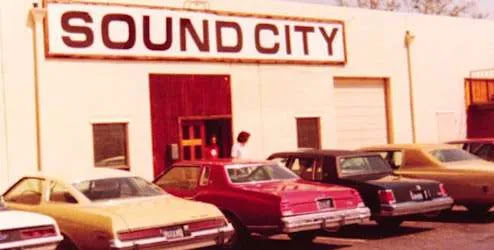
Fleetwood Mac had already transitioned to a softer, less bluesy sound in 1973, with the release of their seventh studio record, Penguin. Christine McVie, wife of John, officially joined the band in 1971 for the record Future Games, but had contributed piano parts prior to becoming a full-time member. With the new (now considered classic) line-up set, the band relocated from England to California and entered the legendary Sound City Studios.
Sound City Studios in the 1970s.
The group's previous album, Heroes Are Hard To Find, had been a disappointment commercially. However, fortunes changed with the addition of  "the Americans" -- despite many heated clashes between Buckingham and John McVie during the recording of the self-titled record. It spawned three Top 20 singles and went on to sell eight million copies. It would also establish Fleetwood Mac as one of the most successful bands of all time and set the stage for 1977's Rumours (#26 on The 500).
Rumours album cover -- we'll get to this one in about
two and a half years.
I am a fan of so much from Fleetwood Mac. I delight in their Peter Green, blues rock roots, Green Manalishi included, and the incredible harmonies and musicianship that came with their classic line-up.

Historical fact: Green eventually ‘fessed up that a Green Manalishi was a fictional representation of the inherent evil in money -- he had made the word up because it sounded menacing.


Sunday, 8 December 2024

The 500 - #183 - Red Headed Stranger - Willie Nelson

I was inspired by a podcast called The 500 hosted by Los Angeles-based comedian Josh Adam Meyers. His goal, and mine, is to explore Rolling Stone Magazine's 2012 edition of The 500 Greatest Albums of All Time. 


Album: #183
Album Title: Red Headed Stranger
Artist: Willie Nelson
Genre: Outlaw Country
Recorded: Autumn Sound (Garland, Texas)
Released: May, 1975
My age at release: 9
How familiar was I with it before this week: One song
Is it on the 2020 list? Yes, at #237, dropping 54 places
Song I am putting on my Spotify Playlist: Blue Eyes Crying in the Rain
Album cover for Willie Nelson's Red Headed Stranger (1975).
As has been documented numerous times in this blog series, I am a huge fan of concept albums -- those records whose individual tracks hold a larger meaning when listened to as a whole. My favourites include 2112 from Rush; The Lamb Lies Down on Broadway from Genesis; Misplaced Childhood from Marillion; and Operation: Mindcrime from Queensryche. A few of my other favourites have even made The 500 list, including The Who's Tommy; David Bowie's The Rise and Fall of Ziggy Stardust; Elton John's Captain Fantastic and the Brown Dirt Cowboy; and Pink Floyd's The Wall.
A selection of concept records from the Progressive Rock genre.
Colour me surprised on learning that concept records had been recorded by country artists. Released in the spring of 1975, Willie Nelson's Red Headed Stranger was hailed by critics as one of the best from both the outlaw country genre and as a concept record. Rolling Stone Magazine listed it at #26 in its October, 2022, article, The 50 Greatest Concept Albums of All Time. (I covered the outlaw country genre in detail in my 2023 post about Nelson's 1978 record Stardust.)
Album cover for Willie Nelson's Stardust (1978).
Red Headed Stranger tells the story of a preacher, turned fugitive, who is on the run in the American southwest (Texas to Colorado) after killing his wife and her lover. The titular character then wanders aimlessly from town to town in an alcoholic haze of self-loathing, riding a black stallion while toting behind him the pony of his deceased wife. There is plenty of room for metaphoric interpretation based on that image.

A shot from the film adaptation of Red Headed Stranger.  Nelson, as the

titular antihero, riding his stallion while towing his late wife's pony – ,

loaded figuratively and literally with the baggage of his past.

There is a shift at the midpoint of the record. The story could be interpreted as an allegory for "The American Dream". The Stranger continuing his westward quest, seeking a fresh start to his life. He meets a new love in Denver and the music becomes noticeably more upbeat, with some songs written in a buoyant waltz time. The final track is the instrumental Bandera. However, the song that precedes it, Hands On The Wheel, suggests that redemption for The Stranger has been found in the heart of a woman who loves him unconditionally.

"And I looked to the stars,
Tried all of the bars,
And I've nearly gone up in smoke.
Now my hand's on the wheel,
I've something that's real,
And I feel like I'm going home."

Red Headed Stranger absolutely wowed me. I listened to it perhaps a dozen times in the week leading up to this posting. In future, when I talk about my favourite concept records, this album will certainly be among them. There is something stirring and beautiful in the album's simplicity. Much like the wide open vistas so typical in a western movie, Red Headed Stranger is sparse and uncomplicated, with lots of space for contemplation and interpretation -- none of it hurried.


"Some day when we meet up yonder
We'll stroll hand-in-hand again
In a land that knows no parting
Blue eyes crying in the rain."


Monday, 27 May 2024

The 500 - #211 - Wish You Were Here - Pink Floyd

I was inspired by a podcast called The 500 hosted by Los Angeles-based comedian Josh Adam Meyers. His goal, and mine, is to explore Rolling Stone Magazine's 2012 edition of The 500 Greatest Albums of All Time. 


Album: #211
Album Title: Wish You Were Here
Artist: Pink Floyd
Genre: Progressive Rock, Art Rock
Recorded: EMI Studios (Now Abbey Road Studios), London, England
Released: September, 1975
My age at release: 10
How familiar was I with it before this week: Very!
Is it on the 2020 list? Yes, at #264, dropping 53 spots
Song I am putting on my Spotify Playlist: Shine On You Crazy Diamond (Parts 6 - 9)
There is not another album on The 500 list that I have listened to more often than Wish You Were Here by English quartet Pink Floyd. The album has spoken to me deeply for more than 40 years and I never tire of listening to it because it seems to age along with me. The lyrics, which resonated so powerfully as a teenager, take on a different tenor now that I am listening to it as a man nearing 60. Like "comfort food" -- warm, hearty traditional dishes – that sustain you and also remind you of childhood and home.

However, the album is more than that. It is a piece of art that has seeped into the fibre of my being – witness to my life in times of joy, triumph and elation, as well as periods of darkness, sadness and loss. Seemingly part of my DNA.
The album consists of only five songs: Welcome To The Machine, Have A Cigar and the title track Wish You Were Here, book-ended by the 30-minute opus, Shine On You Crazy Diamond, which is divided into nine parts. Shine was written by three members of the band – bassist and vocalist Roger Waters, guitarist and vocalist David Gilmour and keyboardist Richard Wright. The final member of the classic line-up was drummer Nick Mason.
Pink Floyd in 1975 (l-r) Mason, Gilmour, Waters and Wright.
Shine On You Crazy Diamond was conceived by Waters as a tribute to the band's founding member, Syd Barrett. Barrett, who struggled with mental health issues and drug addiction, was eased out of the band in 1968, and his health continued to decline. Once joyful, friendly and extroverted, Barrett began experimenting heavily with the psychedelic drug LSD (Lysergic Acid Diethylamide) in the mid-sixties. Changes in his personality were gradual. However, after a long weekend during which he went missing, he returned "a different person", according to keyboardist Wright. Barrett became increasingly unreliable as a band mate. He was withdrawn, experienced hallucinations, struggled with his speech and was even prone to bouts of catatonia -- sometimes when on stage.

Syd Barrett - 1960s.
Gilmour, who was a college friend of Barrett, joined Pink Floyd as a fifth member to fill in - as needed - during live performances. However, eventually, the situation became untenable. As bassist Waters put it, "He was our friend, but most of the time we wanted to strangle him."

Although Barrett  continued to write music and released two solo albums in 1970, (Barrett and The Madcap Laughs), his mental health continued to decline. The rest of the band did not see him for many years, but  in 1975, as Floyd were recording Wish You Were Here, he arrived at the studio unannounced. He had gained a lot of weight and had shaved himself bald, including his eyebrows.  For much of the visit he brushed his teeth. When Waters asked him what he thought about the songs, Barrett replied, "Sounds a bit old."
Barrett at Abbey Road Studios (1975)
The first time I heard Shine On You Crazy Diamond, I was leveled by its hypnotic beauty. It was late at night and I was listening to a rock radio station, procrastinating over a high school homework assignment. I don't recall the song being introduced; I just remember that, at first, there was silence, which I assumed was "dead air". --

Then a gentle susurration pulsed from my tiny transistor speaker. Almost imperceptible, a rich synthetic/orchestral, whispering swelled slowly. I could detect the faint tinkling of chimes, and imagined the sound waves as electronic vines being absorbed by my entire being.
Shine On You Crazy Diamond Pt. 1 - released
as a single (which seems ridiculous - you need the
whole suite.)
The first time you truly “hear” a song, time seems to move more slowly. This was one of those times. It was like floating comfortably through a warm pool toward a distant light. I stopped everything, entranced. The notes modulated ever so subtly, but always found their way to a perfect, albeit temporary, resolution...and then a guitar, (a black Stratocaster, I  later learned) struck a simple series of four notes. I don't think I did anything but breathe for the next eight minutes...and then the vocals began…
"Remember when you were young?
You shone like the sun.
Shine on you crazy diamond.
Now there's a look in your eyes,
Like black holes in the sky.
Shine on you crazy diamond."
I had no idea what it meant and it was some time before I learned it was about Barrett.  My world was forever changed by this album. I wore out at least two cassettes, listening to them over and over on my portable player. The music was my companion on walks and in the evening on my bed and on countless bus trips around the city. Sometimes, I skipped class and sat on concrete benches out side the school in order to listen to it again.
I was a toddler when the original Floyd group broke up in 1968, and I was too young to see the classic line-up (Waters, Gilmour, Mason & Wright). However, I have seen the other members on their solo outings numerous times. Most recently, I saw Roger Waters (for the sixth time) on his This Is Not A Drill tour in 2022. He included Shine (Parts 6-9) in his first set.
Waters on tour in 2022.
I also attended what was billed as David Gilmour's final concert tour in 2016. He played the first half of Shine (Parts 1-5) -- which was the highlight for me. Thirty-six years removed from my first listen, I am still transfixed by the sound Gilmour seduced from his trademark black Stratocaster guitar. Below is a photo I took at the concert.
In 2021, he auctioned off 126 of his guitars at a fund-raising event for climate change -- netting $21 million. Included in the auction was the famous "Black Strat" which fetched $3.9 million. My friends and I believed the fund-raiser signalled the end of his writing and touring. However, last month, the 78-year old announced the release of his fifth solo record, Luck And Strange, along with dates for a small 2024 tour – visiting only Rome, London, Los Angeles and New York.

It seems unlikely that we will see either of these band members perform again, but I’m thrilled to have had the opportunity of sharing their careers. As I said at the start, I’ll always have this album – my auditory comfort food.
And we'll bask in the shadow of yesterday's triumph
And sail on the steel breeze
Come on, you boy child, you winner and loser
Come on, you miner for truth and delusion, and shine!