I was inspired by a podcast called The 500 hosted by Los Angeles-based comedian Josh Adam Meyers. His goal, and mine, is to explore Rolling Stone Magazine's 2012 edition of The 500 Greatest Albums of All Time.
Album: # 340
Album Title: Damaged
Artist: Black Flag
Genre: Hardcore Punk
Recorded: Unicorn Studios, West Hollywood, California
Released: December, 1981
My age at release: 16
How familiar was I with it before this week: One Song
Is it on the 2020 list? Yes, #487 - dropping 140 places
Song I am putting on my Spotify Playlist: TV Party
Punk rock was not my scene in high school, but I dipped a toe in the pool. There was a small contingent of "punk rockers'' among the student cohort and when we interacted in class, or out on the smoking patio, it became apparent they were bright and incredibly nice.  |
| Saunders Secondary School (London, Ontario) |
One weekend a guy named Pete, affectionately known as Punker Pete, invited me to a party. In anticipation of the event, I tried to "dress the part" -- slicking back my longish mop of rocker hair along the sides while spiking it up in the middle. I think I was going for something in-between Johnny Rotten of the Sex Pistols and a Stray Cats style pompadour.
 |
| Johnny Rotten (Sex Pistols) and Brian Setzer (Stray Cats) |
I donned my green army jacket bought from a military surplus store in downtown London, Ontario and adorned it with a sad collection of safety pins cobbled together from my mother's sewing drawer. Tight black jeans were de rigueur in 1983 -- and the one fashion statement punkers and rockers seemed to agree on was painfully tight pants.  |
| Novack's - A London Landmark (1939-2012) |
In retrospect, my choice of apparel was awful, but to my surprise no one said a thing. I was simply accepted as one of the partiers. I was further surprised to see many familiar faces from school not part of the punker scene. There were preppies and kids who played in the school band with me, plus several art-hall students and a bunch from drama class. I was expecting Rock and Roll High School and it ended up being The Breakfast Club. The music was a mix of pop, punk and new wave (Talking Heads, The Pretenders, The Specials, The Jam). However, the crowd eventually gathered in a large room at the back of the house where Punker Pete and his friend Chester pulled out acoustic guitars.
They played about a dozen songs, most unfamiliar, but I did recognize a couple from The Clash. They even played the song Unchained, from rock band Van Halen. They laughed as they played and, at first, I thought they were mocking the rock and roll hit, but, no, they were playing earnestly and laughing at their own improvisations, good or bad.Looking back, I hadn't attended a "punk rock party" that night. Rather it was a get-together with a collection of sociable people who enjoyed hanging out, drinking beer and hearing music -- only some of which was punk.
It was also around this time that I first heard the name Black Flag. Of course, I had seen the band's iconic logo long before I ever heard a track -- a simple design comprising four thick black vertical bars sandwiched between the word "Black" above and "Flag" below just slightly offset.. To me, there was something menacing about it. The logo's designer, Raymond Pettibon ( the brother of Black Flag's founder and guitarist, Greg Ginn) has said, "If a white flag means surrender, a black flag represents anarchy."  |
| The iconic Black Flag logo by Raymond Pettibon |
Coincidently, I began to hear the name Henry Rollins being associated with the band. Black Flag would only play a small part in my personal history, but Rollins has become, and continues to be, an important part of my pop-culture ethos. |
| Henry Rollins, 1981, singing for Black Flag |
Black Flag’s debut album Damaged is notable for the arrival of Rollins as the lead singer. Before then, the hardcore punk band from Hermosa Beach, California, had been performing for five years and had released two Extended Play (EP) records (1979 and 1980). Rollins remained with Black Flag for five years before forming his own group, while touring as a spoken word performer.  |
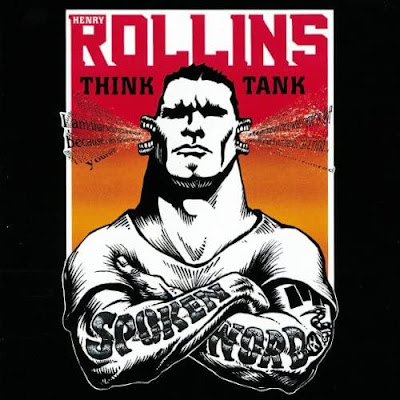
| Promotional poster for an early spoken word performance |
It was around this time that Rollins began to appear more frequently on my radar. Indeed, Rollins’ songs were regularly played by kitchen staff, usually at closing time, in restaurants where I worked. Rollins also began to host television programs and had a small, but memorable role in the 1994 film, The Chase. My friend Jeff introduced me to Rollins’ spoken word releases in the early 90s. I was hooked by his smarts and his long, free-form, storytelling sessions, which highlighted his wit, wisdom and, perhaps most importantly, compassion. Rollins was discussing racism, homophobia and justice reform long before these social issues entered mainstream conversation among the "woke" generation.
In 2008, Rollins brought his Recountdown Spoken Word Tour to London, Ontario, and I picked up tickets for my wife and I and pal Billy as a birthday gift. We had prime, third-row tickets, almost dead center. On the night of the performance, Rollins waxed and rambled for nearly two hours -- discussing his seven-day adventure aboard the Trans-Siberian Express from Moscow to the border of North Korea. It was a journey that included two days during which he struggled through a remorseless case of food poisoning as the train whisked through the Ural mountains.
 |
| My ticket stub for the Henry Rollins show |
They say no favour goes unpunished. Jet-lagged after rushing to the show following a business trip to India, friend Bill fought a valiant battle with consciousness throughout. I am sure he would have preferred tickets in the shadowy recesses of the concert hall, not bathed in the spotlight that illuminated an animated and effusive Rollins who occasionally glanced curiously at our trio -- Billy's head bobbing like a punch-drunk fighter. Postscript: Punk rock was not my scene in high school, but Henry Rollins has become part of my world over the past 35 years. I remained casual friends with Peter, who invited me to that party. He also became an educator, spending time in Japan (where he met his wife) and in Alberta. He currently works as a Principal with the Waterloo-District Region School Board, about 100 km west of me. He still plays music and he's still a really, nice guy. |
| Pete (foreground) playing in 2010 |
 Like many people of my vintage who did not have older siblings, my first record collection belonged to my parents. Nestled among the Nana Mouskouri, Elvis Presley and Mario Lanza records were a small assortment of soundtracks from movies and musicals. Some came from films I had seen -- The Sound Of Music, Oliver and Mary Poppins. Others were from unfamiliar sources -- Saturday Night Fever, Fiddler On The Roof and My Fair Lady. Regardless, I loved them all and spent many Saturday afternoons doing school work or sorting hockey cards while listening to Chaim Topol as Tevye the Milkman sing If I Were A Rich Man.
  The punk-rock opera features a narrative set in the shadow of 9/11, the Iraq War and the presidency of George W. Bush. The protagonist is a disillusioned teenage slacker, dubbed the Jesus of Suburbia. This anti-hero describes himself as "a son of rage and love", surviving on a "steady diet of soda pop and Ritalin", looking for meaning in a world where he feels he cannot trust the media or government.
 In many ways, the themes on the record line-up nicely with those concept records I loved in my teens/early twenties -- 2112, The Wall, Misplaced Childhood, The Lamb and Operation:Mindcrime. However, listening to American Idiot when I was 39 failed to inspire the same revolutionary, nihilistic energy of my youth. The angry, romantic outsider that I used to be had been replaced by a calm, professional adult staring down his 40s. Regardless, I embraced the record and enjoyed seeing my young students connect with its message of moral, political and social outrage. Most of all, I enjoyed watching them head toward their high-school years, inspired by art the same way I had been two decades earlier. That time when fascination with Fiddler On The Roof turned passe I discovered that music and lyrics could be complex narratives, shaping and lasting a lifetime.