Showing posts with label Grunge. Show all posts

Sunday, 9 June 2024

The 500 - #209 - Ten - Pearl Jam

I was inspired by a podcast called The 500 hosted by Los Angeles-based comedian Josh Adam Meyers. His goal, and mine, is to explore Rolling Stone Magazine's 2012 edition of The 500 Greatest Albums of All Time. 


Album: #209
Album Title: Ten
Artist: Pearl Jam
Genre: Hard Rock, Alternative Rock, Grunge
Recorded: London Bridge Studio (Seattle, U.S.A.) & Ridge Farm Studios (Surrey, England)
Released: August, 1991
My age at release: 26
How familiar was I with it before this week: Very
Is it on the 2020 list? Yes, at #160, up 49 spots
Song I am putting on my Spotify Playlist: Black
When I wrote about Blood, Sugar, Sex, Magic by Red Hot Chili Peppers (#310 on The 500), I related the story of a kitchen co-worker nick-named 'Boog' who introduced me to much of the alternative rock music that would become part of the mainstream zeitgeist in 1992. My favourite two discoveries in the spring of that year were, without a doubt, BadMotorFinger from Soundgarden and this week’s feature, Pearl Jam's Ten. Both were among the "Big Four" bands from Seattle who rocketed from small club obscurity to mega-stardom in 1992 -- Nirvana and Alice in Chains occupying the other two slots. Collectively, they have six records on The 500 list. It turned out that Boog, despite his unfortunate sobriquet, was a pretty good judge of music.
Around that time, my future wife and I moved from London, Ontario, to Brampton -- then a smallish city in the Greater Toronto area. As it turned out, I picked up a job with the same restaurant chain I had been the bartender and night manager of in London. However, it was 40 kilometres from Brampton in Oakville. A cassette recording of my Ten CD accompanied me on many of my daily commutes to work. It was also a "go-to" record when we entertained. At the time, my social circle was obsessed with the board game Scrabble and numerous word-battles dominated our evenings -- as we guzzled coffee and poisoned ourselves smoking cigarettes. Being a non-smoker now for more than 30 years, I can't imagine how awful our small Brampton apartment must have smelled – but, it was the ‘90s, we all just accepted that cigarette smoke was everywhere.
Our first "smoky" apartment. "Scrabble Table" at right, coffee maker
visible in kitchen - surprisingly not in use.
Pearl Jam, considered by some to be the most popular American band of the ‘90s, formed as a result of tragedy. Founding members Stone Gossard (guitars) and Jeff Ament (bass) were previously members of Mother Love Bone. However, shortly after the release of Love Bone’s debut record, the group's charismatic lead singer, Andrew Wood, overdosed on heroin.
Devastated by the loss, Gossard and Ament began writing darker, edgier music. Eventually, they connected with fellow Seattle guitarist Mike McCready, whose band Shadow had just broken up. The trio created a five-song demo cassette, hoping it would help them find a drummer and a lead singer. The cassette made its way to San Diego-based vocalist Eddie Vedder who was singing with the band Bad Radio and working part-time at a gas station. Vedder loved what he heard and began recording vocal tracks for three of the songs - Alive, Once and Footsteps. Vedder intended them to be included in a dark, mini-opera he called Mamasan. The themes from that mini-opera canl be heard in the lyrics to Alive and Once (which appear on Ten).  However,, the group opted against making their first record a concept album. The song Footsteps was shelved and eventually released as the B side for the single, Jeremy.
Pearl Jam (1991) (l-r) McCready, Ament, Vedder, Gossard and 
Dave Krusen (drums).
Gossard, Ament and McCready were so impressed with Vedder's vocal and lyrical efforts that they paid to fly him to Seattle to rehearse with the band, which in the meantime had recruited drummer Dave Krusen. A week later, 11 songs were crafted and the band was signed to Epic Records. Ten months later, Ten was released. Originally, the band wanted to be called Mookie Blaylock – the name of a point guard who was playing for the New Jersey Nets in the National Basketball League in 1991. However, the record company insisted they change their name. Blaylock’s jersey number is 10, so the name of their debut album is a nod to him and their original moniker. Over the years, band members have offered several stories about the origin of the name Pearl Jam. It seems the group enjoys fan speculation far more than solving the mystery.
Pearl Jam (1991).
My Ten album is one that I loaded in my CD player hundreds of times in the early ‘90s, and I bought their second record, Vs., the day it came out in 1993. At that time, I suspected Ten might be shuffled to the back of my CD cabinet, retrieved occasionally for a nostalgic spin. Such is the fate of many albums in my collection -- and I don’t think I am alone in doing that.
Another shot of my Brampton apartment - one of my three CD 
racks can be seen - I am sure the Pearl Jam record is in the left column.
However, in the autumn of 1995, I began my Teachers' College studies at Lakehead University in Thunder Bay and, unexpectedly, my listening habits gave Ten an auditory renaissance. The 14-hour drive necessitated a litre of coffee and plenty of cassette tapes. I made a number of "mixed cassettes" to keep me occupied, but I also dug through my old collections and Ten found its way into the cassette player in my gray 1990 Chevy Cavalier.
A 1990 Chevrolet Cavalier.
This coincided with what, at the time, seemed like an end to my 10-year romantic relationship when we decided to take a break. The fifth track on Ten was the emotionally heavy ballad, Black. The lyrics, penned by Vedder, reflect on a break-up he had experienced. In the bridge, he sings the emotional lyric:
"I know someday you'll have a beautiful life, I know you'll be a star in somebody else's sky, but why? Why?
Why can't it be, oh, can't it be mine?"

In retrospect, I can understand how this might sound a bit maudlin. But, as I drove through the night, on a lonely stretch of the Trans-Canada Highway toward an expensive academic risk that I desperately hoped was the right decision, the song was an emotional gut punch. I won’t say I sang along with the "doo-doo-doo-do-doo-doo-doo" chorus as I cut my way through the Canadian Shield landscape north of Lake Superior -- but I won’t say I didn't. 

The drive from London, Ontario to Thunder Bay.
Because of those long drives, Ten has a special place in my heart. I can lose myself in the incredible guitar solos on songs that include Alive, Even Flow or the tremendously underrated Porch. The lyrics to Jeremy, which were inspired by the tragic death of a high school student who shot himself in front of his English class in 1991, are powerfully prescient and I'll always get a little wistful when I hear Black -- despite the fact that everything worked out. Teachers' College was a smart idea and I reconnected with the girl of my dreams and she is still "a star in my sky".

Sunday, 3 July 2022

The 500 - #310 - Blood Sugar Sex Magik - Red Hot Chili Peppers

I was inspired by a podcast called The 500 hosted by Los Angeles-based comedian Josh Adam Meyers. His goal, and mine, is to explore Rolling Stone Magazine's 2012 edition of The 500 Greatest Albums of All Time. 


Album: # 310

Album Title: Blood Sugar Sex Magik

Artist: Red Hot Chili Peppers

Genre: Funk-Rock, Rap-Metal, Funk-Metal, Alternative

Recorded: The Mansion, Los Angeles, California

Released: 1991

My age at release: 26

How familiar was I with it before this week: Very

Is it on the 2020 list? Yes, at #186, Moving up 124 spots

Song I am putting on my Spotify Playlist: Breaking The Girl

In the spring of 1992, I was finishing my degree at Western University in London, Ontario, while working six or seven days a week at East Side Mario’s restaurant. The Canadian- based chain of casual restaurants "specializes" in Italian-American "cuisine". It is to Italian food what Taco Bell is to Mexican fare -- it's not authentic, or particularly good, but it is inexpensive and acceptable. The location where I worked was wildly popular and busy with crowds of all ages from lunch until close.  
It was an exhausting pace, but was one of the most financially lucrative times of my life. In fact, it was one of those economic bubbles of youth that one intuitively knows is unsustainable. Like any bull market you just know the phase will pass.  Making hay while the sun shines, I managed the restaurant four nights a week for a decent salary, free food and beer and picked up shifts on profitable Friday and Saturday evenings as bartender.
By far, the most exhausting day was Sunday, when I was scheduled, twice monthly, to open the restaurant and run the bar for Sunday Brunch. I needed to arrive by 7 a.m. to let the cooks into the building. Often, I had closed the restaurant five hours earlier. Yes, I debated sleeping there to steal a few extra minutes of shut-eye.
Much like custodial staff and administrative assistants are essential to the smooth operation of a school, cooks are the engine of any restaurant. Without cooks, the doors can’t open. 

Gratitude works.

For night cooks, liquid lubrication at the end of a shift – usually ice-cold beer.

For groggy-eyed and sometimes hungover Sunday morning prep cooks – fresh hot coffee and letting them play their music loud, until the restaurant opened for business.

That spring (1992) their track selection was my introduction to an eclectic mix of genres that would grow in popularity over the next five years. It was on those groggy but hectic mornings that I first heard grunge, rap-rock and funk-metal. Much of it was loud, raw, fuzzy, unkempt and honest. Not unlike the punk rock movement of 15 years earlier, this music was both alarming and refreshing. Every Sunday, the restaurant vibrated to sonic booms I had never heard before – Alice in Chains, Pearl Jam, Mother Love Bone, Green River, Soundgarden, Babes in Toyland, Mr. Bungle and Mudhoney.
One of the early-morning prep-cooks was an 18-year-old, long-haired skateboarder nicknamed “Boog” – a seemingly unfortunate moniker, but one that he embraced like a rare jewel. Boog blasted many cassette-tape selections through the kitchen boom-box, but was particularly keen on Blood, Sugar, Sex, Magik, the fifth release by Los Angeles-based funk-metal rockers Red Hot Chili Peppers.
Red Hot Chili Peppers (1992) (l-r) John Frusciante (guitars)
Chad Smith (drums) Flea (bass) and Anthony Kiedis (vocals)
I was already a “Peppers” fan. As I wrote in an October, 2020, blog post, I was introduced to them in the mid-80s by my good friend Paul Dawson. I had purchased most of their discography, but that November, 1991 , release had thus far escaped my attention. There was something markedly different about the record and it went quickly into heavy rotation during study and workout sessions.
Peppers performing at Lollapalooza (1992)
Later that spring, I bought Funky Monks on video-cassette, a documentary filmed during the making of the record.  Significant changes had been made to create Blood Sugar Sex Magic. In order to achieve the re-shaping after several commercial failures, legendary producer and Def-Jam Records co-founder Rick Rubin agreed to work with the band. Rubin suggested that the group cohabitate for one month at his four-bedroom studio, The Mansion, during production.
The Mansion is an iconic house in the Laurel Canyon area of Los Angeles. Built in 1918, it was originally the home of Golden Age Hollywood star Errol Flynn. Magician/escape artist Harry Houdini had also used the pool area to rehearse his illusions and escape-routines while living nearby.
Errol Flynn
It is also rumoured to be haunted. In the summer of 1918, the son of a wealthy furniture store owner pushed his lover to her death from the balcony. The grisly lore reportedly troubled Pepper’s drummer, Chad Smith, so much that he refused to spend the nights there with Rubin and band mates. Smith has denied this claim, saying he preferred to go home to his wife. However, his chums, particularly guitarist John Frusciante, continue to lightheartedly needle him.
The Mansion Recording Studio
The record was completed at a rapid pace compared to previous efforts. Lyricist and singer Kiedis focused much of his writing on sexual references and bawdy innuendo, but the album’s biggest hit, Under The Bridge, was a dirge about his heroin addiction. The song told the story of Kiedis’ lowest moments, when he literally lived under a bridge in downtown Los Angeles.
Under The Bridge - Single Cover
Blood Sugar Sex Magic went on to achieve worldwide popularity and critical acclaim and is recognized as a seminal record in the alternative rock movement that swept the early 90s – an evolution that a skateboarding dishwasher named Boog recognized far earlier than I.

Monday, 14 February 2022

The 500 - #330 - Tonight's The Night - Neil Young

I was inspired by a podcast called The 500 hosted by Los Angeles-based comedian Josh Adam Meyers. His goal, and mine, is to explore Rolling Stone Magazine's 2012 edition of The 500 Greatest Albums of All Time. 


Album: # 330

Album Title: Tonight's The Night

Artist: Neil Young

Genre: Blues-Rock, Country-Rock, Pre-Grunge

Recorded: Multiple Venues (Live from the floor - No Overdubs)

Released: June, 1975

My age at release: 9

How familiar was I with it before this week: One Song

Is it on the 2020 list? Yes - #302 (Up 28 spots)

Song I am putting on my Spotify Playlist: None - Neil recently pulled his music from Spotify to protest the platform's decision to continue broadcasting conspiracy theories and Covid misinformation, particularly on The Joe Rogan Experience podcast. (Updated: December, 2024 - Neil is back on Spotify - Tonight's The Night added

How do you process grief?

I have been fortunate. I have not experienced much grief, yet we all know we are subject to deep sadness as we travel through life. And the older we get, the more evident that fact becomes. Personally, in my mid-fifties, I try not to think about such morbid matters and focus on the moment -- the present.

As a kid, I'd imagine making it to 100 years of age. I was optimistic that technology would advance to the point where most of the population born post World War II would easily reach that milestone. I suppose I still could. However, I hadn't factored in potential grief. A long life means having to say goodbye to loved ones and then living without them.
Tonight's The Night, the sixth studio album by Canadian musician Neil Young, was an album born of grief. Two close friends of Young, guitarist Danny Whitten and road crew member Bruce Berry, died of heroin overdoses around the time Young was doing preparations for the recording of this record. Whitten’s loss was particularly painful because Young had dismissed him from the studio on the night of his overdose. As the story goes, Whitten was so absorbed by his addiction that he was unable to play his guitar. Young "fired" him from the gig, telling him to go home and get better. Instead, he left and purchased the heroin that would kill him that night.

The recording was completed in the summer of 1973, mostly on the evening of August 26, but its release was delayed for two years. However, in between, Young released a live record, Time Fades Away, and another studio album, On The Beach, which was recorded in 1974.
The reason for the delay is unclear. Some speculate the record company chose to shelve it in favour of the live recordings. Others  believe it was Young's choice to keep it, temporarily, for himself as a way of dealing with the raw emotion of Whitten’s death.

A cryptic note from Young is included in the liner notes of the record. It reads, "I'm sorry. You don't know these people. This means nothing to you." This apology was to the listener who would not know Whitten and Berry -- the "people" that inspired many of the songs on the record.

The book, Neil and Me, written by his father, Scott, suggests that there are even darker versions of these recording sessions stored in Neil's private archives. All, I would suspect, was part of Young's grieving process.
Upon release, it met with little commercial success, but was lauded by music critics. Rolling Stone Magazine writer Dave Marsh summarized the album as follows:
"The record chronicles the post-hippie, post-Vietnam demise of counterculture idealism, and a generation's long, slow trickle down the drain through drugs, violence, and twisted sexuality. This is Young's only conceptually cohesive record, and it's a great one."
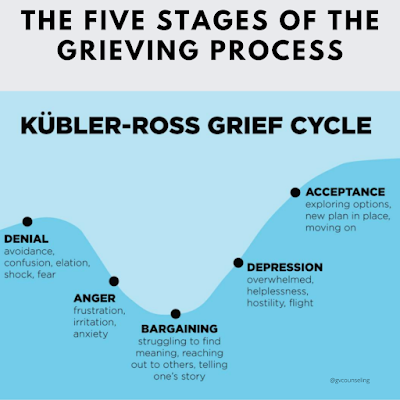
So, how does one process grief? I'm not sure how effectively I do it. I suppose I go through the usual stages outlined by the Kübler-Ross Model - Denial, Anger, Bargaining, Depression and, ultimately, Acceptance.


I suspect I will write regularly while working through the first four stages: A way of focusing to process the pain. I suspect this might be something Young and I have in common -- aside from being fellow Canadians -- healing through the power of creativity.

Sunday, 30 August 2020

The 500 - #406 - Rid of Me - PJ Harvey

I was inspired by a podcast called The 500 hosted by Los Angeles-based comedian Josh Adam Meyers. His goal, and mine, is to explore Rolling Stone's 2012 edition of The 500 Greatest Albums of All Time. 

Album # 406

Album Title:  Rid of Me
Artist: PJ Harvey
Genre: Indie Rock, Alternative Rock, Punk-Blues
Recorded: Pachyderm Studios, Minnesota
Released: May, 1993
My age at release: 27
How familiar was I with it before this week: Not at all
Song I am putting on my Spotify Mix: 
Man-Size

This week, I am fortunate to have a guest blogger Karen Snell. Interestingly, I have never met Karen. Our mutual friend, James, suggested we follow each other on Facebook because we had common interests, particularly music. Consequently, we have known each other "virtually" for about five years. 

Last May, my blog post for PJ Harvey's 2000 record, Stories from the City, Stories from the Sea (#431 on The 500 list), was published. Karen reached out and let me know she was a big fan who had seen PJ in concert. Realizing that another PJ Harvey record was imminent, I asked her if she'd be willing to share her memories for this record, 1993's Rid of Me. To my delight and great appreciation, she agreed. Enjoy!
Rid of Me album Cover (1993)

I’ve liked PJ Harvey for a long time, and probably my biggest PJ-related musical memory happened when I went to see her at The Warehouse in Toronto on October 30, 1998. 

For those of you who might have also frequented this venue back in the day, you might remember that there were two adjacent places to see concerts right down by the lake, a few blocks east of the Harbourfront area, right at the foot of Lower Jarvis Street.

Blue dot in the red circle shows the location of The Warehouse and The Guvernment Music Clubs
The first venue in this location opened in the mid-80s as a club called RPM. It was later renamed The Guvernment, and became an intimate location for live shows. The second was a larger concert space, conveniently located right next door. It was dubbed The Warehouse when it opened in 1996 and renamed Kool Haus in the early 2000s.

The Guvernment Music Club 2006
The Warehouse had crazy posts from floor to ceiling at various spots throughout the concert space. This made for pretty poor sight-lines if you stood in certain areas, but, if you could get in front of them, it was a terrific concert-going experience. At capacity, The Warehouse could hold several thousand people.

I saw a lot of great concerts in these adjoining locations through the 90s and early 2000s, including The Heads, Pretty and Twisted in 1995 -- which was the lamentably short-lived side project featuring Concrete Blonde’s Johnette Napolitano and Wall Of Voodoo alumni Marc Moreland and Danny Montgomery. I also saw Portishead (fantastic show!), The Chemical Brothers, Moby, The The, The Orb, and Amon Tobin in 2012, not long before the property was sold and the buildings torn down.

Kool Haus (formerly The Warehouse) being demolished in 2015
However, it was PJ Harvey’s concert in 1998, that ranks as one of the best and certainly one of the most memorable. 

Waiting for the concert to begin, as usual, brought on a ripple of anticipation throughout the crowd, as people talked with their friends and jockeyed for the best places to view the stage. When PJ came on stage, there was the typical crowd reaction of cheering, clapping, and whistling, everyone anxious for her to begin.

PJ Harvey Live at the V Festival (2003)
What happened next, though, literally sent chills down my spine. PJ began playing the opening of Catherine, a fantastic song from the album she was touring at the time. As she did, an intense hush fell over the crowd to the point that you could have heard a pin drop. It was amazing! Literally thousands of people went from cheering, clapping and talking to being utterly transfixed within seconds of her starting. Nobody, anywhere, in the whole place, was making a sound. You could hear her voice ringing out across the hall. This was truly one of the most memorable moments I’ve ever had at a live gig in my life! Of course, she went on to rock out the whole evening and the crowd came back to earth to sing along and make noise with her, but that opening is seared in my memory!

PJ Harvey is always great live, and I saw her again in 2004 at the Phoenix in Toronto, which was also a fantastic gig; nothing, however, quite matched this amazing concert opening on that night in 1998.

For this album, Rid of Me, I think you’ll find this performance of PJ singing the title track at Big Day Out Festival in Sydney in 2001 captures a little of that magic of 1998. She can really dominate a massive crowd.

However, if I had to recommend just one song on Rid of Me it would probably be Man-Size. It has great vocals and PJ rocks out in a way only she can -- with her unique voice and raunchy guitar -- all the while exuding extreme confidence in her music, her body and herself. She is even commenting on gender and power while she’s at it, It’s pretty fantastic stuff!

Honourable mention and a particular recommendation for guitar-lovers is the track Ecstasy – great!

Unapologetically unique throughout her career and consistently evolving, Polly Jean Harvey has always been a risk taker. You might really love one or two albums more than the others because they’re all unique. They are well worth the time listening to with care, as she always has something to say.

This week's Guest Blogger - Karen Snell


Tuesday, 14 April 2020

The 500 - #435 - Nirvana - In Utero

I was inspired by a podcast called The 500 hosted by Los Angeles-based comedian Josh Adam Meyers. His goal, and mine, is to explore Rolling Stone's 2012 edition of The 500 Greatest Albums of All Time. 

Album # 435

Album Title: In Utero
Artist: Nirvana
Genre: Grunge, Alternative Rock
Recorded: February, 1993
Released: September, 1993
My age at release: 28
How familiar was I with it before this week: Fairly
Song I am putting on my Spotify Mix: All Apologies 
(Suggested by my friend Michelle Ryan, honourable mention to Brent Kelders who pitched some awesome "deep track" choices.)

The grunge movement of the early 90s wasn't intended to be a movement. Before 1990, the burgeoning Seattle music scene was an underground collection of bands who began fusing elements of punk rock and heavy metal into their own sound. It was a reaction to the heavily commercialized "over-the-top" glam-rock of the MTV 80s. However, these musicians did not call themselves "grunge" nor did they seek to revolutionize the sound of the day. They just wanted to make authentic music without worrying about style. If this was a restaurant, they sold the steak, not the sizzle.
Four Seattle Bands - Pearl Jam (Top Left) , Nirvana (Top Right),
 Soundgarden (Bottom Left), Alice in Chains (Bottom Right)
The so-called "grunge" sound varied from band to band. Some played fast, angry and loud -- replicating the raw energy of punk and garage rock bands of the previous two decades (Black Flag, The Misfits, The MC5 or The Stooges). Other Seattle rockers were influenced by 70s heavy metal acts (Black Sabbath, Deep Purple and UFO). They used distortion to create brooding anthems that were low and slow. Both of these styles provided a canvas for lyrics that were dark, angst-filled and deeply introspective, seeking to capture the isolation and alienation of upstate Washington's dismal climate.
By the time In Utero was released in September 1993, the Seattle scene had exploded. An art form which began with earnest intention was now a commercial juggernaut. The 1992 film Singles had thrust the movement into mainstream culture. 
Teens and twenty-somethings across the world were decked out in the same loose-fitting, androgynous, disheveled clothing that were trademarks of bands who had now become household names (Nirvana, Pearl Jam, Soundgarden, Alice in Chains). However, these clothes were no longer inexpensive, thrift-store discoveries. "Granddad's old lumber jacket" was on sale at mainstream outlets and designers (including Marc Jacobs and Perry Ellis) capitalized on the trend, incorporating elements into their 1993 spring collections.
There are three Nirvana records on The 500 List, including Nevermind which cracks the top 20. In Utero appears first at #435.
Beyond the fashion, I really liked the music and, in the fall of 1993, I was excited about the release of this record. However, after my first listen, I wasn't as impressed as I'd hoped. I had the feeling that might best be captured by the well known expression "You can never go home again." It seemed as if the band was trying to recapture something that had been swept away by this commercial whirlwind.
The "lightning in a bottle" sound captured in those early days was now a "genie out of the bottle" -- and she was wearing Doc Martens' combat boots and baggy flannel from The Gap. 

Some of these thoughts were confirmed this week as I listened to The 500 Podcast episode dedicated to the In Utero record. In it, host Josh and guest, Jeff Dye. a comedian, actor and Nirvana fan, discussed the band's intention to create a more unpolished, raw and authentic record. To help capture the abrasive sound, the band hired outspoken and controversial engineer Steve Albini, who abhorred any effort to homogenize a band's sound. Nirvana also committed themselves to a rigid two-week recording session at the remote Pachyderm Studio in Cannon Falls, Minnesota. According to a Rolling Stone article at the time:
"The music was quickly recorded within that time with few studio embellishments. The song lyrics and album packaging largely incorporated medical imagery that conveyed front-man Kurt Cobain's outlook on his publicized personal life and his band's newfound fame."

Cobain had actually wanted the record to be titled, I Hate Myself And I Want To Die, which was the response he gave to anyone who asked how he was doing. The title was rejected but the words would become a terrible harbinger. 

Overwhelmed by his mental illness and heroin addiction, Cobain would take his life seven months after the record's release on April 8, 1994. The suicide note he left echoed the sentiments he'd made clear in multiple interviews. He simply could not find joy in the music he was creating or from the energy of fans he entertained. 
After his passing I, like many, revisited the Nirvana catalog.  Over time, I gained a deeper appreciation for the cathartic, almost corrosive energy of In Utero. Certainly, it is coloured by Cobain's suicide, but I also understand the record a little better now. Perhaps, I was right. "You can't go home again"...and that can be devastatingly painful.