Showing posts with label Neil Young. Show all posts

Sunday, 6 July 2025

The 500 - #153 - The Low End Theory - A Tribe Called Quest

I was inspired by a podcast called The 500 hosted by New York-based comedian Josh Adam Meyers. His goal, and mine, is to explore Rolling Stone Magazine's 2012 edition of The 500 Greatest Albums of All Time. 


Album: #153
Album Title: The Low End Theory
Artist: A Tribe Called Quest
Genre: East Coast Hip Hop, Jazz Rap, Boom Bap, Alternative Rap
Recorded: Battery, Green Street and Soundtrack Studios, New York City, New York, U.S.A.
Released: September, 1991
My age at release: 26
How familiar was I with it before this week: Fairly
Is it on the 2020 list? Yes, at #43, rising 110 spots
Song I am putting on my Spotify Playlist: Scenario
In 2016, I was grinding through an elliptical workout at the gym, distracting myself with a podcast. That week it was an episode of the longform, interview/conversation program WTF with Marc Maron. Maron’s guest was  Canadian music legend Neil Young, who appears on The 500 list seven times -- as a solo artist and with two groups (Crosby, Stills, Nash & Young and Buffalo Springfield).

Responding to Maron, Young talked about his time as a teen in Winnipeg, which he described as being “in the middle of everything that’s missing.” That cheeky poetic line stuck with me for weeks because of its beautiful ambiguity, artfully critical, yet deeply affectionate.

Winnipeg sits in the middle of the country, practically isolated from other cultural and economic hubs. Its location matches Young’s description, evoking a sense of emptiness in the stark landscape of the Canadian Prairies. Appropriately enough, his thoughtful, sometimes melancholy, lyrics appear to have been the source of his inspiration. For the creative individual, solace can serve as a laboratory in seeking those things that are "missing" and bringing them to life.

Maron and Young pose for a picture after their June. 2016 interview.
A few months after that WTF interview, I probed deeper into the music of A Tribe Called Quest. Someone had recommended their latest release, We Got It From Here... Thank You 4 Your Service, and it temporarily replaced podcasts as my audio distraction during workouts. In fact, it became a bit of an obsession for about three weeks -- dominating my playlist the same way a record on this list can.

We Got It From Here…, released within a week of the election of Donald Trump to his first presidential term, is a politically charged album that tackles a wide spectrum of social and institutional issues, with sharp lyricism and cultural insight. However, despite its heavy themes, the album also offers hope, emphasizing the power of community, and the importance of intergenerational activism in the fight for justice through art.

I had heard tracks from the group before, including Scenario, Oh My God and, my favourite, Can I Kick It? But, this was the first time I checked out  their discography. For years, I appreciated hip hop from a distance. I recognized its cultural impact, admired its lyrical dexterity, but never felt fully connected. Something was missing.
A Tribe Called Quest (l-r) Jarobi White, Q-Tip,
Ali Shaheed Muhammad and Phife Dawg (2011).
As I read up on the pioneering group, that Neil Young quote flooded back. Their music lifted me to a new level of appreciation of hip hop through its layers of richness that I had needed to make me a full-fledged convert.

Listening to Tribe felt like finding the centre of a map I didn’t realize I’d been drawing. Their music didn’t just fill a gap, it defined the space and time, making me realize my understanding of hip hop had been incomplete.

In short, Tribe’s music, its rhythm, intelligence, activist spirit, clever sampling and jazz-influenced sound, was the bridge to appreciating hip hop. Indeed, I would perhaps have been an ardent fan in the ‘90s had I heard  the group’s first two records, (People's Instinctive Travels and the Paths of Rhythm and The Low End Theory). However, I wonder if I was ready for this understanding at that time. Perhaps, Tribe arrived in my life exactly when I was available to receive their message.
People's Instinctive Travels and the Paths of Rhythm,
the debut record from A Tribe Called Quest (1990).

The Low End Theory was Tribe’s second album after the group formed in 1985 in Queens, New York. The players comprised Q-Tip (Kamaal Fareed), Phife Dawg (Malik Taylor), Ali Shaheed Muhammad, and Jarobi White. They met through school and community ties in the late ’70s and early ’80s.

Originally, Q-Tip and Ali Shaheed Muhammad performed as a duo called Crush Connection, later changing their name to Quest. In 1988, during a friendly game of cards, fellow musician, Afrika Baby Bam (Nathaniel Hall), of the Jungle Brothers suggested expanding the name to A Tribe Called Quest.

This name stuck, cleverly capturing their identity. Alongside Jungle Brothers, De La Soul, Queen Latifah, and others, they helped form the influential Native Tongues Collective (NTC), a loose crew of artists known for thoughtful lyrics, Afrocentric themes, and innovative, jazz-infused productions. Additionally, NTC considered itself an artistic movement that rejected the trend toward violent or materialistic rap. Instead, they promoted positivity, individualism and social awareness while embracing collaboration over competition.

Africa Baby Bam (centre) flanked by the other members of
Jungle Brothers -- Mike Gee(left) and DJ Sammy B.

After a modest debut with People’s Instinctive Travels and the Paths of Rhythm, A Tribe Called Quest returned a year later with a bold leap forward: The Low End Theory. Released in 1991, the album broke fresh ground by blending stripped-down hip-hop beats with samples from jazz’s bebop and hard bop eras, an unusual and inventive fusion at the time.

Produced by group members Q-Tip and Ali Shaheed Muhammad, the record focused on the essentials of drums, bass, and vocals. This minimalist approach set it apart from the densely layered productions typical of early ’90s rap. One of the album’s defining features was a guest performance by Ron Carter, a Grammy-winning jazz bassist renowned for his work with Miles Davis, Herbie Hancock, Roberta Flack and Aretha Franklin. His appearance symbolically and sonically bridged the worlds of classic jazz and contemporary hip-hop.

Ron Carter, still holding down the groove at 88.

Hailed by some as “The Sgt. Pepper of Hip-Hop”, a nod to the revolutionary Beatles album ranked #1 on Rolling Stone’s 500 Greatest Albums list, The Low End Theory is more than just a record. It’s regarded as a cultural blueprint that reshaped hip-hop. So much so that in 2010, the album was added to the U.S. Library of Congress’ National Recording Registry, solidifying its status as a work of enduring artistic and historical significance. With its stripped-back production, jazz-infused beats, and seamless lyrical interplay, The Low End Theory challenged conventions. It showed how rap could tackle social issues with intelligence, wit, and humor...all while eschewing most profanity.

We Got It From Here... Thank You 4 Your Service was the final record for Tribe. The group disbanded following the death of founding member Phife Dawg in March 2016, due to complications from diabetes. Much of the album was recorded before his passing, and his presence is felt throughout the project. The group saw the album as a way to honor his legacy and contributions. It was also a way to bring a 30-year collaborative project to a meaningful end.

Tribe was inducted into the Rock and Roll Hall of Fame in 2024. In their induction speech, comedian Dave Chappelle shared the following:
“Years ago, in a tough time in my life, I read a Chinese proverb that changed my life. It said, ‘The best meal you can cook is made with ingredients that you already have.’ That proverb reminds me of hip-hop. And it reminds me, in particular, of Tribe.”

Tribe were a revolutionary, groundbreaking group whose sound found me, "In the middle of everything that was missing", and, like a good meal, helped nourish my growing appreciation of the art of hip hop.


Sunday, 3 November 2024

The 500 - #188 - Buffalo Springfield Again - Buffalo Springfield

I was inspired by a podcast called The 500 hosted by Los Angeles-based comedian Josh Adam Meyers. His goal, and mine, is to explore Rolling Stone Magazine's 2012 edition of The 500 Greatest Albums of All Time. 


Album: #188
Album Title: Buffalo Springfield Again
Artist: Buffalo Springfield
Genre: Multiple genres: Folk Rock, Psychedelia, Rock, Country Folk
Recorded: Three Studios - Two in Los Angeles, California, and one in New York City, New York
Released: October, 1967
My age at release: 2
How familiar was I with it before this week: A little
Is it on the 2020 list? No
Song I am putting on my Spotify Playlist: Mr. Soul
Much of my early exposure to music came from high school parties in the '80s. In a time before streaming music services, compact discs, music television and even the "mixed tape", the soundtracks at these teenage gatherings often emanated from the family record player. Consequently, entire album sides played to entertain this awkward, ebullient, juvenile congregation of (sometimes) stoned or drunk participants in the throes of developing their social skills.

  Some ‘80s parties relied on the old family stereo cabinet for music,

often tucked against a wood-paneled wall in a shag-carpeted basement.

The choice of music was reserved for the host. However, the music savvy were always nearby to offer suggestions. There were many records I first heard at house parties which are on The 500 list, including Paranoid by Black Sabbath (#131), Physical Graffiti from Led Zeppelin (#73) and this week's record, Buffalo Springfield Again, from Canadian/American folk rock group Buffalo Springfield. Formed in Los Angeles in 1966, the group comprised Americans Stephen Stills and Rich Furay, and Canadians Bruce Palmer, Dewey Martin and Neil Young.
Buffalo Springfield in 1966 (l-r) Stephen Stills, Rich Furay, Bruce Palmer, Dewey Martin and Neil Young.
I was pleasantly surprised by the sound of Buffalo Springfield the first time I heard it with friends who were mainly a heavy metal/classic rock crowd. At the time, most parties featured music by Def Leppard, Iron Maiden, Judas Priest and the aforementioned Sabbath and Zeppelin. To play music from a group influenced by folk, country and psychedelia, like Buffalo Springfield, seemed an odd choice. However, this was one of the best things about being at a party. It was a chance to hear something new and learn about a different group. I distinctly remember reading the album jacket while this record played. I liked the name Buffalo Springfield – not knowing they took their name from a company that made industrial steamrollers.
The back cover of the Buffalo Springfield Again album.
In a previous post about Neil Young's 1979 record, Rust Never Sleeps (#351 on The 500), I wasn't charitable in my assessment of his nasal-sounding voice. However, I didn't mind it on the opening track, Mr. Soul, which has been a personal favourite  since I first heard it. As I said in that post, Young’s voice has grown on me. Like a fine wine, my appreciation of his talent has grown with age. The rest of the record is terrific, with four of the five members taking vocal duties on the 10 tracks. I've always been a fan of harmonies and variety on a record, which Buffalo Springfield Again delivers in spades. As I revisited it for this post, I was surprised to realize I hadn’t purchased a copy for my collection. Probably in my youth I failed to recognize how good this album is.
Buffalo Springfield induction into the Rock and Roll Hall of Fame
in 1977 - Young chose not to attend.
The group released only three records between 1966 and 1968 before disbanding to pursue other projects. However, their influence was seismic, hence their induction to the Hall of Fame in 1997. Some members went on to enjoy successful solo careers; others either formed or joined bands that became popular and often influential. Among them were Crosby Stills Nash & Young; Poco; The Flying Burrito Brothers; and Manasas.

Buffalo Springfield left a music legacy that continues today. Surprisingly, they are not represented on the 2020 500 list, which is a glaring omission.

Sunday, 2 June 2024

The 500 - #210 - Everybody Knows This Is Nowhere - Neil Young

I was inspired by a podcast called The 500 hosted by Los Angeles-based comedian Josh Adam Meyers. His goal, and mine, is to explore Rolling Stone Magazine's 2012 edition of The 500 Greatest Albums of All Time. 


Album: #210
Album Title: Everybody Knows This Is Nowhere
Artist: Neil Young
Genre: Hard Rock, Country Rock, Proto-Grunge
Recorded: Wally Heider Studio (Hollywood, California)
Released: May, 1969
My age at release: 3
How familiar was I with it before this week: A couple of songs
Is it on the 2020 list? Yes, at #407, dropping 193 spots
Song I am putting on my Spotify Playlist: Down By The River
"Life is what happens to you while you are busy making other plans" is a quote often attributed to Beatle John Lennon because he used it in the song Beautiful Boy (Darling Boy) from his 1980 album, Double Fantasy. However, Lennon borrowed the lyric from writer and cartoonist Allen Saunders who was credited with the quote in a 1958 edition of Reader's Digest Magazine.
Saunder's meme had originally appeared (in a slightly varied form) in his American newspaper comic strip, Mary Worth. However, the sentiment is one that has been with man for centuries. Semantic precursors can be found as far back as c. 43 B.C.E. with the Latin proverb
"Homo semper aliud, Fortuna aliud cogitat" (Man intends one thing, Fate another). 
Proverb 16:9 of the Old Testament offers a similar proposition: 
"A man’s heart deviseth his way: but the Lord directeth his steps." 
c. 350 B.C.E.
Personal events over the past few weeks have had me thinking about the unpredictability of life and how our "best laid plans", in the words of Scottish poet Robbie Burns, "gang aft agley" (often go astray).
As you may have gathered, this has been a week of deep contemplation. The soundtrack to many of these pensive, thoughtful moments of reflection was found in Everybody Knows This Is Nowhere -- a record full of crunchy, hypnotic guitar jams, captivating melodies and evocative lyrics that are just abstract enough to provoke introspection.

Everybody Knows This Is Nowhere is the second studio release from Neil Young and the first that features backing band Crazy Horse -- a group of musicians who continue to tour with him today. In fact, Neil and two of the original members, Billy Talbot (bass, vocals) and Ralph Molina (drums, vocals) will perform in July (2024) in my hometown of London, Ontario, at the city’s annual Rock The Park Festival. The fourth original member, guitarist Danny Whitten, died in November, 1972 of a drug overdose.
The title track, Everybody Knows This Is Nowhere, describes Young's disillusionment with the music scene in Los Angeles in the late-sixties. The chorus features the lyric; "I gotta get away from this day-to-day running around", while  the verses pine for a simpler life  "back home" where it is "cool and breezy" and one can "take it easy...just passing time." It posits the notion that even a successful life isn't as fulfilling as just being "home".
I suppose that is a universal message to which we can all relate. Regardless of where we are and what we are doing, “home” beckons within. Abraham Maslow recognized this as the first step in his theory about humans’ Hierarchy of Needs -- we want our physiological needs met before anything else -- this includes shelter and safety.
In his 2018 stand-up special, Disgraceful, comedian Tom Segura puts a humourous spin on this prevailing sentiment suggesting that even when he is doing something he enjoys (attending a party with good friends or even recording the very comedy special we are watching) he is really just thinking, "I wish I was home right now."
If “life is something that happens when you are busy making other plans”, then the most meaningful way to exist is to escape the hurly-burly of our distracting commitments.

Sure, much like the mouse in Burns' classic poem, whose home is overturned by a farmer's plow, the chaos of the world will inevitably come crashing in on us. But, for a short time, we can disappear into the predictability of our favourite chair, a warm meal, a hot cup of tea and the love of those who share that place we call home. Even, perhaps, by giving this wonderful record from Neil Young and Crazy Horse another listen.

Monday, 14 February 2022

The 500 - #330 - Tonight's The Night - Neil Young

I was inspired by a podcast called The 500 hosted by Los Angeles-based comedian Josh Adam Meyers. His goal, and mine, is to explore Rolling Stone Magazine's 2012 edition of The 500 Greatest Albums of All Time. 


Album: # 330

Album Title: Tonight's The Night

Artist: Neil Young

Genre: Blues-Rock, Country-Rock, Pre-Grunge

Recorded: Multiple Venues (Live from the floor - No Overdubs)

Released: June, 1975

My age at release: 9

How familiar was I with it before this week: One Song

Is it on the 2020 list? Yes - #302 (Up 28 spots)

Song I am putting on my Spotify Playlist: None - Neil recently pulled his music from Spotify to protest the platform's decision to continue broadcasting conspiracy theories and Covid misinformation, particularly on The Joe Rogan Experience podcast. (Updated: December, 2024 - Neil is back on Spotify - Tonight's The Night added

How do you process grief?

I have been fortunate. I have not experienced much grief, yet we all know we are subject to deep sadness as we travel through life. And the older we get, the more evident that fact becomes. Personally, in my mid-fifties, I try not to think about such morbid matters and focus on the moment -- the present.

As a kid, I'd imagine making it to 100 years of age. I was optimistic that technology would advance to the point where most of the population born post World War II would easily reach that milestone. I suppose I still could. However, I hadn't factored in potential grief. A long life means having to say goodbye to loved ones and then living without them.
Tonight's The Night, the sixth studio album by Canadian musician Neil Young, was an album born of grief. Two close friends of Young, guitarist Danny Whitten and road crew member Bruce Berry, died of heroin overdoses around the time Young was doing preparations for the recording of this record. Whitten’s loss was particularly painful because Young had dismissed him from the studio on the night of his overdose. As the story goes, Whitten was so absorbed by his addiction that he was unable to play his guitar. Young "fired" him from the gig, telling him to go home and get better. Instead, he left and purchased the heroin that would kill him that night.

The recording was completed in the summer of 1973, mostly on the evening of August 26, but its release was delayed for two years. However, in between, Young released a live record, Time Fades Away, and another studio album, On The Beach, which was recorded in 1974.
The reason for the delay is unclear. Some speculate the record company chose to shelve it in favour of the live recordings. Others  believe it was Young's choice to keep it, temporarily, for himself as a way of dealing with the raw emotion of Whitten’s death.

A cryptic note from Young is included in the liner notes of the record. It reads, "I'm sorry. You don't know these people. This means nothing to you." This apology was to the listener who would not know Whitten and Berry -- the "people" that inspired many of the songs on the record.

The book, Neil and Me, written by his father, Scott, suggests that there are even darker versions of these recording sessions stored in Neil's private archives. All, I would suspect, was part of Young's grieving process.
Upon release, it met with little commercial success, but was lauded by music critics. Rolling Stone Magazine writer Dave Marsh summarized the album as follows:
"The record chronicles the post-hippie, post-Vietnam demise of counterculture idealism, and a generation's long, slow trickle down the drain through drugs, violence, and twisted sexuality. This is Young's only conceptually cohesive record, and it's a great one."
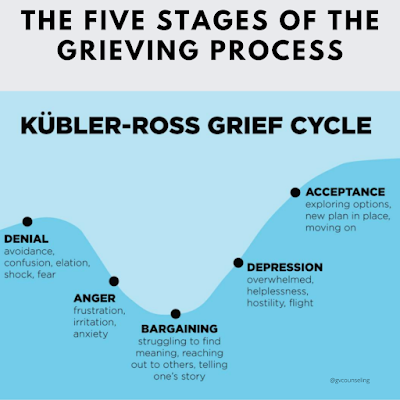
So, how does one process grief? I'm not sure how effectively I do it. I suppose I go through the usual stages outlined by the Kübler-Ross Model - Denial, Anger, Bargaining, Depression and, ultimately, Acceptance.


I suspect I will write regularly while working through the first four stages: A way of focusing to process the pain. I suspect this might be something Young and I have in common -- aside from being fellow Canadians -- healing through the power of creativity.

Monday, 20 September 2021

The 500 - #351 - Rust Never Sleeps - Neil Young

 I was inspired by a podcast called The 500 hosted by Los Angeles-based comedian Josh Adam Meyers. His goal, and mine, is to explore Rolling Stone Magazine's 2012 edition of The 500 Greatest Albums of All Time. 


Album: # 351

Album Title: Rust Never Sleeps

Artist: Neil Young

Genre: Acoustic, Hard Rock, Proto-Grunge

Recorded: Live at Six Venues

Released: June, 1979

My age at release: 13

How familiar was I with it before this week: Quite familiar

Song I am putting on my Spotify Playlist: Hey Hey, My My (Into The Black)

As a kid, I was quick to negatively judge Neil Young's distinctly nasal, falsetto singing voice. Two of my high-school chums, Glen and Brent, were committed Young fans and, if given the opportunity, would cue-up Rust Never Sleeps at any social gathering -- typically in smoke filled basements. Like most of my friends in the early 80s, we were deep into hard rock and heavy metal. We preferred the ripping guitars and high-octane vocals of bands such as Iron Maiden, Black Sabbath, Ozzy Osbourne, Scorpions, Led Zeppelin and Def Leppard over the more acoustic and folk-influenced music of Neil Young.
Six frequently played records from our 82/83 basement parties
Invariably, when Brent or Glen would bring up Neil Young or any of his other musical partnerships (Buffalo Springfield, Crosby, Stills, Nash & Young or Crazy Horse), I would launch a light-hearted complaint, which would invariably include an irritating impersonation of his singing voice. A high-spirited debate on musical taste would ensue and, predictably, shots would be fired at my favourite band, Rush.
Rush in concert - late 70s
As I've mentioned in previous posts, there is a quote I love from Adam Horovitz (Ad Rock of Beastie Boys): "I'd rather be a hypocrite than the same person forever." 
Time and maturity have changed my opinion. About 15 years ago, I began learning the Neil Young song Harvest Moon on the guitar. When I was sufficiently competent enough to try singing it, the first thing I did was attempt to effect Young's characteristic contra-tenor style. It didn't work. I'm not Neil. Nobody is -- and that is a good thing.
In a commercial music market crowded with perfect-pitch singers more suited for Broadway than contemporary songwriting, we need more unique voices. We need more Neil Youngs, Louis Armstrongs, Bob Dylans and Geddy Lees. We need singers who are comfortable with their own unique sound. Artists such as Dave Matthews, Kate Bush and Gord Downie. If an old guy can attempt to be tragically hip, Billie Eilish, Sia, or Lana Del Rey fit the bill in contemporary music.
Billie Eilish
Rust Never Sleeps is a live recording by Young, the Canadian multi-instrumentalist, singer and songwriter. Side one features him performing solo with an acoustic guitar and harmonica. Side two is electric, featuring Young with the American band Crazy Horse. At the time of these recordings, Crazy Horse included Billy Talbot (bass), Ralph Molino (drums) and Frank "Poncho" Pedro (guitars). All three also contributed backing vocals.

The record was recorded in 1978 during a lengthy tour of North America. It was later overdubbed in a studio. (Overdubbing, sometimes called "sweetening", is a technique where previously recorded material is processed in the studio in order to upgrade the audio quality. Additionally, any errors or flaws in the recording process can be corrected by adding additional instrumentation over top of the existing recording.)
An example of a computer program adding overdubbing
Jonathan Merlot, on his website Reboot Recording, offers a simplified explanation of the two benefits -- Corrective Overdubbing and Layering of Sounds:
"Let’s say we have recorded a guitar part and it sounds great throughout the song, however there’s a mistake during the solo. We can record over that specific section and record a new solo that sounds amazing from start to end.

Also, imagine if you wanted to have two guitars playing during the chorus, however there is just one guitarist in the band. You can record the original guitar track with the band and then come in later to record another guitar part on top of the original."
The result is a magnificent record, clean and clear, with most of the audience noise removed. Rust Never Sleeps is the ideal marriage between the live experience and high quality studio sound -- particularly for 1979, long before today's digital technology.

While preparing for this week's post, I cued up Rust Never Sleeps at least a dozen times. With each listen, my enjoyment increased. I couldn't help but think about Glen and Brent, whom I've not seen in nearly twenty years. I suppose I owe them an apology. Neil Young is pretty special, and this record deserved its spins in high school.

Some Cool Facts:
  • The songs Hey Hey, My My bookend the record. The opening track, Hey Hey, My My (Out Of the Blue), is an acoustic version and was recorded at The Boarding House Music Club in San Francisco. The closing track, Hey Hey, My My (Into The Black), is an electric version that was influenced by the punk rock zeitgeist of the late 70s.
  • The art-punk band Devo collaborated with Young and Crazy Horse on the recording -- Devo guitarist/singer Mark Mothersbaugh suggested the phrase "rust never sleeps" to Young. It was the tag-line Mothersbaugh remembered from his time working as a graphic-artist and promoting Rust-Oleum, an automobile rust-proofing product.
  • The lyrics to both songs reference the meteoric rise in popularity of Sex Pistols singer Johnny Rotten (John Lydon) among youth, despite being disparaged by adults and mainstream media as a dangerous influence. Rotten is compared to Elvis Presley, who had died a year earlier and had been similarly denigrated in the 50s.
  • The song has been retroactively dubbed Proto-Grunge because of its influence on the musicians who emerged from Seattle's Post-Punk/Grunge scene in the 1990s. The bands Nirvana, Alice In Chains, Soundgarden and Pearl Jam have all cited it as a seminal influence.
  • In 1995, Young recorded his 21st studio record, Mirror Ball, in Seattle where he collaborated with Pearl Jam.
    Mirror Ball Album Cover (1995)
In many ways, Rust Never Sleeps is the connective tissue between the punk sounds of the 70s and the grunge music of the 90s. The bands I have just mentioned (Neil Young, Devo, Sex Pistols, John Lydon (PIL), Pearl Jam, Nirvana and Soundgarden) collectively have 14 albums on The 500.