Showing posts with label Collaboration. Show all posts

Monday, 3 March 2025

The 500 - #171- The Notorious Byrd Brothers - The Byrds

I was inspired by a podcast called The 500 hosted by Los Angeles-based comedian Josh Adam Meyers. His goal, and mine, is to explore Rolling Stone Magazine's 2012 edition of The 500 Greatest Albums of All Time. 


Album: #171
Album Title: The Notorious Byrd Brothers
Artist: The Byrds
Genre: Experimental, Psychedelic Rock, Pop, Folk Rock
Recorded: Columbia Studios, Hollywood
Released: January, 1968
My age at release: 2
How familiar was I with it before this week: Not at all
Is it on the 2020 list? No
Song I am putting on my Spotify Playlist: Goin' Back
Album cover for The Notorious Byrd Brothers.
Peter Liljedahl, a math professor at Simon Fraser University in British Columbia, Canada, is well regarded by my teaching colleagues. Many of us have read his books on the Thinking Classroom. In a nutshell, the Thinking Classroom is one where students are randomly sorted into groups that work on a problem while standing, often scribing their ideas, computations and answers on chart paper or on erasable whiteboards -- dubbed a Vertical Non Permanent Surface (VNPS).
One of Liljedahl's Thinking Classroom books.
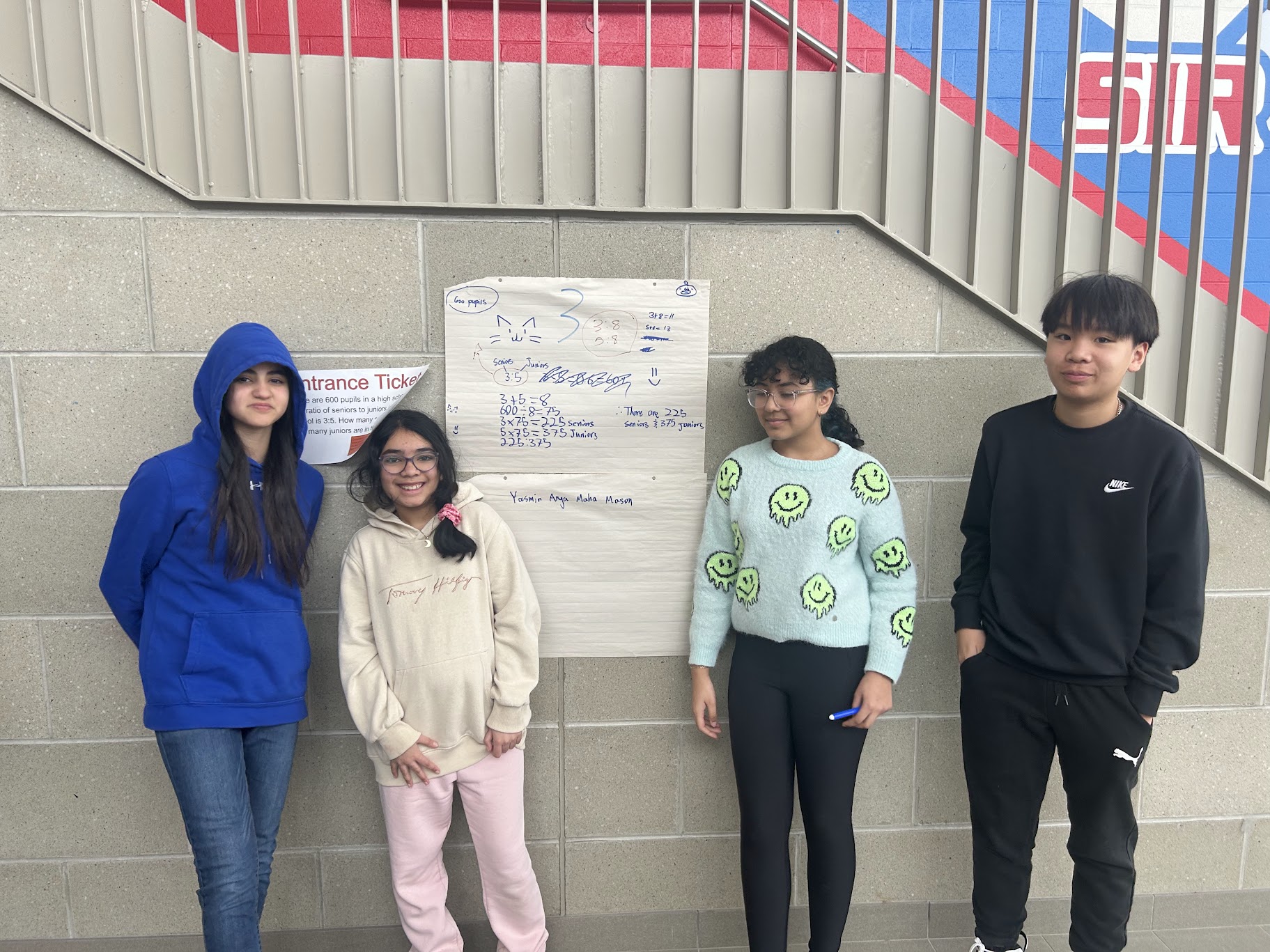
Last week, my Grade 7 students solved a ratio problem in the lobby of our school, using the Thinking Classroom approach. They were randomly assigned to one of seven groups of four, and chart paper was displayed so they could write down their progress for their fellow classmates and passersby to see.
Four Grade 7 students show off their calculations.
According to Liljedahl's research, frequent visible randomization is essential for success using the Thinking Classroom approach. He says:
“Whether we grouped students strategically or we let students form their own groups, we found that 80% of students entered these groups with the mindset that, within this group, their job is not to think. However, when we frequently formed visibly random groups, within six weeks, 100% of students entered their groups with the mindset that they were not only going to think, but that they were going to contribute."
As one might imagine, students are not always thrilled with their assigned group -- particularly if their close friends are placed in another team. However, to their credit they willingly participate and, to assuage their groans of frustration, I remind them that we rarely get a chance to pick our coworkers in life. I didn't get to pick the administrators, custodial staff or the grade partners with whom I work daily...and they didn't get to pick me. Throughout my nearly 50 years of employment I've been fortunate. Only on a few occasions have I had to work with a difficult colleague. It can be a challenging, frustrating and exhausting experience trying to forge interpersonal relationships in the workplace when personalities, goals, attitudes, work ethics or interests are not aligned.
Not all co-workers have good interpersonal relationships.
Such was the case for the members of The Byrds during the recording of their fifth studio record, The Notorious Byrd Brothers, in 1967. The sessions were fraught with tension and, by the time the album was released, the quartet was reduced to a duo. The studio sessions began with founding members David Crosby (guitars, vocals) and Roger McGuinn (guitar, vocals, banjo, synthesizers). They were joined by Chris Hillman (bass, guitar, vocals) and Michael Clarke (drums), both of whom had been with them since the Byrds’ debut release, Mr. Tambourine Man, in 1965(#233 on The 500). When the Notorious album was released, co-founder Crosby and Clarke were gone.
The Byrds in 1967, (l-r) Crosby, Hillman, Clarke, McGuinn
Crosby was particularly difficult to work with, arguing with his fellow musicians over song selection. He wanted to include a controversial song he had written called Triad, which detailed the events of a
ménage à trois. The other three wanted to record Goin' Back. a composition penned by the legendary songwriting team of Gerry Goffin and Carole King. It had been a Top 10 hit for Dusty Springfield the previous year.
Cover for Goin' Back from Dusty Springfield.
Additionally, Crosby had frustrated the band members earlier in the year at the Monterey Pop Festival. He would spontaneously go on lengthy rants between songs, hectoring the audience on controversial subjects, while the rest of the band waited for him to finish. Not only did Crosby offer theories on the John F. Kennedy assassination, he also extolled the benefits of giving psychedelic drugs to "all the statesmen and politicians of the world".
Crosby, ranting to the audience, at the 1966 Monterey Pop Festival.
Despite the tension and acrimony, The Notorious Byrd Brothers album was well received by critics. Many considered it the pinnacle of the Byrds' late-’60s musical experimentation, featuring a blend of genres that included psychedelia, folk rock, country, electronic, baroque pop and jazz. The record-buying audience was less enthusiastic and it was only moderately successful commercially. It peaked at #47 on the Billboard Top LP charts in 1967.
The remaining duo of McGuinn and Hillman soldiered on, recruiting the talented Gram Parsons and Kevin Kelley to release Sweethearts Of The Rodeo in 1968. It appears at #120 on The 500 and I'll be diving into it in about a year to determine whether that foursome endangered a more harmonious working relationship than the previous ensemble. Then again, perhaps a little friction and acrimony is good for creativity. We’ll see. I doubt the
Liljedahl visible randomization strategy would have helped. Who knows? Perhaps Crosby could have enjoyed detailing his threesome on chart paper beside his political theories?

Monday, 4 October 2021

The 500 - #349 - The Black Album - Jay Z

I was inspired by a podcast called The 500 hosted by Los Angeles-based comedian Josh Adam Meyers. His goal, and mine, is to explore Rolling Stone Magazine's 2012 edition of The 500 Greatest Albums of All Time. 


Album: # 349

Album Title: The Black Album

Artist: Jay Z

Genre: Hip-Hop

Recorded: 4 U.S. Studios (New York, Detroit, Los Angeles & Miami)

Released: November, 2003

My age at release: 38

How familiar was I with it before this week: One Song

Song I am putting on my Spotify Playlist: 99 Problems

On the Ontario Report Card for elementary students (Grade 1-8), the most important section is Learning Skills and Working Habits. In Growing Success, the 2010 document that outlines the policies and practises for educators to assess, evaluate and report on student progress in Ontario schools, six specific learning skills are identified: Responsibility, Organization, Independent Work, Initiative, Self-Regulation and Collaboration.
For the past few years, I have been teaching Grade 7 students (12 to 13 year-olds). They are at the age where they can develop a deeper understanding of these learning skills and reflect on their strengths and challenges through a metacognitive lens. This involves working with them to write their own report card comments. For me, this means much less writing, but much more time discussing how best to assess each learner's triumphs and prepare strategies to improve their work habits.
Among the questions I ask are two that almost always elicit the same responses. The first is, "Which of these learning skills do you think is the most important in our class, and for life?" The second is, "Which learning skill do you think is your best?"

I don't have documented data, but venture to say that, overwhelmingly, the answer to both questions is Collaboration. The responses thrill me because employment opportunities are increasingly prioritizing teamwork. The Google Workplace Model, which fosters creativity, flexibility and collaboration, is being adopted by companies in greater numbers. This is particularly true in the tech-sector, where many jobs can now be found.
I thought a lot about collaboration as I listened to this week's record, The Black Album by Jay Z. It is the eighth studio record by the rapper, songwriter, record executive and entrepreneur who is widely regarded as one of the most influential hip-hop artists in history. 
Jay Z with his wife  Beyoncé
The Black Album features almost 50 collaborators, including many big names from the world of entertainment, such as: Kanye West, Eminem, Cedric The Entertainer, John Legend, Timbaland, Rick Rubin and Pharrell Williams. Additionally, samples have been borrowed from multiple artists, including: Bill Haley and The Comets, Madonna, Wilson Pickett and Billy Squier. Rather than relying on a single producer, Jay Z recruited ten individuals or production teams. He even co-produced the song Threat alongside Patrick Denard Douthit, better known by his hip-hop pseudonym, 9th Wonder. 
Hip Hop Producer 9th Wonder
There was a time when I didn't recognize the importance of the spirit of collaboration in the hip-hop recording community. I grew up as a fan of music that was written, performed and sometimes even produced by the members of the bands I loved. My favourite group growing up, Rush, comprised a trio that wrote and performed all of the music. For nine of their first ten records, they employed Terry Brown as their sole producer. 
Rush with producer Terry Brown (third from left)
In 2015, fans of performer Beyoncé (who call themselves The Beehive), were outraged when the singer's fifth record, Beyoncé, failed to win the Grammy Award for Album of The Year. The honour was, instead, awarded to the record Morning Phase by Beck. Fans of Beck were quick to post the following graphic to social media threads, suggesting that the Beck record was superior because Morning Phase had been written and produced by Beck while Beyoncé had worked with more than 20 writers and producers, including her husband Shawn "Jay Z" Carter.
Social Media graphic comparing Beck's record with Beyonce's
At the time of this controversy, I would have been on Team Beck. My mindset about record production prioritized individual creativity above collaboration. However, as my appreciation of the hip-hop genre has increased, mainly because of The 500, I better understand the importance of a collaborative spirit. After all, I encourage collaboration with my students daily. Why, then, wouldn't I tout Beyoncé’s record? -- An album which on the updated 2020 list is ranked #81. Beck's Morning Phase failed to chart.  
The Black Album exhibits Jay Z's willingness to work with many artists to create a record that welcomes a variety of sounds and styles. It is, as Rolling Stone Magazine writer Joe Caramanica put it, "both old school and utterly modern. showcasing Jay Z's rapping talents at the top of their game."

My first exposure to the album came when the song 99 Problems was remixed by producer Danger Mouse for The Grey Album, a record that blended "a cappella" versions of Jay Z's raps with samples from The Beatles' 1968 self-titled record, often called The White Album -- A clever title given that elements from The Black Album blended with The White Album -- created The Grey Album.
I was hooked. The aggressive and catchy lyrics from 99 Problems brilliantly fused with the raw and raunchy signature guitar riff from the song Helter Skelter.  It's worth a listen.

I was hesitant to rhapsodize about this song for some time because of being troubled by the apparently disparaging chorus. 
"If you're having girl problems I feel bad for you son,
I've got 99 problems and a bitch ain't one."
However, I recently learned (through The 500 Podcast episode with guest Neal Brennan) that "bitches" referred to police dogs. In his 2010 autobiography, Decoded, Jay Z maintained that the lyrics referenced a 1994 incident when he was pulled over by police. He refused to allow them to search his car. The police threatened to bring in police "drug" dogs to sniff the vehicle and, potentially, give them just cause for a search. However, the dogs never arrived and the threat proved to be an empty one.
When I revisited verse two of 99 Problems, the narrative became obvious and the deeper commentary on the prevalence of racial profiling was crystal clear.
"So I pull over to the side of the road
I heard, "Son, do you know why I'm stopping you for?"
‘Cause I'm young and I'm black and my hat's real low?
Do I look like a mind reader, sir? I don't know
Am I under arrest or should I guess some more?
"Well, you was doing 55 in a 54
License and registration and step out of the car
Are you carrying a weapon on you? I know a lot of you are."

So, a tip-of-the-hat to Jay Z and Beyoncé and their comfort with collaboration, as well as the guts to relinquish control of their art in the hopes of creating something even better. Clearly, with The Black Album, this was achieved. 


Saturday, 8 July 2017

Alright, Fair Enough

Recently, I was visiting a friend when a noise erupted from the basement. His children, two young boys, had obviously reached a tipping-point in their play, and a screaming match ensued. Frustrated, he did what I have seen many adults do. He interceded, a little angrily, and the argument stopped.

I’m no stranger to this tactic. I’ve done it many times at school. Two students are in a conflict at recess and, immediately, I default to a well rehearsed proclamation - like a code in a program, randomly selecting a line of script.


“Enough!”
“Stop it!”
“Just try to get along.”
“Find someone else to play with”
“You go that way … and you go that way.”


However, I have been thinking about a line from this classic Monty Python sketch


“An argument is an intellectual process”.

Recently, I heard comedian Bill Burr discuss the topic of arguments between friends. He highlighted the power of three words that can bring two sides to a quick and amicable resolution when the exhaustion point in a quarrel is reached.


“Alright. Fair Enough.”


The intersection of these events got me thinking about curriculum and teaching - which might be the mantra of every teacher.


If it is important to learn how to argue, or debate, how can I teach my students (Grade 5 - 8) to do it?
Can I do this in an effective, fun, cross-curricular, & collaborative way?


I’ve decided to call this activity “Fair Enough”.


  • Perhaps, the Monty Python argument sketch could be used as a “Minds On”.
  • Start with a discussion about arguments. Present them as valuable. Make the connection to science, essay writing, political opinion, sports, laws, etc.
  • Allow for Student Voice. Have them Think-Pair-Share stories about arguments they have had, won and/or lost.
  • Talk about the idea of a debate as a formal, respectful exchange of ideas in front of a crowd.
  • Students find partners and choose a pair of opposing topics. I have started a list here, but students can determine their own.
  • Collaboratively (or independently), they prepare their arguments. Depending on age and ability, this could be done as simple point form notes, or as a Ignite or Lightning Talk with a Google Slideshow.
  • Practice time can be provided depending on the desired complexity.
  • Students go head-to-head in front of the class.
  • When ideas have been exhausted, the students look at each other, shrug their shoulders and say “Alright, fair enough.”
  • I’ve included a Google Slide that you can edit for your purposes.


Curriculum & Learning Skill Connections


  • The connections to Oral Language, Literacy and Drama are obvious.
  • I like the idea that we are embracing the importance of an argument as a foundation for progress in our society.
  • I think it connects well to curriculum expectations for writing structure (The five paragraph answer sandwich model).
  • I like that students who are about to argue are encouraged to collaborate to help each other solidify their points and counterpoints.
  • I like that this activity could be unplugged (scrap paper and a pencil) or plugged (Google Slides).
  • I like that there is a safe conclusion for both parties: “Alright, Fair Enough”. This is also a useful social strategy for future arguments.

Hopefully, I can share this lesson with a class next year. I’ll write about the results. If it doesn’t go well...Alright, fair enough.

Wednesday, 26 August 2015

Make A Dot...Day!

For the third year, I will be participating in Dot Day in my classroom. I will also be promoting it with my colleagues and organizing class-to-class celebrations.

For those of you unfamiliar with Dot Day, it began in 2009 when teacher Terry Shay introduced his classroom to the Peter H. Reynolds’ book "The Dot".  It is now celebrated annually on September 15th-(ish) in classes around the world. According to the Dot Day Website it was celebrated in over 100 countries by nearly 3 million people in the last year.

The Story


The story involves a patient teacher who encourages a reserved student to trust in her own abilities and “make her mark”. The student defiantly plunks a small dot on a piece of paper. Her teacher’s caring and supportive reaction ignites her confidence and gives her the courage to create and share. As the author puts it, this is a book that seeks to “Celebrate Creativity, Courage and Collaboration” or, more simply, challenges the reader to “Make your mark and see where it takes you”!

Resources

The book can be purchased here but many libraries have a copy. An interactive whiteboard version of the story can be accessed through through this link. There is also a YouTube version here and Primary/Junior classes enjoy the song "The Bouncing Dot" which is available with printable lyrics here.

Things to do

I'll admit, there is not a lot of time to get things rolling in classrooms that begin in September. This is certainly the case in Ontario classrooms which, this year, begin on September 8th. However, fear not, a Dot Day can be a simple and fun affair. Here is a list of ideas that I have considered or explored.

  • Just share the story and let the class know that it’s International Dot Day around the world.
  • Talk about 3 million people and predict how many will participate this year or in ten years.
  • Read the book and sing “The Bouncing Dot”.
  • Get out a variety of markers, pencil crayons, paints, pastels and chalk and make some dots.
  • Use Ipads to find and take a digital picture of dots around the classroom and the school.
  • Pass a fabric dot around the class. Each student imagines and pantomimes it as something else.
  • Have them go home and find 3 important dots in their home. Write about them in Edmodo.
  • Register for Dot Day and get the free educator’s handbook for more ideas.
 
My "go-to" activity has always been to create T-shirts with permanent markers (Sharpies) and eye-droppers of isopropyl alcohol. Send a note home to request white T-shirts - they do not need to be new, but should be design/logo free. Have students create designs and patterns with multi-coloured sharpies and then use eye-droppers to diffuse the ink through the fabric for a tie-dyed effect. Be sure to set up your eye-dropper stations outside to reduce the impact of fumes from the alcohol.

Be sure to share your creativity at your school or in the global community through social media.