Showing posts with label 1984. Show all posts

Sunday, 29 October 2023

The 500 - #241 - Let It Be - The Replacements

I was inspired by a podcast called The 500 hosted by Los Angeles-based comedian Josh Adam Meyers. His goal, and mine, is to explore Rolling Stone Magazine's 2012 edition of The 500 Greatest Albums of All Time. 


Album: #241
Album Title: Let It Be
Artist: The Replacements
Genre: Post Punk, Alternative Rock, College Rock
Recorded: Blackberry Way Studios, Minneapolis
Released: October, 1984
My age at release: 19
How familiar was I with it before this week: Not at all
Is it on the 2020 list? Yes, at #156, up 85 places from 241 since 2012
Song I am putting on my Spotify Playlist: I Will Dare
Let It Be album cover from The Replacements.
I knew little about the American, post-punk, rock band The Replacements until this week. Sure, I'd heard of them and knew that Paul Westerberg was their vocalist and guitarist. It was actually Westerberg who first came to my attention  in the spring of 1993 when I bought the soundtrack to the film Singles. Singles was a romantic-drama/comedy (dramedy) set in contemporary (early ‘90s) Seattle at the height of the grunge music scene -- a Generation X music phenomenon that became the dominant commercial genre in the first half of that decade.
Poster for the 1992 film Singles.
The Singles soundtrack featured Seattle-based artists from the ascendent grunge scene -- Pearl Jam, Soundgarden, Mudhoney, Screaming Trees, Mother Love Bone and Alice In Chains. However, it also contained songs from earlier Washington state artists, including May This Be Love by Jimi Hendrix and a cover of Led Zeppelin's Battle Of Evermore from The Lovemongers (a band featuring Ann and Nancy Wilson of the group Heart). In many ways, that CD was a  mix of the music I had thoroughly enjoyed for a decade, combining  the latest new sounds coming into fashion. I recorded it along with an assortment of other songs of the day. On a mixed cassette tape that "lived" in my car stereo for most of the spring of '93 -- a time when I was going through my own twenty-something, existential malaise. (Something documented in previous blog posts).
Album cover for the soundtrack to Singles.
The soundtrack contained two songs from Westerberg, his first as a solo artist after The Replacements disbanded in the summer of 1991. Those songs, Dyslexic Heart and Waiting For Somebody, won me over and, in retrospect, I am surprised I didn't dig deeper into his catalogue. Seeing him perform on Saturday Night Live (SNL) in December, 1993, (when Charlton Heston was the host) should also have kick-started my admiration for Westerberg's talent. His performances from that show were terrific and can be seen here.
Westerberg (centre) with Heston at right. Cast of SNL, including the late Chris Farley, in rear.
Westerberg's first band, The Replacements, formed in 1979 in Minneapolis, Minnesota. Initially a punk band, the group comprised Westerberg (vocals & rhythm guitar), Bob Stinson (lead guitar), his brother Tommy Stinson (bass guitar) and Chris Mars (drums).
The Replacements (l-r) T. Stinson, Westerberg, Mars, B. Stinson.
Originally called (and I love this) Dogbreath, the band technically began in 1978 when 19-year-old Bob Stinson bought his 11-year-old brother Tommy a bass guitar to keep him "off the streets". Shortly after, Bob met Mars (who first played guitar) and they began jamming songs from an eclectic mix of artists such as Ted Nugent, Aerosmith and Yes. Westerberg was working as a custodian in the office of a U.S. senator and heard the trio playing in the Stinson's garage while walking home. After a few misstarts and name changes, Westerberg joined the trio, Mars moved to drums and The Replacements were ready to hit the scene.
The Replacements (early 80s).
Let It Be was an audacious title for the band's third record -- it is, after all, the same name as the final studio record released by The Beatles (#392 on The 500). However, that cheeky choice was perfectly "on brand" for a group who approached music with a "nothing is sacred" individualistic attitude -- truly "punk rock".
Let It Be album cover by The Beatles.
There were so many tracks on this record that resonated with me -- I Will Dare, Unsatisfied and, to my delight, a cover version of Black Diamond from KISS. However, the song that struck me was Androgynous, a piano ballad penned by principal songwriter Westerberg. The song is a celebration of a romantic relationship between two gender non-conforming individuals. It expresses the hope that we are heading to a future where all people and their relationships will be accepted. Some say it was decades ahead of its time; but I am pretty sure Andy Warhol, Candy Darling, Lou Reed and The Velvet Underground would disagree, as I discussed in my May, 2022 post.
Andy Warhol and transgender actress Candy Darling.
This week, and this post, began with the recognition that "I didn't know much about The Replacements". I'll end by saying I know quite a bit now. I've read articles, watched YouTube documentaries and, most importantly, listened to Let It Be many times. I'm happy to report that I am now a fan, rectifying my lack of appreciation for the group in 1993.


Sunday, 22 October 2023

The 500 - #242 - RUN-D.M.C. (debut) - RUN-D.M.C.

I was inspired by a podcast called The 500 hosted by Los Angeles-based comedian Josh Adam Meyers. His goal, and mine, is to explore Rolling Stone Magazine's 2012 edition of The 500 Greatest Albums of All Time. 


Album: #242
Album Title: RUN-D.M.C.
Artist: RUN-D.M.C.
Genre: East Coast Hip-Hop, Rap Rock
Recorded: Green Street Recording Studio, New York City
Released: March, 1984
My age at release: 18
How familiar was I with it before this week: Not at all
Is it on the 2020 list? Yes, at #378, dropping 136 spots since 2012
Song I am putting on my Spotify Playlist: Rock Box
My family emigrated to Canada from England twice. The first time was shortly before I was born, in 1964. The second time was in the spring of 1971 just after my twin brother and sister were born. Consequently, I grew up with few relatives in Canada. I had only two second cousins, Daryl and Karen, who lived a few hundred kilometers away, initially in Bramalea, near Toronto, and then in Bobcaygeon, east of Peterborough, Ontario.
A handy "Cousin Chart".
I mentioned this because it was my cousin Daryl, who was one year older than I, who introduced me to funk and hip-hop music. When he came to visit me in London, in the summer of 1981, I was excited to share with him my record collection, including favourite progressive rock bands Rush, Genesis and Yes. He had brought his favourite cassettes, including Feel Me, by the funk band Cameo.
Feel Me by Cameo.
I was surprised to learn that all of his revered music was by black artists. In retrospect, I shouldn't have been surprised. Daryl attended a school in the Greater Toronto area that was far more multicultural than the one I went to in the white enclave of London. I often joke that my early-’80s high school experience was so white that the Portuguese kids were the only ones considered “people of colour. That isn't the case now; Saunders Secondary School (which celebrated its 50th anniversary in 2022) is one of the most multi-cultural schools in the city.
Saunders Secondary School in London, Ontario.
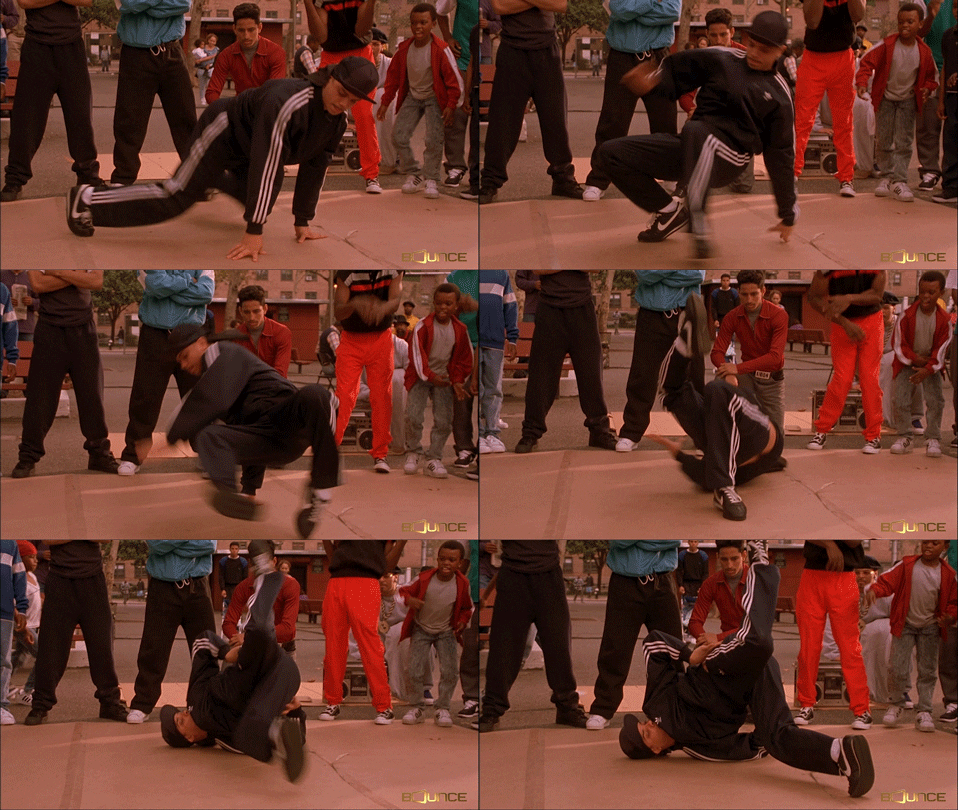
He listened to some of the records I played on my cheap, bedroom turntable. He had his driver's licence and we went for a cruise in the nearby countryside so that he could play some of his choices. As I listened to Cameo and an album by Kurtis Blow called, The Breaks, Daryl began to explain his love for break-dancing. It was the first time I had heard about the acrobatic form of street dance that had its roots in the African and Caribbean communities of New York City in the 1970s.
An example of Break Dancing.
As we drove, listened to music and talked, it became increasingly obvious to each other that we had little in common. I suspect we both realized that we would probably not be friends if it were not for our blood connection. However, the experience shaped my earliest understanding of the hip-hop genre -- one that was about to explode into the mainstream (even at my fairly monocultural high school). Among the first bands to gain a foothold was RUN-D.M.C., a group that formed in the Hollis, Queens neighbourhood of New York City.
Jason Mizell, Darryl McDaniels
& Joseph Simmons (l-r) are RUN D.M.C.
Formed in 1983, the groundbreaking trio comprised musicians Joseph Simmons (DJ Run), Jason Mizell (Jam Master Jay) and Darryl McDaniels (DMC). When they performed, Mizell worked the turntables while Simmons and McDaniels performed their raps on the microphone. The influential group pioneered the relationship between the disc jockey (DJ) and the mike controllers (MCs). They were massively successful, becoming the first hip-hop group to have a gold record (their self-titled debut) and a platinum record (Raising Hell, released in 1986 and #123 on The 500). They were also the first hip-hop act to have a video air on MTV, appear on American Bandstand and make the cover of Rolling Stone magazine (December, 1986).
It wasn't until their 1986 release, Raising Hell, that I became familiar with the group. I will share that story when we get to that record in about two years. That said, I thoroughly enjoyed listening to their debut album for this blog. I was surprised by their piece, Rock Box, which blends hard rock and hip-hop, and a blistering guitar solo from studio musician Eddie Martinez. This was the first of several Rap-Rock songs released by the group and paved the way for many other artists in the late ‘80s, including one of my favourite groups, Rage Against The Machine.
Raising Hell - the 1986 platinum released from RUN-D.M.C.
I was also surprised by the lyrics on the RUN-D.M.C.debut album. I had pigeon-holed a lot of early rap as being excessively self-aggrandizing. Much of the mainstream rap I heard in the ‘80s focused on the rapper's skills and the lyrics seemed full of boastful statements about the singer's financial status or success with the fairer sex. Sure, there is some of that on RUN-D.M.C.'s debut, but the record also addresses poverty (Hard Times) and positive relationships (30 Days). The song Wake Up recounts a dream about a utopian world, free of hate, war, violence, homelessness and greed. It was written to address the tensions created during the Cold War between the United States and the Soviet Union when the threat of nuclear annihilation was palpable.
The back cover of the debut record by RUN-D.M.C.
including the track listing.
After that summer afternoon with Daryl, I saw him only once more -- the next summer when my family rented a cottage near Bobcaygeon where he was then living. I haven't spoken with him in more than 30 years. Our lives simply grew in different directions. It would be interesting to reunite and talk about where our love of music took us through our 20s, 30s, 40s and 50s. I wonder if he still likes Cameo? I do now.


Monday, 1 November 2021

The 500 - #345 - Stop Making Sense - Talking Heads

I was inspired by a podcast called The 500 hosted by Los Angeles-based comedian Josh Adam Meyers. His goal, and mine, is to explore Rolling Stone Magazine's 2012 edition of The 500 Greatest Albums of All Time. 


Album: # 345

Album Title: Stop Making Sense

Artist: Talking Heads

Genre: New Wave, Post Punk

Recorded: Pantages Theatre, Los Angeles (Live)

Released: September, 1984

My age at release: 19, my guest blogger was 17

How familiar was I with it before this week: Very

Song I am putting on my Spotify Playlist: Once In A Lifetime

This week, we welcome back guest blogger Steve “Lumpy” Sullivan. “Lump”, as he is known to friends, previously wrote about album #417, Boy, by U2 in the summer of 2020.  He’s been a close friend for nearly 30 years. We met when he hired me as a bartender at Kelsey’s Restaurant in London, Ontario, in 1993. For the past 12 years he has  worked  at the Frobisher Inn  in Iqaluit,  but plans to leave the Arctic for semi-retirement in the Philippines with his wife, Mae. Enjoy his take on a record that we both adore.


Stop Making Sense is the title for both the soundtrack and the 1984 film by experimental New Wave/Post Punk American band, Talking Heads. The film was directed by future Academy award-winning director Jonathan Demme (Silence Of The Lambs, Philadelphia). The filming was completed during four live performances at the Pantages Theatre in Hollywood, California, in December, 1983.
Director Jonathan Demme
The concert video was released commercially in October, 1984, about a month after the soundtrack hit record shelves. The film is considered by many, including well-known critic Leonard Maltin, to be one of the best concert films of all time. The band performed 19 songs throughout the live performances. Sixteen tracks made it to the original film and nine appeared on the release of the record that is listed on The 500. In 1999, the film and soundtrack were released as a Special Edition version, containing most of the missing tracks.
I was in Grade 11 in 1984 at the time and a HUGE fan of Talking Heads, as was my friend, Gavin Granger. When the film hit theatres we lined up for the midnight showing at the Hyland Theatre in our hometown of London, Ontario. We were so excited and the performance did not disappoint.
London's Hyland Theatre - operating for more than 50 years
Unbeknownst to me at the time, this was the first concert film made using digital audio techniques, a burgeoning technology in the early 80s. The Talking Heads were always ahead of the curve. They were a collection of four artistic people collaborating as a group: David Byrne (lead vocals and guitar), Tina Weymouth (bass), Chris Frantz (drums) and Jerry Harrison (Keyboards). Marc covered their formation and history in his February, 2021 post -- Album #383, More Songs About Buildings And Food.
Talking Heads - 1980 (l-r) Frantz, Weymouth, Byrne & Harrison
The album spent two years on the Billboard 200 chart. The track listing reads like a greatest hits package. It’s tough to think about the album without reflecting on the visuals in the film for which it is the soundtrack. The live show opens with Byrne walking on-stage with an acoustic guitar and a “boom box”. He performs an acoustic version of Psycho Killer from their debut album, Talking Heads ‘77 (coming up at #291). The boom box appears to be playing an electronic drum track to accompany Byrne, but it was actually a Roland TR808 Drum Machine cued at the soundboard.
Byrne in Stop Making Sense, performing Psycho Killer to open the show
With each subsequent track, another band member appears on stage to perform alongside Byrne, as stage crew slide set-pieces and instruments into place. Eventually, a nine-piece group, including the four original members, are on stage. The nine comprise a larger, theatrical company of musicians. Renowned percussionist Steve Scales, for example, joins the group to help deliver the infectiously funky rhythms on Burning Down the House from Talking Heads’ 1983 record, Speaking In Tongues.
Percussionist Steve Scales (2017)
For me, there are several highlights in this performance. The first occurs when the band plays What a Day That Was from David Byrne’s solo album, The Catherine Wheel. The other was the inclusion of Genius of Love by the Tom Tom Club, which was a side product for members Frantz and Weymouth, who are also husband and wife. Unfortunately, the second track did not make the original soundtrack release, but was included in the Special Edition version.
The added musicians: Scales on percussion, Bernie Worrell on keyboards, Alex Weir on guitar, Ednah Holt and Lynn Mabry for backing vocals, added layers to each song on the album. The album is listed as ‘new wave’ and ‘post punk’, but there is a lot more going on. There are elements of dance, funk and Afro-beat world music. Songs that were brilliant on their original albums were much more layered and richer in sound when performed live with additional musicians.
My favourite track on the album, and the one I am picking for Marc’s Spotify Playlist, is Once in a Lifetime. This incredible concert movie is stored on my iPhone and I watch or listen to it often, remembering that early-winter night in 1984 standing in line with Gavin for a midnight showing.

Wednesday, 15 July 2020

The 500 - #413 - Minutemen - Double Nickels On The Dime

I was inspired by a podcast called The 500 hosted by Los Angeles-based comedian Josh Adam Meyers. His goal, and mine, is to explore Rolling Stone's 2012 edition of The 500 Greatest Albums of All Time. 

Album # 414

Album Title: Double Nickels On The Dime
Artist: Minutemen
Genre: Alternative Rock, Post Punk, Hardcore Punk
Recorded: Radio Tokyo Studios, Venice, California
Released: July, 1984
My age at release: 13
How familiar was I with it before this week: 1 song
Song I am putting on my Spotify Mix: History Lesson Part II

For help with this week's blog, I reached out to my chum Claudio Sossi. Claudio and I share a love of music, Pro-Wrestling and the comedy stylings of our mutual friend Oscar Macedo. I knew that Claudio was well versed in the US hardcore punk scene...so I suggested this album to him. I was thrilled when he agreed. I spent the last week listening to it and I can understand his passion. This is a great record and not at all what I was expecting. Imagine my surprise when I suddenly heard the signature guitar lick from the infamous Jackass television program blasting through my speakers. I am sure you will enjoy Claudio's connection with this band's eclectic sound.


I hope everyone has been enjoying Marc's 500 album project as much as I have! I was honoured to be asked to make a contribution and hope I'm worthy of the standard Marc's set here.

In the late 70s through to the early 80s, there wasn't anything to distinguish your musical tastes as "different" quite like embracing what was happening in the American hardcore punk scene. If you happened to find like-minded individuals, it made for a making great new friends. It also had the ability to clear a room in record time with the "classic rock set". 

I mean, it was Anti-Everything...yes? Certainly many of the trappings embraced by the world of classic rock.

Anti-progressive rock, anti-guitar solos, anti-drum solos, anti-self indulgence, anti-lyrics inspired by The Hobbit, anti-15 minute opuses.

Few bands captured that short, sharp burst of inspiration like Minutemen - a trio from San Pedro that blended punk with funk, jazz and poetry. They had a "lead" bass player in Mike Watt jamming along to the more rhythmic, treble-heavy style of guitarist D. Boon punctuated by drummer George Hurley's hyperactive rat-a-tat-tat. It was a working man's punk rock that said what it had to say -- typically in under two minutes.
Minutemen in 1982 (Left to Right) Watt, Boone Hurley

Which makes one wonder: What was with the decision, in 1984, to go where only classic rock (and jazz) dared to tread?  You know...that bloated beast called..."The Double Album!"

Credit must go to Husker Du and their two-LP Zen Arcade for coming up with the notion first. Although released simultaneously with Double Nickels On The Dime, it was the Minutemen hearing Zen Arcade in advance, through their kinship with SST Records, that gave them the noton to expand their already-recorded single disc into a double. 
Zen Arcade by Husker Du (1984)

But, come on man! What are we talking about here? That would be like 40 songs, right? 

Nope. 45!

I was obsessed with the record, buying it just before moving to London, Ontario. Each band member curated a side (the fourth, called "Side Chaff", were the leftovers after the band made their choices). Each side began with a car engine starting up and pals, such as Henry Rollins (Black Flag) and Jack Brewer (Saccharine Trust) popped in with a few lyrics. The band even chose to include a few cover songs. It was easy to read a comical irony in their 40-second burst on Van Halen's Ain't Talking 'bout Love, but...was that a reverential take on Steely Dan's Dr. Wu? It suited me fine -- a love for Steely Dan, an American jazz-fusion and soft rock band of the 70s, was one of my dirty little secrets as I tried to pass for a "punk rock guy".

There was also a camaraderie implied by this sequencing. Taking a page from Pink Floyd's 1969 record, Ummagumma, each band member was allocated a side of the record. Additionally, the car engine heard at the start of each side belonged to that member, Side D, Side Mike and Side George, respectively. This was a huge part of the album's appeal for me, it felt like a shared car ride. Singing about themselves on songs like Take 5, D. One Reporter's Opinion, and the sentimental History Lesson - Part II, made you feel that you were part of the gang, a Minuteman. 

With D. Boon, songs like VietNam and This Ain't No Picnic, you could get mad together at all the right things to get mad about. And, it was just fun to sing along with wordsmith Watt's songs like The Big Foist before delving into the more personal, Do You Want New Wave Or Do You Want The Truth. 

So many of my nights ended with the headphones on, listening to Double Nickels On The Dime. It rarely strays far from my stereo, making it a great way to remember the larger-than-life D. Boon, who died tragically in a car accident in 1985, just a few days before Christmas. A big loss. Sigh.

Double Nickels On The Dime is a spectacular ride -- and every listen makes me feel like I chipped in for gas.

Guest Blogger Claudio with his editing assistant.