Showing posts with label 1994. Show all posts

Monday, 17 November 2025

The 500 - #134 - Ready To Die - The Notorious B.I.G.

I was inspired by a podcast called The 500 hosted by New York-based comedian Josh Adam Meyers. His goal, and mine, is to explore Rolling Stone Magazine's 2012 edition of The 500 Greatest Albums of All Time.


Album: #134
Album Title: Ready To Die
Artist: The Notorious B.I.G.
Genre: East Coast Hip Hop
Recorded: The Hit Factory and D&D Studios, New York, New York.
Released: September, 1994
My age at release: 29
How familiar was I with it before this week: One song
Is it on the 2020 list? Yes, at position #22, rising 112 spots
Song I am putting on my Spotify Playlist: Big Poppa

Few things in hip hop engage me more than razor-sharp wordplay, intricate multi-syllabic rhymes, and storytelling that feels cinematic. Add in lyrics that carry political or social weight, and you’ve got my full attention.

If you’ve been following this series, you know I celebrated Eric B. & Rakim’s ability to rhyme across the bar line in my January, 2024, post on Paid in Full (#228 on The 500) and Eminem’s linguistic acrobatics in October, 2023, when I explored The Marshall Mathers LP (#244). I’ve also unpacked the groundbreaking social commentary in Public Enemy’s Fear of a Black Planet (#302); Illmatic (#402) from Nas or the raw bullhorn of protest found in N.W.A.’s Straight Outta Compton (#144). Meanwhile, I've also become a fan of clever sampling, especially the work of Erick Sermon and Parrish Smith on their first release, Strictly Business (#453).

Album covers for records mentioned above.
When it comes to pure smoothness, few can rival the late Christopher George Latore Wallace, better known as Biggie Smalls, The Notorious B.I.G., or simply Biggie. He delivers all of that and more. His verses aren’t just lyrics; they’re vivid narratives woven into rhythm, making Ready to Die a masterclass in clever, seemingly effortless rap. Biggie’s command of internal rhyme and multi-syllabic wordplay is matched by his breath control and rich vocal tone, allowing him to glide through complex lines with ease. Layer in his knack for striking imagery and streetwise slang, and the result is music that flows with smooth confidence.

Biggie’s work has only grown in stature over time. As noted earlier, Ready to Die jumped more than 100 spots in Rolling Stone Magazine's 2020 update of 2012’s The 500 Greatest Albums of All Time, landing in the Top 25. That said, not every track has aged gracefully. Some songs reveal the raw edges of Biggie’s youth...he was just 21 when he wrote them. The 14th track, Friend of Mine, leans heavily on crude humor and explicit sexual detail, tarnishing his lyrical brilliance. Respect, the album’s 13th cut, brims with sexual bravado, ego-driven bluster, and violent imagery, relying more on shock value than the sophistication Biggie displays elsewhere. And then there’s the awkwardly titled Me and My Bitch, intended as a love song but now jarring and undeniably misogynistic by today’s standards.

Biggie with his wife Faith Evans. It is unconfirmed if she
was the inspiration for his love song Me And My Bitch, but 
the timelines match-up. They married in August, 1994.
The Notorious B.I.G. released only two studio albums before his life was tragically cut short in a drive-by shooting in Los Angeles on March 8, 1997. Both records earned spots on Rolling Stone’s 2012 and 2020 editions of The 500 Greatest Albums of All Time. I’ll keep revisiting Biggie’s catalog, but I suspect my go-to will be the 2007 Greatest Hits compilation, released on the tenth anniversary of his death. It pulls together standout tracks from both studio albums, along with select posthumous material, that offer a powerful snapshot of his legacy in one collection while side-stepping some of his less mature tracks.


Sunday, 4 August 2024

The 500 - #201 - The Downward Spiral - Nine Inch Nails

I was inspired by a podcast called The 500 hosted by Los Angeles-based comedian Josh Adam Meyers. His goal, and mine, is to explore Rolling Stone Magazine's 2012 edition of The 500 Greatest Albums of All Time. 


Album: #201
Album Title: The Downward Spiral
Artist: Nine Inch Nails 
Genre: Industrial Rock, Industrial Metal
Recorded: Three Studios, Los Angeles, U.S.A.
Released: March, 1994
My age at release: 28
How familiar was I with it before this week: Fairly
Is it on the 2020 list? Yes, at #122, moving up 79 spots
Song I am putting on my Spotify Playlist: Piggy
Album cover for The Downward Spiral from Nine Inch Nails.
It was a line cook named Jeff Nisbet who first pushed a cassette copy of The Downward Spiral into my hands following a busy dinner shift at a London, Ontario, restaurant in the spring of 1994.

"You gotta hear this! It is incredible," he exclaimed.

Granted, he said that about a lot of music. Jeff was prone to superlatives when it came to his love of music and hockey. The two of us had bonded quickly around those two topics when I was first hired at the restaurant six months earlier. That, and the fact that he was, like me, born in St. Catharines, Ontario. Well, technically, he was from Thorold, -- a village that was incorporated into the Greater Niagara Region, including St. Catharines. Jeff was quite proud of being a classmate and friend of Thorold's best known citizen, Owen Nolan, who was drafted first overall into the 1990 National Hockey League by the Quebec Nordiques. Jeff proudly wore a Nolan Nordique jersey when we played pick-up hockey three times a week.

The only pictures I have of Jeff were scanned from
an old photo album -- notice his Nordiques jersey 
playing pick-up hockey.
I took the Nine Inch Nails cassette home and played it in the basement stereo of the townhouse I shared with two high school chums. I wasn't sure what I was hearing. I can't say I didn't like it. There were elements of hard rock that I appreciated; but there was something darker, grittier and more sinister about the sound. Of course, I'd heard about industrial music and could name a few bands that played the style, although I was less than enthusiastic about it. This record, the second from Nine Inch Nails, was essentially my initiation into the genre.
Industrial music was defined by the AllMusic database and website as "the most abrasive and aggressive fusion of rock and electronic music." It is a genre  that draws on, as the name suggests, harsh, mechanical and industrial sounds, blending them with avant garde experimental electronic noise. The pioneers of this provocative and transgressive cacophony was  the British group Throbbing Gristle, which coined the term along with the release of its first full-length record, The Second Annual Report, in 1977.
The Second Annual Report album cover from Throbbing Gristle
Although influential, Throbbing Gristle and other bands inspired by the industrial movement appealed to a niche audience and, unsurprisingly, their jarring, unconventional work did not enjoy mainstream success. However, that changed in the early 1990s with the hybrid genre of industrial metal and the emergence of bands that included Ministry, Rammstein, Marilyn Manson, Rob Zombie and Nine Inch Nails. Each had platinum-selling discs.
A collage of band logs from successful industrial metal bands of the 90s.
The Downward Spiral from Nine Inch Nails (often abbreviated to NIN, with the second N stylistically reversed) was by far the most successful record of its type. It was certified 3x platinum in Canada (300,000 units sold) and 4x platinum in the United States (four million sold).
The Downward Spiral was a concept record, detailing the protagonist's self-destructive plummet from misanthropic despair to suicidal ideation. The concept of a "downward spiral" was, prior to the album's release, an established clinical phenomenon in psychotherapy. It occurs when "negative emotions narrow one's attention and cognitive understanding of life's circumstances. This, in turn, initiates a spiral of emotional and physical changes which alter an individual's perception of their reality."
In a way, the “spiral” is an example of perpetual self-fulfilling prophecy. An individual loses his job and is unable to provide for his family. Understandably, he feels useless and inadequate. These feelings impact his ability to sleep, eat and socialize, consequently impacting his ability to secure gainful employment. Pushed deeper into depression, he begins to withdraw from friends and family. The cycle can persist without professional intervention and suicide is possible.

Suicide is a permanent solution to a temporary problem. If you experience such feelings,

contact a professional (Dial or Text 9-8-8).

I'm not sure why the ‘90s featured so many depressing and tragic themes in pop culture. Industrial metal was only one form of entertainment rife with themes of nihilism, angst and hostile social critique. It was a time of grunge music and the ironic thrift store "anti-fashion" mentality that was spawned. Even the most popular movies were bummers as they tackled grim disaster themes (Titanic, Twister); the holocaust (Life Is Beautiful, Schindler's List); mental breakdowns (The Fisher King, Girl Interrupted, Fight Club); social lassitude (Slackers, Clerks); and crazed serial murders (Kalifornia, Natural Born Killers). Regardless, I watched every flick -- sometimes more than once.
The soundtrack to Natural Born Killers featured the song Burn from
Nine Inch Nails.
I suspect there were many factors – political, economic, technological and cultural –that contributed to the general sense of disillusionment that many people felt toward mainstream institutions as the millennium drew to a close. I'm sure sociologists have examined the causes far better than I could here. However, I admit getting caught up in that general malaise. Perhaps it was  a byproduct of transitioning through my late-twenties into my early thirties.

Me aged 29 in the summer of 1994 , at a road hockey tournament

in Victoria Park, London, Ontario.

When I think back on who I was at that time, it feels less like nostalgia and more like imagination. I'm really not sure who that guy was -- the one who worked in a bar, lived with roommates and borrowed industrial metal cassette tapes from kitchen chums. Relistening to The Downward Spiral certainly brought back a few emotions, fortunately, they were a mix, and some were even jovial -- particularly remembering Jeff Nisbet and his unabashed enthusiasm for music and hockey.


Sunday, 19 May 2024

The 500 - #212 - Crooked Rain, Crooked Rain - Pavement

I was inspired by a podcast called The 500 hosted by Los Angeles-based comedian Josh Adam Meyers. His goal, and mine, is to explore Rolling Stone Magazine's 2012 edition of The 500 Greatest Albums of All Time. 


Album: #212
Album Title: Crooked Rain, Crooked Rain
Artist: Pavement
Genre: Indie Rock, Alt-Rock
Recorded: Random Falls Studio, New York & Louder Than You Think Studio, California
Released: February, 1994
My age at release: 28
How familiar was I with it before this week: Not at all
Is it on the 2020 list? Yes, at #434, dropping 222 spots
Song I am putting on my Spotify Playlist: Range Life

This week, I am excited to welcome a new guest blogger. Although I have never met T.J. Gillespie in person, we have connected over a shared love of music and The 500 podcast. T.J. is a regular reader of my blog and is always kind enough to respond on social media  -- often quoting his favourite line from my weekly post. He lives in Abington, Pennsylvania, a short drive north of Philadelphia. He is a high school English teacher, has two daughters (Lucy and Elizabeth), a cat and a rabbit. When I saw the Pavement record coming up on the 500 list, I remembered seeing T.J.'s post about attending their concert during their 2022 tour. As I was unfamiliar with the band, I reached out to see if he was willing to "pinch hit" for me. A day later, the following, wonderful essay arrived in my email. I am sure you will enjoy it as much as I did.

Guest blogger T.J. Gillespie in his Pavement T-shirt.
The sound of the 1990s, as is commonly reduced, started with the Big Bang of Smells Like Teen Spirit and ended in the nu-metal mayhem of Woodstock ‘99. In between, the decade seemed to move from one genre to another: grunge to Britpop to industrial to ska, with some weird swerves into electronica, trip hop, and even a swing music revival. What is unusual, looking back, is how we used one catch-all word to try to describe these disparate sounds: Alternative. I am not sure what the sounds of the Rage Against the Machine, The Cranberries, and Beck have in common except that they’d all appear on my local Alternative Radio (WDRE in Philadelphia and WHFS when I was in college in Baltimore). Originally, it was a designation to indicate artists that were alternative to the mainstream. Weezer and Tori Amos certainly seemed different from Celine Dion and Garth Brooks, but by the middle of the decade when Alanis Morrisette was selling millions of albums, the alternative was the mainstream.

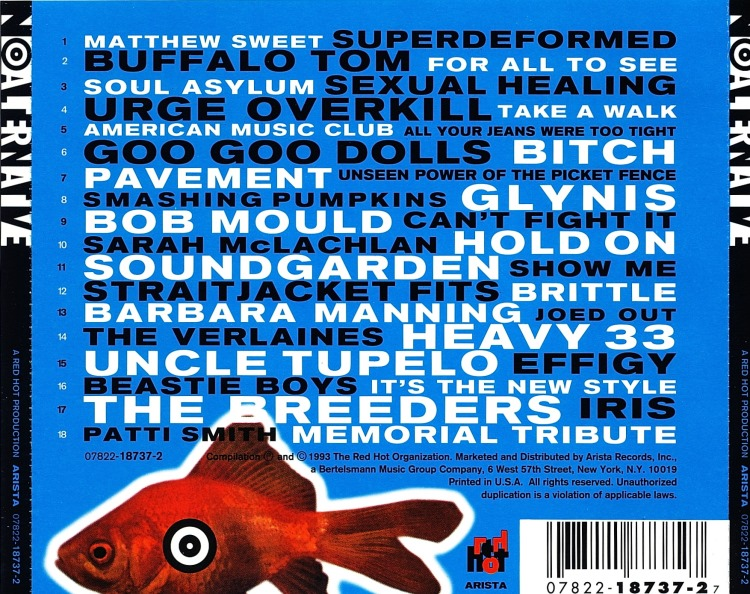
It was in the fall of 1993 as a music loving college freshman that I picked up a copy of a charity compilation CD called No Alternative, whose title alluded to both the bands included (Matthew Sweet, Soundgarden, Soul Asylum and a hidden track by Nirvana) and also the album’s mission: there’s no alternative to fighting AIDS. The record stands as a nice time capsule of mid-nineties trends. There are some ironic covers, some sincere ones too, a live recording, some grungy guitars, and a couple of acts forgotten by time (Straitjacket Fits, anyone?). But to my ears there were two songs that seemed to stand out because they didn’t feel of the time. They weren’t following trends because they were steadfastly doing their own thing. They fit under the “alternative umbrella,” but they also felt alternative to the alternative. They were Smashing Pumpkins, who I knew well, and a mysterious band who sang a song about R.E.M and the U.S. Civil War titled Unseen Power of the Picket Fence. They were called Pavement.


These two bands occupied two different places in modern rock. Smashing Pumpkins were on the Singles soundtrack, but they were an anomaly. They weren’t from Seattle, they didn’t play grunge, their influences were prog rock and not punk. Combining shoegaze guitar with a polished poppier sound reminiscent of arena rockers Boston, the Pumpkins played covers of Fleetwood Mac (at the nadir of their popularity) and featured virtuosic ‘70s-style solos. They weren’t ironic; they were sincere. They weren’t cheeky or arch or winking at the audience. They didn’t hide their ambitions. In other words, they were the diametric opposite of Pavement. Formed in Stockton, California, in 1989, Pavement combined the jangly guitars of early R.E.M. with the brash experimental noise of Sonic Youth. An album might have a beautiful melodic line buried in a jarring squall of feedback. After their release of their debut album Slanted and Enchanted in 1992, Pavement would become the embodiment of slacker rock; they were five guys making messy compositions seemingly without ever really trying. They had a singer known only as “SM” and a guitarist who called himself Spiral Stairs and they didn’t release any band photographs. Meanwhile Smashing Pumpkins, or more specifically lead singer, songwriter, and multi-instrumentalist Billy Corgan, was laboring as pop music’s most monomaniacal control-freak. Who but Corgan would have cello, violin, timpani, and bells(!) on a single, as he did on Disarm?
In 1993, No Alternative juxtaposed these two approaches back to back, on tracks six and seven. In 1994, Pavement would release their sophomore album, Crooked Rain, Crooked Rain, and create a kind of explicit rivalry with their song Range Life. In it Steven Malkmus, the sardonic leader, sings, 
“Out on tour with the Smashing Pumpkins/ Nature kids / They don’t have no function / I don’t understand what they mean /And I could really give a f---.” 
 Like a lot of Pavement lyrics, there is a kind of offhanded throw-away quality. There’s something barbed there, something funny, but also something inscrutable and nonsensical. But for Billy Corgan, the barb stung. The song allegedly irked Corgan so much at the time that he had Pavement removed from the Lollapalooza 1994 lineup that the Pumpkins were headlining. (I saw that show at Philadelphia’s FDR park and was so blown away by the Beastie Boys that I didn’t miss anyone else). In a world before social media, this low stakes beef barely registered in the wider cultural consciousness, but for record store obsessives and rock geeks a simmering feud was born.
In terms of sales, Grammys, name recognition, MTV presence, t-shirt sales, and any other measure of popularity and cultural imprint, Billy Corgan won the war. Smashing Pumpkins sold 30 million records in the nineties, while Crooked Rain, Pavement’s most successful album, sold 237,000. But in another sense, he lost. It’s not just because we tend to root for the underdog (Pavement remained signed to independent labels throughout their career, including Flying Nun and Matador) or because we value “coolness” over hot-headed hubris, but because Corgan committed the cardinal sin of taking everything so seriously. The line nettled him and he let it be known that it bugged him. The lyric itself is a goof. What does it even mean? It’s a joke line from a much smaller band that could have been laughed off or ignored. The rock critic Steven Hyden covered the aftermath in his 2016 book on intra-band squabbles, Your Favorite Band is Killing Me, writing, “Malkmus seemed less perturbed by the supposed beef, telling NY Rock magazine in 1999, ‘I only laughed about the band name, because it does sound kind of silly. . . . I like their songs — well, most of their songs, anyway. . . . I just dissed their status.’” But for Billy Corgan, for whatever reason, “Nature kids” was personal.

The problem with reducing CR,CR to a silly rivalry is that it turns art into a tabloid narrative and takes attention away from the songs themselves. The album is on Rolling Stone Magazine’s 500 Greatest Albums list not because of a single snarky joke, but because of its DIY-style recording, because of its influence on a generation of guitar based bands, and, most of all, because of the songs themselves. There’s the radio friendly almost-hit Cut Your Hair with its catchy ooh-ooh-oohs, the almost Grateful Dead-like jams on Stop Breathin the garage rock fury of Unfair, the weirdo-jazz of 5-4=Unity and all kinds of strange experimentations which all go to show that while the band may have had the reputation of slackers making messy cacophonous songs, they were ambitious in scope and sincere in their attempts to develop sonically. Gold Soundz is as catchy and melodic as anything else on nineties radio. It would fit in perfectly next to 1979 or Today for example.

Nobody cares about selling out in 2024. Alternative died out long ago. “Indie” is more of an aesthetic, a subgenre, than it is a lifestyle, a set of rules, or a designation of record label affiliation. Nobody is making you choose between tribes. Darling, you can cut your hair. You can even shave your head. Maybe this is the lasting legacy of the alternative rock era: You don’t have to be just one thing. Slackers and perfectionists can coexist, like tracks on compilation CDs, like songs on the radio.

Sunday, 22 January 2023

The 500 - #281 - My Life - Mary J Blige

I was inspired by a podcast called The 500 hosted by Los Angeles-based comedian Josh Adam Meyers. His goal, and mine, is to explore Rolling Stone Magazine's 2012 edition of The 500 Greatest Albums of All Time. 


Album: #281

Album Title: My Life

Artist: Mary J. Blige

Genre: R&B, Hip-Hop, Soul

Recorded: Five New York Studios

Released: November, 1994

My age at release: 29

How familiar was I with it before this week: Not At All

Is it on the 2020 list? Yes, at #126, moving up 155 places from the 2012 list

Song I am putting on my Spotify Playlist: You Bring Me Joy

The Sophomore Jinx, sometimes called the Sophomore Slump, is a term typically associated with professional sports. In that context, it refers to athletes who have a superb rookie season and then fail to meet the same lofty expectations in their second campaign. Consider the example of Finnish ice hockey player Teemu Selanne, who set the NHL record for goals scored by a rookie in 1993 when he potted a league-leading 76. The following season he scored only 25. Granted, he finished his 21-season, Hall of Fame career with 684 tallies -- enough for 12th all-time in NHL history – so the slump was an anomaly.

Teemu Selanne in his rookie season

The term also applies to university students who, after having a successful first year, face significant challenges with the second year of their program, with plummeting grades and, often, a change to their course trajectory. I am familiar with this phenomenon. I did quite well in my first year and, in 1988, I was excited to pursue a degree in Psychology. My second year was abysmal as the challenges in the required mathematics courses ramped up. By third year, I had switched my studies to English and History, which played to my strengths.

In a 2020 interview, singer, songwriter and actress Mary J. Blige admitted that she was worried about a Sophomore Slump when she returned to the studio to record her second album. Her first record, What's The 411?, had been a critical and commercial success in 1992.

It reached number one on the R&B/Hip-Hop chart and number six on the Billboard Top 200. The album's five singles were so well received that a second album, featuring remixes of the most popular tracks, was released in 1993.

Blige's debut record fell into a genre of pop music called "new jack swing", a style best described as a fusion of hip-hop, dance-pop and classic rhythm and blues. Coined in 1987, new jack swing often used sampled beats or electronic drum machines as the foundation for a light melody line and clearly enunciated vocals.
When Blige entered the studio in the winter of 1993, she had more than a sophomore slump on her mind. She was battling clinical depression as well as alcohol and drug dependency while navigating an abusive relationship with singer K-Ci Haley. Blige had also decided to make two significant changes to her sound. She moved away from the new jack swing sound that had made her a star and began writing lyrics that were introspective and deeply personal. 
K-Ci and Blige (1992)

Her risks paid off and 1994’s My Life was a massive commercial success. It spent eight weeks at the number one spot on the Hip-Hop/R&B Albums chart and was certified triple platinum (three million copies sold) within its first year. It was also well received by critics. Not only is it on Rolling Stone magazine's 500 list, it made similar lists published by Time, Blender, Entertainment Weekly and Vibe.

Blige has earned the monikers, "The Queen of Hip-Hop Soul" and "The Queen of R&B". She has won an Emmy, nine Grammys, four American Music Awards, and 12 Billboard Music Awards, including the Icon honours. She was nominated for two Academy Awards in 2017 for the historical drama Mudbound and the film's original song, Mighty River. It was the first time a performer has been nominated for acting and songwriting in the same year.

With 15 successful studio albums under her belt, Blige's star continues to rise. Her jaw-dropping performance at last year's Super Bowl made it clear that the 52-year-old singer has plenty left in the tank and her earlier concerns about a Sophomore Slump were unwarranted. However, sometimes a little apprehension and uncertainty can fuel great work.


Monday, 19 September 2022

The 500 - #299 - Debut (Blue Album) - Weezer

I was inspired by a podcast called The 500 hosted by Los Angeles-based comedian Josh Adam Meyers. His goal, and mine, is to explore Rolling Stone Magazine's 2012 edition of The 500 Greatest Albums of All Time. 


Album: #299

Album Title: Self-Titled Debut (Blue Album)

Artist: Weezer

Genre: Alternative Rock, Power Pop, Pop Punk

Recorded: Electric Lady Studios, New York, USA

Released: May, 1994

My age at release: 28

How familiar was I with it before this week: Familiar

Is it on the 2020 list? Yes, at 294 (Moving up 5 spots)

Song I am putting on my Spotify Playlist: Say It Ain't So

If you entered Unit 3 of the Ogoki Townhouse Complex on Bearskin Lake Road at Lakehead University during the winter of 1995/96, you would likely have been greeted by two things: Shaft, our adopted residence dog, and the sound of music blasting from the communal stereo system in the living room.

Shaft and two of my other three roomates, Craig (seated) & Brendan

Ogoki Townhouse was located a short distance from the Bora Laskin building where all of my Teacher's College classes were held. Lakehead, in Thunder Bay, Ontario, offered two programs – a five-year combined program for students without a degree – and a one year-program for those who had already obtained a baccalaureate. My roommates and I were all in the one-year program and, for the first few weeks, felt a little out of place as we attended lectures with many fellow students who had known each other for four years. Consequently, we bonded quickly as outsiders, and got along well.
We were all music lovers, so the stereo system (which I had lugged up from London) got plenty of use. Randy, who had adopted Shaft from a local Humane Society, was the first to introduce me to Weezer and their debut record, sometimes called Blue Album.  The record was given the chromatic moniker because of the background behind the picture of the four members. The band went on to release several other "colour" albums, including Green, Red, White, Teal and Black.
The six "colour" records from Weezer
Randy brought the Blue Album to my attention, although I was familiar with two of the single releases from it: Undone -- The Sweater Song and Buddy Holly. The latter really impressed me –  in a cleverly edited video that seemed like the band had appeared on the 1970s television show Happy Days. Directed by Spike Jonze, who later won an Academy Award for his work on the film Adaptation, the video almost seamlessly combined footage from the television program with the band, dressed in 50s teen attire, performing on a stage.
Weezer on stage at Arnold's Restaurant, a set on Happy Days
It even featured a cameo appearance by actor Al Molinaro who reprised his role as Al Delvecchio, the owner and cook of the fictional Arnold's Drive-In Restaurant featured frequently on the television show.
Molinaro as Delvecchio with The Fonz (Henry Winkler) 
Weezer are an American rock band formed in 1992 in Los Angeles, California. The members on the debut release were Rivers Cuomo (lead vocals, keyboards and guitars), Patrick Wilson (drums), Brian Bell (rhythm guitar and vocals) and Matt Sharp (bass and vocals). Sharp left the band in 1998 and was replaced by Scott Shriner in 2002.
Weezer in 1994, Bell, Wilson, Sharp Cuomo (l-r)
The Blue Album became a multi-platinum success and, with the  exception of a brief hiatus in the late 90s, the band has continued to build a loyal following, releasing 15 well-received albums. The debut remains the group's best-selling record, with 15 million copies sold worldwide. The song, Buddy Holly, made the cut, at #499, on Rolling Stone Magazine's 2010 edition of The 500 Greatest Songs Of All Time. The video, which was provided with every CD-ROM copy of the Windows 95 operating system, is also part of the music exhibit in the Museum of Modern Art (MoMA) in New York City.
Museum of Modern Art (MoMA)
I really enjoyed listening to it again for this blog. The music transported me back to that bone-numbing cold winter in Thunder Bay...with Randy, Craig, Brendan and, of course, Shaft.

Post Script

My favourite Weezer story does not come from the Blue Album. Instead, it happened in 2017 when a 14-year-old fan named Mary Klym from Cleveland, Ohio, created a Twitter profile called @WeezerAfrica. Daily, she sent the following message, tagging Weezer frontman Cuomo:
Klym wanted the band to record a cover of the song Africa, released in 1982 by the soft-rock (Yacht Rock) band Toto. After several months, Weezer announced that they would release a cover version of a song by Toto. The next day, the band dropped a version of Rosanna, a different song by the band Toto, as a playful joke on Klym.
Good sports that they are, the band followed it with their version of Africa a few days later. It, and nine other cover versions, appeared on their 2019 release, the Teal Album. Not to be outdone, the band Toto covered the Weezer song Hash Pipe that August.
The band Toto posing as Weezer
The video for Weezer's version of Africa was a parody of the band's earlier video for Undone -- The Sweater Song from the Blue Album, with "Weird Al" Yankovic standing in for Cuomo and Yankovic's bandmates replacing the other members of Weezer.
"Weird Al" Yankovic with his trademark accordion as River's Cuomo
I've always been a fan of multi-layered jokes and parodies, so this entire exchange delighted me.