Showing posts with label Glam Rock. Show all posts

Monday, 19 May 2025

The 500 - #160 - Electric Warrior - T. Rex

I was inspired by a podcast called The 500 hosted by New York-based comedian Josh Adam Meyers. His goal, and mine, is to explore Rolling Stone Magazine's 2012 edition of The 500 Greatest Albums of All Time. 


Album: #160
Album Title: Electric Warrior
Artist: T-Rex
Genre: Glam Rock, Hard Rock, Boogie Rock
Recorded: 4 studios. London, U.K., Los Angeles & New York U.S.A.
Released: September, 1971
My age at release: 6
How familiar was I with it before this week: Several songs
Is it on the 2020 list? Yes, at #188, dropping 18 spots
Song I am putting on my Spotify Playlist: Jeepster
Like many of my vintage, my first exposure to the music of T. Rex came in 1985 when supergroup The Power Station recorded their version of (Bang A Gong) Get It On. In all honesty, when I first heard The Power Station version, I thought it was an original track from the band. The initial single from their self-titled album had been the original composition, Some Like It Hot. So, logically, I assumed that (Bang A Gong) Get It On was also written by the quartet. My pal Roderick, who was several years older than I, quickly disabused me of this fiction and, shortly afterwards, he played Electric Warrior while we sipped tea and talked about the fantasy role-playing game Dungeons & Dragons. (I shared my brief history with Roderick in my July, 2022, post about Frank Sinatra's Songs For Swingin’ Lovers! In many ways, Roderick served as a de facto "older brother" and he was instrumental in building my music knowledge in a time before the Internet.
The Power Station were a supergroup comprising singer Robert
Palmer, Chic drummer Tony Thompson and Duran Duran
bassist and guitarist John and Andy Taylor (no relation).
T. Rex (originally Tyrannosaurus Rex) were formed in London in 1968 by singer, songwriter, guitarist and poet Marc Bolan (born Mark Feld). There are several conflicting stories about how Feld chose his stage name. My favourite is that he cleverly cobbled it together by taking the front two letters and last three letters from his musical idol, Bob Dylan. Following two years playing with the proto-punk, beat band John's Children, Bolan founded T. Rex as a psychedelic folk duo. His first record had the cumbersome title My People Were Fair And Had Sky In Their Hair...But Now They're Content To Wear Stars On Their Brows. It features all the trappings of the psychedelic hippie scene of the time when Hare Krishna chants, bongos, new age mysticism and fantasy--inspired lyrics were prominent.
Electric Warrior marked a drastic shift from Bolan's hippie roots. He replaced his acoustic guitar with an electric one and embraced a more flamboyant pop-rock sound that was influenced by rock and roll artists, including Little Richard, Jimi Hendrix and The Rolling Stones, as well as American blues performers such as Howlin' Wolf. The lyrics still had some fantasy elements, but Bolan also began to write songs with familiar rock imagery that included cars, women and celebration. Many critics consider Electric Warrior to be the first record in the glam rock genre. When Bolan appeared on Top Of The Pops in March, 1971, to promote the single Hot Love, he was decked out in a silver satin suit with glitter under his eyes.  The video can be seen here.
A Glam Rock idol is born. Bolan on Top Of The Pops performing
Hot Love in 1971.
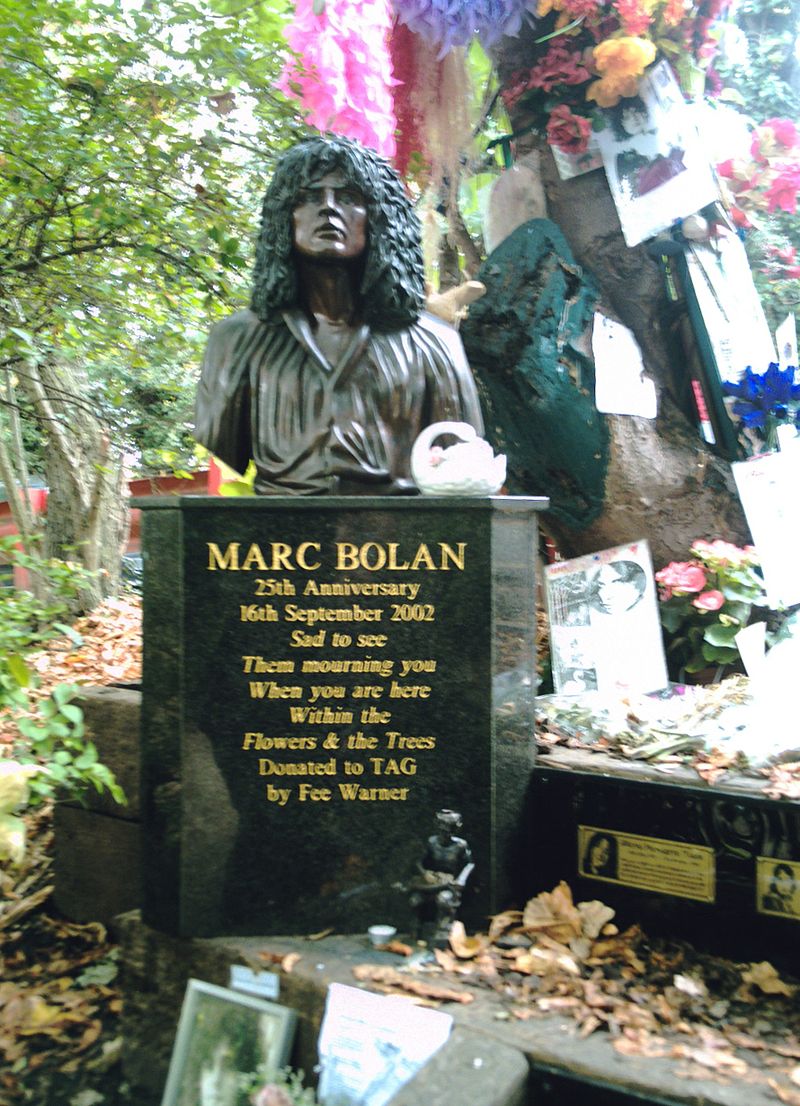
T. Rex released six additional records in the glam rock genre, with the final release, Dandy In The Underworld, hitting shelves in 1977. It was lauded by critics for the strength of the songwriting and Bolan's vocal performance. During a touring hiatus in the fall of that year, Bolan was a passenger in a Mini 1275GT being driven by his romantic partner Gloria Jones. Both had been drinking and, after crossing a small, humpback bridge in Southwest London ,Jones lost control and hit a fence post and a tree. Bolan died at the scene and Jones was critically injured, but survived.
The wrecked Mini in which Bolan died (Photo by Maurice Wallace).
Although I didn't purchase any of the band’s records when I collected vinyl, I have become a fan of  T. Rex’s music, particularly the tracks that have appeared in some of my favourite movies. Bolan's tracks are infectiously catchy and I've always been of the opinion that they elevate a film brilliantly. Some songs immediately transport me to a specific scene from the film in which it is featured. Two examples that immediately come to mind are Cosmic Dancer from the opening credits to Billy Elliot and Jeepster from the Tarantino flick Death Proof. There are also T. Rex tracks used excellently in the movies Lords Of Dogtown, The Break-Up, School Of Rock, Hot Fuzz, Scott Pilgrim Vs. The World and, most recently, the horror Longlegs.
Bolan, like many artists I've discussed in this blog series, was lost far too soon. He would only be in his late-seventies if still alive today. I am confident he would have entertained the world with many more terrific songs and albums like Electric Warrior -- a delightful listen that will blast many more times through my speakers. Now I need to watch Billy Elliot and Deathproof again.

Sunday, 22 September 2024

The 500 - #194 - Transformer - Lou Reed

I was inspired by a podcast called The 500 hosted by Los Angeles-based comedian Josh Adam Meyers. His goal, and mine, is to explore Rolling Stone Magazine's 2012 edition of The 500 Greatest Albums of All Time. 


Album: #194

Album Title: Transformer

Artist: Lou Reed

Genre: Glam Rock, Pop Rock

Recorded: Trident Studios, London

Released: September, 1972

My age at release: 7

How familiar was I with it before this week: Somewhat

Is it on the 2020 list? Yes, at position #109, moving up 85 spots

Song I am putting on my Spotify Playlist: Andy's Chest

I am excited to introduce a new guest poster to The 500 Blog series – Jennifer Jones. I have been friends with Jennifer for more than 25 years, having met her through her husband Oscar. Not only was Oscar the goaltender on my tournament hockey team, he was also a talented musician and is still part of the live music scene here in the city of London, Ontario. There were many nights when my wife, Jen and I would be in the audience at a local watering hole (The Wick, The Brass Door, The Salt Lounge, Call The Office) while Oscar played bass. I always appreciated her perspective on music, as her tastes varied from mine.

Last November, Jennifer was posting photos of some of her favourite albums of all time. Among those posts was the cover to this week’s record, Transformer by Lou Reed. I dropped her a line and asked if she would be interested in sharing a few thoughts and, delightfully, she agreed. Here is her post.

—-------------------------


As a really young teenager, the soundtrack of my life was monopolized by the Velvet Underground, and by Lou Reed in particular. It’s hard to explain my love for Lou: Despite his infamy, I can say that this love has been long-lived and has zero chance of dying.
Guitarist, singer and songwriter Lou Reed (Circa 1975) 
To me, Lou’s music is about stories: Stories that paint a picture of the people he surrounded himself with (or who happened to surround him) and the kinds of things that irked or inspired them. These stories are so raw and colourful and real, I’ve always felt a little transported back to Andy Warhol’s Factory and the dirty streets of New York. (Holly, good for you, girl - I would have gone too!) I feel like Lou did with his music what Andy did with his art, which was to create these stark, unapologetic snapshots capturing – even elevating - the culture around them and reflecting this back to those living it - and to anyone paying attention.
American visual artist Andy Warhol (left) and Reed in the 70s.
Warhol's studio in New York was called "The Factory" and
was a famous hang-out for artists, musicians and celebrities. 
I was later to the Transformer party, for sure, but since I first heard it, it’s always been my favourite: It is simply impossible to get sick of this album. Like my love for Lou, I find it hard to explain, but I suspect it’s because it is textured with a little of everything, from the catty, campy, burlesque (New York Telephone Conversation, Good Night Ladies), to the sweet, melodious, slightly tragic (Perfect Day and Satellite of Love) and of course the ultimate story-scape anthem that is Walk on the Wild Side.
Album cover for the single, Walk On The Wild Side. An
iconic song and Reed's best known, Rolling Stone ranked
it #223 on The 500 Greatest Songs of All Time.
Although some of the songs were written or recorded earlier than Transformer, every single one belongs here - and has to be here - to make up this magnificent whole. Even in the midst of some of Lou’s most celebrated work, Andy’s Chest is still one of my all-time favourite Lou songs, less for the honour it gives Warhol (wonderful in itself) but more for the magical intimacy of its tiny, nonsensical, surely drug-fueled, vignettes. For me, this song has always been a kind of demented lullaby - maybe it’s all that swooping and rocking.
Marilyn Diptych - one of Warhol's best know art pieces.
While Transformer does feel a little gentler in some ways than what I think of as typical Lou (because of David Bowie’s involvement and influence?), Lou’s trademark “snark” is definitely felt all the way through. The connection between Lou and Bowie is interesting: I always saw Lou as much grittier and rougher around the edges, but maybe paired with Bowie’s grace and elegance, the match was all the better.
Friends and musical collaborators, Bowie (left) and Reed (right)
take a humorous photo with Iggy Pop. Collectively, with
14 records on The 500 list (as musicians).
I like to think about the album title and all that it evokes: Lou transforming himself, becoming “someone else, someone good”, moving in a different, separate direction (I’m So Free, Hangin’ Round), and the evolution/ transformation/becoming that occurs in some of the songs (Make Up, Walk on the Wild Side).

There’s an addictively bold, infectious, prideful energy to all of Transformer’s stories that draws you back to listen again and again - and again! To me, overall, Transformer is disarmingly poetic, a little fantastical, and a little snide – just like Lou.


Guest Blogger - Jennifer Jones

Sunday, 28 April 2024

The 500 - #215 - Self-Titled Debut - New York Dolls

I was inspired by a podcast called The 500 hosted by Los Angeles-based comedian Josh Adam Meyers. His goal, and mine, is to explore Rolling Stone Magazine's 2012 edition of The 500 Greatest Albums of All Time. 


Album: #215
Album Title: Self-Titled Debut
Artist: New York Dolls
Genre: Hard Rock, Proto-Punk, Punk Rock, Glam Rock
Recorded: The Record Plant, New York City
Released:  July, 1973
My age at release: 8
How familiar was I with it before this week: A little
Is it on the 2020 list? Yes, at #301, dropping 76 places
Song I am putting on my Spotify Playlist: Jet Boy
A significant portion of the North American population, particularly those on the political right, are expressing outrage and concern about drag performances. Drag Queen Storytimes (events which parents must provide permission allowing their children to attend) are being targeted by far-right, neo-fascist paramilitary groups, including the Proud Boys, who seek to intimidate participants and promoters with threats of violence. This climate of hostility befuddles me. Drag  performances have been a part of my life since childhood. I always found them funny and if the intention was to "groom me" -- it failed miserably.
Robin Williams, Dustin Hoffman, Tom Hanks, Jamie Farr
and Bugs Bunny were comfortable with drag performances.
The term drag, typically, refers to men cross-dressing, often in loud, exaggerated feminine clothing -- accented with garish, make-up and wigs. Drag performances are intended to be entertaining and are regularly punctuated with music, comedic routines, social satire or political commentary.
Australian comedian Barry Humphries performing in drag as
his alter-ego Dame Edna - with Jay Leno (The Tonight Show).
The history of drag goes back centuries. It was part of folk performances, including mummers’ plays -- 13th century dramatic productions put on by amateur community players. The tradition spread to English-speaking colonies and continues today with annual Mummers’ Parades in many major cities -- the largest being held in Philadelphia nearly every New Year's Day since 1901... and, yes, children have always attended.

In fact, my dad remembers his father and uncles disappearing upstairs during parties to swap into women’s clothing, then returning to perform a song and dance routine. “It must be something peculiar to English men,” he says of the accepted practice. "Much like children 'dressing down' 
on New Year’s Eve as penniless urchins with soot-covered faces. They stormed into pubs pretending to clean-up and were tossed coins for their efforts by laughing patrons."
Philadelphia Mummer's Parade drag performers.
The first time I saw the album cover for The New York Dolls debut record, I was standing in Dr. Disc, a London, Ontario, record store that I visited weekly. Located on Clarence Street, Dr. Disc was a London landmark throughout the ‘80s and ‘90s. As a teen and young adult, I spent hours perusing the massive bins of new and used vinyl and, eventually, CDs.
Dr. Disc (circa 1985). Next door is The Silver Ball, an arcade that
I helped finance - 25 cents at a time.
The cover of The New York Dolls caught my attention immediately. It features a black and white photograph of all five members of the band crammed together on a couch. Each is shown dressed in drag, complete with gigantic wigs, garish make-up, platform shoes and even a pair of roller skates. The original members were, David Johansen (vocals, harmonica); Arthur "Killer" Kane (bass guitar); Jerry Nolan (drums); Sylvain Sylvain (piano, guitar, vocals); and Johnny Thunders (lead guitars, vocals). The band's name appeared in the top left corner -- artistically depicted to seem as if it had been hurriedly scrawled in lipstick.
New York Dolls debut record. (l-r) Kane, Sylvain, Johansen,
Thunders and Nolan.
I didn't purchase The Dolls’ record that day. As a high-school student, my funds were limited and the teenage demands of arcade games, submarine sandwiches, French fries and movie tickets kept my record purchases in check. Regardless, I do remember mentally registering the band under the "maybe another day" file. However, I do recall enjoying a chuckle as I walked away from it.
A typical 80s arcade. The Galaga game (pictured right) likely
depleted my bank account by $10 weekly throughout the early '80s.
That's the thing about drag. I've always found it funny. My first exposure likely came during my adolescence when watching reruns of Monty Python's Flying Circus. The Python troupe frequently performed in drag and one of my favourite sketches featured writing partners John Cleese and Graham Chapman as middle-aged, working class women – Mrs. Premise and Mrs. Conclusion. The increasingly absurd sketch begins in a laundromat as the pair discuss the challenges of burying a living cat and the best way to put down a budgie.
Cleese (left) as Mrs. Premise and Chapman as Mrs. Conclusion.
The duo eventually end up in a philosophical debate about freedom that concludes with a trip to Paris to visit the home of French philosopher Jean-Paul Satre in order to settle their dispute about the meaning behind his Roads To Freedom (Les chemins de la liberté) trilogy. The sketch can be seen in its entirety here.
Premise and Conclusion (Cleese & Chapman) crossing the 
channel to confer with Jean-Paul Satre in Paris.
My friend Don and I liked these characters so much that, in 1983, we co-opted them for a series of commercials on the televised announcements at our high-school -- broadcast each Wednesday morning.  At the time, I was part of the Saunders Secondary School Concert Band and, as a senior, we each had to take on a job for the music department. Conductor and teacher Mr. Gwyn Beynon assigned me to the promotions team.
Former Saunders Music Teacher and Conductor, Gwyn Beynon.
Recipient of the Golden Baton Award and on the Western University
Alumni Wall of Fame
.
In order to underwrite the band's trip to Boston in the spring we sold boxes of oranges and grapefruit to our families and the community. This was done through pre-sales and to encourage students to take home order forms, Don and I appeared on the school's closed circuit broadcast in drag -- adopting falsetto British female accents (in the Python-style) as we provided details about the promotion.
In one sketch, my "Mrs. Conclusion" repeatedly mishears the word grapefruit, thinking it is flake-fruit, ape-fruit and rape-fruit (a poor teenage attempt at humour I regret).

Mrs. Conclusion: "Why would you want a fruit that molests you?!"


Frustrated, Don's Mrs. Premise reached into his top to produce a grapefruit from inside the bra he was wearing -- borrowed from his mother. 


Mrs. Premise: "Grapefruit! grapefruit! You daft woman -- these bloody things!"


Abruptly storming off the set we targeted unsuspecting classes -- interrupting lessons in an effort to pitch our sales catalogues.
Saunders Secondary School in London, Ontario.
The New York Dolls, much like my high school efforts at comedy, were often misunderstood. They enjoyed limited commercial and critical success. When they released their debut record in 1973, they managed to be voted both the best and worst band in Creem Magazine's annual readers’ poll. They released only two records before disbanding in 1975. There was a reunion in the 2000s, along with more records, but their proto-punk, drag experiment came to an end. 
The Dolls in a promotional photo for Creem Magazine.
However, their impact would be felt for years to come and the group is cited as a significant influence by artists with multiple albums on The 500 list. Paul Stanley of KISS (Albums #489 and #159) says his theatrical stage performances were informed after seeing Dolls’ singer Johansen perform in a New York tavern. 
The group KISS, looking Doll-esque, before they
donned their trademark make-up.
Other artists who celebrate the impact of The Dolls include: The Ramones (#33 & #106), The Smiths (#473, #369, #296 & #218), The White Stripes (#497 & #390), Guns ‘N Roses (#62), Green Day (#225 & #193) and Sex Pistols (#41).

Out of drag, The Dolls pose with record producer,
the legendary Todd Rundgren (3rd from right).
Getting a chance to listen to the Dolls’ debut record many times as I prepared for this post was a treat. I regret not picking it up that day many years ago. That was one of those situations when I should have judged a book by its cover. It is high-energy, raunchy and raw-sounding – and punctuated with campy comedy and song titles that include Personality Crisis, Vietnamese Baby, Trash, Bad Girl and, my favourite, Jet Boy.
Cover for the single release of Jet Boy and
B-side Vietnamese Baby.
I still remain flummoxed by the anger generated by drag performers and shows. With their over-the-top gaudy make-up and ridiculous outfits, how can anyone consider them anything but funny. And don't even get me started on their ridiculously silly, but clever, pseudonyms, such as Dixie Normous, Betty Bitchslap, Sham Payne and Amanda Porq.

Much like Python, there is the stuff I laughed about as an adolescent -- John Cleese performing his trademark "silly walk". Then, as I aged, I better understood the satire on bureaucratic inefficiency embodied in the entire premise of "A Ministry of Silly Walks" existing in proper British society. I think kids process a drag queen the same way -- in simple terms.
I am sure  children are more intimidated by the angry Proud Boys outside a Drag Queen Story Hour than they are by the funny looking lady who reads them a book with affected silly voices.
Proud Boys marching to protest a Drag Queen Story Hour
juxtaposed against the event that creates their ire.


Monday, 13 March 2023

The 500 - #274 - Nightbirds - Labelle

I was inspired by a podcast called The 500 hosted by Los Angeles-based comedian Josh Adam Meyers. His goal, and mine, is to explore Rolling Stone Magazine's 2012 edition of The 500 Greatest Albums of All Time. 


Album: #274

Album Title: Nightbirds

Artist: Labelle

Genre: R&B, Proto-disco, Funk

Recorded: Sea Saint Studios, New Orleans, Louisiana

Released: September, 1974

My age at release: 9

How familiar was I with it before this week: One Song

Is it on the 2020 list? No

Song I am putting on my Spotify Playlist: Are You Lonely?

Although I was not familiar with Labelle, an all-female Philadelphia-based vocal group formed in 1962 I do remember hearing the music of one of its members, Patti LaBelle, in the ‘80s. Her songs, New Attitude and Stir It Up, were featured in the massively successful film and soundtrack to Beverly Hills Cop in 1984.
LaBelle (born Patricia Holte) also had a number one hit with Michael McDonald of Doobie Brothers fame with the duet, On My Own -- written by legendary songwriters Burt Bacharach and Carole Bayer Sager.
At the time, I was working jobs where Top 40 radio was constant, ensuring all three songs reached my ears, despite not being a fan. In the spring of 1985, I was 18 and deeply invested in hard and progressive rock. Like many insufferable teens, I felt I owned the "corner on the truth" when it came to quality music and dismissed Patti LaBelle's songs as simplistic pop-music or cheesy, easy-listening schlock.
Classic album cover iconography from many Prog-Rock artists I loved
Nightbirds was released a decade earlier and was the fourth record by the trio under the name Labelles. Recording and touring since 1962, they have been dubbed The Blue Belles (aka: Patti LaBelle and her Blue Belles, Patti LaBelle and The Bluebelles) the names distinguished by the spellings The 1974 line-up included founding members LaBelle, Nona Hendryx and Sarah Dash.
Labelle (l-r) Hendryx, LaBelle and Dash
The earliest incarnation of the group, which included soprano Cindy Birdsong, found success singing ballads and doo-wop songs on the Chitlin' Circuit. The Chitlin' Circuit was a collection of performance venues spread across the eastern half of the United States that provided commercial and cultural acceptance of African-American entertainers during the era of racial segregation.
Map showing venues on the Chitlin' Circuit
I sometimes forget that racial segregation and the Civil Rights Movement took place in my lifetime. Recently, my current cohort of Grade 7 students and I explored a wonderful CBC podcast series called Portraits of Black Canadians as part of our Black History Month studies. These 12-year-olds were, understandably, aghast when we discussed the Slave Trade. However, they were stunned to realize that segregation continued well into the 1960s, in Canada.
The disheartening story of Africville generated some powerful discussions on human rights and equity. Africville was a small community of African-Canadians in Halifax, Nova Scotia who were denied city services (sidewalks, water, garbage collection) despite paying municipal taxes. Their community was later unceremoniously bulldozed to make way for city expansion. To learn more, you can see all the work of the students at this link.

Birdsong left the Blue Belles in 1967 to join Diana Ross and The Supremes. Around the same time, Blue Belles performed in Europe (mainly in the UK) where black artists found more acceptance with white audiences in pubs and concert halls. On a 2015 episode of The Meredith Vieira Talk Show, LaBelle shared stories of her time in England, performing shows and cooking meals for The Rolling Stones and The Who. At the time, the trio were supported by the group Bluesology, featuring a teenage Reg Dwight (later known as Elton John) on piano. LaBelle humourously recounts taking Dwight for a lot of money playing cards, but never let him head home on an empty stomach or without plenty of leftovers in Tupperware containers. "He didn't return those containers, but made up for it years later with a beautiful diamond ring."
LaBelle with Elton John (Reg Dwight) 2002
During their time in England the Blue Belles transformed their musical direction, sound and style. By 1970, they had changed their name, for the final time, to LaBelle. They also began recording and performing their funky interpretations of contemporary rock and roll and pop standards, including Wild Horses (Rolling Stones), Won't Get Fooled Again (The Who), Moonshadow (Cat Stevens), and You've Got A Friend (Carole King).

Labelle's second record, Moon Shadow (1972)
In 1974, when Nightbirds was released, the group explored glam rock, wearing outlandish, funky, space-age costumes. They also began playing songs that were the prototype for the disco genre, which would dominate the late ‘70s. Their biggest hit, and the only song I knew from the album, was Lady Marmalade.
Labelle in their space-age, glam-rock outfits (1974)
Lady Marmalade was penned by the songwriting team of Bob Crewe (Walk Like A Man, Can't Take My Eyes Off You) and Kenny Nolan (My Eyes Adored You, I Like Dreamin'). The song was originally written for Nolan's disco group, The Eleventh Hour, and is most famous for the risque lyric in the chorus, " voulez-vous coucher avec moi, ce soir?" which translates to "would you like to sleep with me tonight?" Shocking stuff in 1974. So much so, that broadcasting standards on American television insisted they change the lyrics to "voulez-vous danser avec moi, ce soir?" -- "Do you want to dance with me tonight?"
Lady Marmalade became a hit again in 2001 when it was featured in the Baz Luhrmann film Moulin Rouge!. The updated version featured vocals from contemporary singing stars L'il Kim, Christina Aguilara, Pink and Mýa.
Labelle disbanded in 1976 with all three members continuing their musical careers as solo or studio artists. They reunited in 2005, releasing their final album, Back To Now, in 2008. Sarah Dash passed away in September, 2021, two days after a performance with LaBelle in Atlantic City, New Jersey. She was 76.
For this blog post, I  re-listened to those "cheesy", "schlocky", "easy-listening" Patti LaBelle songs from my youth. Sure, they are still not  my cup of tea, but I now recognize how good Ms. Labelle's voice is and how much those songs, despite my teenage protestations, are weaved deeply into the soundtrack of my life.