Showing posts with label 1999. Show all posts

Sunday, 27 April 2025

The 500 - #163 - 1999 - Prince

I was inspired by a podcast called The 500 hosted by New York-based comedian Josh Adam Meyers. His goal, and mine, is to explore Rolling Stone Magazine's 2012 edition of The 500 Greatest Albums of All Time. 


Album: #163
Album Title: 1999
Artist: Prince
Genre: Dance Pop, Art Pop, Minneapolis Sound, R&B, Funk
Recorded: Kiowa Trail (Prince's Home Studio), Chanhassan, Minnesota; and Sunset Sound Recorders, Hollywood, California
Released: October, 1982
My age at release: 17
How familiar was I with it before this week: Fairly
Is it on the 2020 list? Yes, at #130, elevating 33 spots
Song I am putting on my Spotify Playlist: 1999
"You know that feeling you get on a roller coaster, when you are slowly climbing to the top...and it seems to take forever? That's turning 30. You'd better look around...because the rest of the ride is damn quick."
Those astute words by my pal, Paul Dawson, were uttered at the time we were entering our thirties. Paul has always been a clever wordsmith and I laughed off his amusing hyperbole. However, as I prepare to turn 60 this summer, I'll admit that the last 30 years came and went with alarming speed.
Paul Dawson, at his 30th birthday party.
The first time I heard the debut single 1999 from Prince's album of the same name, was in late autumn, 1982. I was a passenger in the car of another pal, Rob Cummings, when it came on the radio. Oddly, I can even remember the road we were on. The music wasn't my cup of tea at the time, but the lyrics sure got me doing some mental math:  "How old will I be in 1999...and what will I be doing? Will I be married? Have kids? What job will pay my bills?"
The idea of being 34 seemed like the stuff of science-fiction to my 17-year-old brain. Besides, as Paul later put it, I was still slowly climbing the first hill on the roller coaster. Now, with that birthday a full 26 years behind me, it feels like contemporary history. Such is our strange perception of time, a topic I tackled in my January, 2025 blog post about The Definitive Collection, from ABBA.
However, the wonderful thing about revisiting music from my youth, especially after a long hiatus, is that it can rekindle some of those vibrant, emotional feelings. There is something about the sound of 1999 that evokes such powerful nostalgia for me. It is likely the distinctively ‘80s "synth and electronic drum" sound that permeates so many of the tracks. That sound reminds me of how much I loved being 17. It was a time of great freedom and discovery. I had money, limited responsibility and incredible health. I didn't know how lucky I was. The curmudgeonly man on the porch in It's A Wonderful Life was right when he lamented to George Bailey and Mary Hatch. "Youth is wasted on the wrong people".
My friendships were also fantastic, including the time I spent with Rob and Paul. I am still in contact with Paul...we've actually been texting about the NFL draft as I write this piece. However, Rob and I drifted apart after high school. After listening to this record, I decided to try to find him through social media. He worked in construction, as a bricklayer, in the early ‘90s, and I found a website for Rob Cummings Contracting Company. I sent a message...we'll see what comes of that.
The album 1999 was the fifth studio production from the multi-talented and influential musician/songwriter Prince. On the strength of three hit singles, it propelled the flamboyant, androgynous entertainer to stardom. Consequently, it is not surprising that 1999 was the first song of his I heard.  In fact, for many years, I assumed this was his debut record and that he was an overnight sensation.
Prince, in his video for Little Red Corvette, the second single from 1999.
Released as a double record on vinyl in 1982, 1999 set the stage for Prince's meteoric rise to superstardom. Two years later, The High Priest of Pop released the landmark record Purple Rain, which also served as the soundtrack to his 1984 film of the same name, at which point he  became one of the biggest artists in the world – rivalled only by The King of Pop, Michael Jackson. Purple Rain appears at #76 on The 500 list. That is 87 weeks away...but on this roller coaster ride that will be here, in the words of Paul Dawson, "damn quick".


Sunday, 25 February 2024

The 500 - #224 - The Neil Diamond Collection - Neil Diamond

I was inspired by a podcast called The 500 hosted by Los Angeles-based comedian Josh Adam Meyers. His goal, and mine, is to explore Rolling Stone Magazine's 2012 edition of The 500 Greatest Albums of All Time. 


Album: #224
Album Title: The Neil Diamond Collection
Artist: Neil Diamond
Genre: Rock, Soft Rock, Pop, Folk, Ballad
Recorded: 1968 - 1972
Released: November, 1999
My age at release: 34
How familiar was I with it before this week: Very
Is it on the 2020 list? Sadly, no Diamond albums made the 2020 list
Song I am putting on my Spotify Playlist:
 I Am, I Said
Album cover for The Neil Diamond Collection.
Every University town has at least one legendary bar. In London, Ontario, (home of Western University) that gathering place is the Ceeps. The restaurant/tavern has been a popular watering hole for students, professors, alumni and locals for more than 100 years. It gets its name from the Canadian Pacific (C.P.) railway tracks just north of its doors on Mill Street. During homecoming week in October the taps rarely stop flowing. The tavern is so staggeringly popular on that weekend a staffer has the sole job of replenishing kegs in the vast, walk-in fridge compartments behind the bar. Rumour has it a keg empties every 15 minutes.
The infamous Ceeps line. Circa 1988.
On my 23rd birthday in 1988, I found myself at the Ceeps with a group of friends. While there, I ran into Shawn Burk, whom I knew casually through a mutual friend, James Fast. As it turns out, it was Shawn's birthday, too. We downed a celebratory drink as we chatted about sports, theatre and music. When I inquired  about his favourite bands, he quickly replied: "Judas Priest and Neil Diamond."
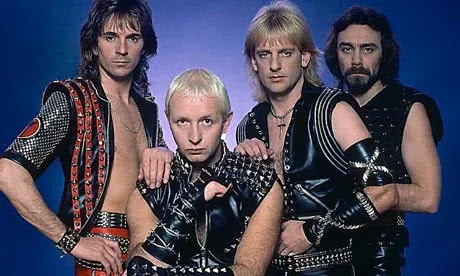
Judas Priest in their 80s heyday.
Back then, being a fan of leather-clad, British heavy metal groups was not unusual. Most of my friends, myself included, owned copies of Priest's seminal records, British Steel, Screaming For Vengeance and Sad Wings Of Destiny. However, admitting that you liked the music of uber-cheesy, soft-rock crooner Neil Diamond was bewildering to me.
Neil Diamond, performing in the 70s.
Fast-forward a few days and I found myself in Shawn's car as he blasted tracks from Hot August Night -- Diamond's 1972 live recording from The Greek Theatre in Los Angeles. By the time we got to the closing song, Soolaiman/Brother Love's Travelling Salvation Show, I was a fan. Sadly, there are no Diamond records on the 2020 edition of The 500. Hot August Night should be.
Album cover for Hot August Night, Neil Diamond (1972).
Shawn and I became terrific friends that summer. We both had a mischievous, theatrical streak. We got our hands on a video camera and started making silly, guerilla-style productions for our friends’ amusement. One afternoon, we set up shop in the hallway of a local mall, posing as representatives from the Kraft Food Company conducting a taste test. Curious mall patrons sampled marshmallows A and B -- and we dutifully noted their preferences on a clipboard. In truth, both "types" of the fluffy, white confectionary treats were the same. Regardless of the a volunteer's choice Shawn would proudly announce: "That's the Kraft Marshmallow!" It was harmless fun that lasted until mall security became suspicious and we scrammed.
Kraft Marshmallows - certainly London's favourite on that 1988 afternoon.
The Neil Diamond Collection is a compilation record released in 1999, containing Diamond's hits from 1968 - 1972. It contains most of the songs I heard on Shawn's car stereo. Diamond, born in 1941, lived a fascinating life even before deciding he wanted to become a songwriter and performer. Born
and raised, for the most part, in Brooklyn, New York, he attended high school with singer Barbara Streisand and chess grandmaster Bobby Fischer.
32 years after being classmates, Streisand and Diamond scored a hit with the duet You Don't Bring Me Flowers in 1988.
Diamond was a member of the school's fencing team with his best friend, future Olympic fencer Herb Cohen. Diamond was good enough to secure a fencing scholarship to New York University where he enrolled in a pre-med program with the goal of becoming a doctor. However, in his senior year and just 10 credits shy of graduation, he made the bold decision to quit medical studies for a job writing songs at Sunbeam Music Publishing. It paid $50 a week, the equivalent to $450 today.
Diamond in a recording studio in 1963.
I was fortunate to see Diamond at Maple Leaf Gardens in 1993 during his Love In The Round tour. Shawn was with me. The 30-song set was performed, without a break, by the then 52-year old entertainer on a circular stage in the centre of the legendary hockey rink. The performance and the Collection album were reminders of the impressive  number of hits the former medical student, known as “The Jewish Elvis”, has penned.
Thirty-eight of his songs have reached the top 10 on Billboard's Adult Contemporary Charts. He has been inducted into the Songwriters Hall Of Fame and The Rock And Roll Hall Of Fame, as well as receiving a Lifetime Achievement Award from The Grammys. As Josh Adam Meyers postulated on the accompanying episode of The 500 Podcast, "Diamond wrote a significant chapter in The Great American Songbook". I agree. Why is he not represented on the 2020 list?

Diamond entering the Songwriter's Hall Of Fame in 1984.
In January 2018, Diamond announced his retirement from touring due to a diagnosis of Parkinson's Disease. He lives in Basalt, Colorado, with his former manager, now wife Katie McNeil.

Diamond and McNeil in 2011 when he received the 
Kennedy Center Honors. 
I visit the Ceeps occasionally – typically in the summer when its expansive patio opens -- connected to its second bar, Barneys. Shawn moved to Toronto, but we remain friends. I am tremendously grateful to him for letting me couch surf at his apartment in 1991 when I first took an ill-fated restaurant job in Toronto. He was also a sympathetic ear in 1996 when my girlfriend, now wife, and I temporarily broke up. His decision to show me the film Swingers in order to help me shake my funk was an inspired decision.
When Shawn and I reconnect, it is easy to pick up where we left off – talking sports and music and laughing about our many videotaped hijinks. We still contact each other on our shared birthday to offer good wishes for another year. I am still a Neil Diamond fan because of him.

Monday, 6 March 2023

The 500 - #275 = The Slim Shady LP - Eminem

I was inspired by a podcast called The 500 hosted by Los Angeles-based comedian Josh Adam Meyers. His goal, and mine, is to explore Rolling Stone Magazine's 2012 edition of The 500 Greatest Albums of All Time. 


Album: #275

Album Title: The Slim Shady LP

Artist: Eminem

Genre: Hip Hop, Horrorcore

Recorded: Studio 8, Ferndale, Michigan

Released: February, 1999

My age at release: 33

How familiar was I with it before this week: A little

Is it on the 2020 list? Yes, at #352 (dropping 77 places since 2012)

Song I am putting on my Spotify Playlist: Brain Damage

In my last post, I wrote about my first year of full-time employment as a teacher. I had been hired as a music educator for Grade 4 - 8 students. To connect with my young charges, I would play music as each class entered or exited my music room. Posters of musicians from different eras plastered the walls diverse genres (Mozart, Miles Davis, Pink Floyd, Dave Matthews Band and Run DMC, to name a few).
The Miles Davis Poster I had in the music room
Additionally, I invited students to bring in compact discs to be played during the next period. Many of them came from challenging socio-economic situations and others were "street-smart" beyond their years. This was 2000, just as Eminem exploded into popular hip-hop culture with the release of his second studio album, The Slim Shady LP. Among the different grade cohorts were fans of the hip-hop and rap genre, and some even sported Eminem's closely-cropped "Caesar haircut".
Eminem (Marshall Mathers)
As you might have guessed, it wasn't long before a student produced a compact disc copy of Eminem's album and asked if we could play it in class.

"It's got a couple bad words though." he said in earnest.

"Let me give it a listen tonight," I replied.


If you are familiar with The Slim Shady LP, you already know where this story is going.  If you don't, check out  the lyrics to the first two tracks – My Name Is or Guilty Conscience – for a dose of anger, violence and misogyny. However, neither prepares you for the song '97 Bonnie & Clyde -- a fantasy scenario, complete with sound effects, where Eminem disposes of the corpse of his ex-wife, Kim Mathers, in a lake while their infant daughter is strapped into the car seat. He speaks as one might talk to a toddler:
Needless to say, I was aghast. However, I reminded myself that "every generation is shocked by the music of the next". 
After all, my mom wouldn't let me purchase KISS or Meat Loaf records because of the album covers, and I distinctly remember how horrified my grandfather was when the Sex Pistols and punk rock hit the scene while I was visiting England in 1977.
Article on Sex Pistols in U.K.'s Daily Mirror
Still, I determined this wasn't going to be played in music class and I returned the CD the next day with a few cautionary words.

"It's not the swear words," I said. "It's more the violence toward women that concerns me."

"He's just kidding about that, he doesn't mean it," came the reply.


I have since learned that this student wasn't entirely wrong with his assessment. The "Slim Shady character" is an alter-ego that represents Eminem's hyper-masculine, dark, troubled and evil side. The character is used within the confines of a sub-genre of hip-hop called “horrorcore”, which intentionally leverages dark, violent and transgressive lyrical content to court controversy. It is to music what slasher-flicks are to film and, much like the aggressive, over-the-top violence in Friday The 13th or Texas Chainsaw Massacre. It is not meant to be taken seriously.
A collection of horrorcore hip-hop artists including Eminem (top left)
There is good reason that Eminem, born Marshall Bruce Mathers III, has a dark, troubled persona lurking within him. Like many students I have worked with over the years, his early life was shaped by abandonment, poverty, physical and mental abuse, as well as frequent housing insecurity.

Born in 1972 in St. Joseph, Missouri, to Marshall Bruce Mathers Jr. and Deborah Rae "Debbie" Nelson, Eminem’s father, soon abandoned the family in order to return to California and his other two children. Debbie, shuttled her son between Missouri and Detroit, Michigan, trailer parks and low-income homes for most of his childhood. Among the places they lived was the Continental Mobile Village near 8 Mile Road in Warren, Michigan -- the setting for his 2002 semi-autobiographical film.
Growing up in predominantly black communities he was treated as an outsider and badly bullied including an assault in elementary school that hospitalized him. He recounts the events in the song Brain Damage from The Slim Shady LP.
Social service investigators were regularly involved in his unstable and traumatic life, with one social worker describing his mother, Debbie, as having addiction issues and a "suspicious, almost paranoid personality". In his song, Cleaning Out My Closet, Eminem reveals that his mother put prescription medications in his food to make him feel ill, ostensibly to keep him home where she could protect him. Often dubbed Munchausen Syndrome By Proxy -- this condition is a mental illness and form of child abuse where a care-giver causes symptoms that make a child feel unwell, often to isolate the victim from the outside world.
As Oscar Wilde famously said: "There is only one thing in life worse than being talked about, and this is not being talked about." The polarizing Eminem has certainly been talked about over his 25-year career. He is loved and loathed by many.

Eminem has courted controversy for decades while simultaneously rising to fame as one of the greatest rappers of all-time. Sometimes dubbed "The King Of Hip-Hop", he is the best-selling solo-rapper ever. His 2002 record, The Marshall Mathers LP (#244 on The 500) sold 11 million copies in the U.S. alone.

I'm at a bit of a crossroads here.

  • My exploration into the world of hip-hop has led me to recognize that Eminem is a gifted wordsmith who deeply understands the interplay between beats and bars. I intend to explore his clever use of multi-syllabic, internal rhyme in a future blog.
  • I also understand that, like a blood-soaked gun battle in a Tarantino film, his horrorcore lyrics are not to be taken seriously.
  • I also know he suffered mightily in his childhood, which led to addiction issues and mental health struggles, exacerbated by an autism diagnosis that was missed until adulthood..
However, I continue to think back to that 12-year-old in my Grade 8 music class who first brought me The Slim Shady LP. He was a bright chap and, clearly, he could separate the messages on this record from reality. Is that the case for the millions of young boys, with their Caesar haircuts, who worshipped and emulated either Eminem or the Slim Shady character who has...
  • Elevated verbal abuse and degradation, particularly of women, to an art form?
  • Amplified and glorified the image of a hyper-masculine male, who casually drops homophobic slurs, while perpetuating the notion that women are attracted to insensitive men who do not respect them?
  • Portrayed a semi-fictional version of themselves as a sympathetic underdog who rebelled against impossible odds? One who not only should be forgiven, but lionized for offensive and warped utterances?
Which takes me back to the same spot I was at when I first listened to this record in 2000. With one exception (I’ve put a track on my Spotify 500 Playlist) I've heard enough to know I’m not going to play it anymore.

This week I talked to several twenty and thirty-somethings who reported that they liked or even loved this record – some admitting they memorized every word while in elementary school.

I thought back to my teenage fascination with Black Sabbath, Dio or the aforementioned Sex Pistols. The music did not make me a satanist or an anarchist. I too understood that "they didn't mean it". So, in the words of The Who: “The Kids Are All Right”.

As my friend’s 30-year-old son put it: “I don’t listen to the Slim Shady LP often, although revisiting it is a guilty pleasure – his later material is far superior, after he got off the drugs”.

We’ll find out soon enough, I get to The Marshall Mathers album in 30 weeks.


Monday, 29 November 2021

The 500 - #341 - Play - Moby

I was inspired by a podcast called The 500 hosted by Los Angeles-based comedian Josh Adam Meyers. His goal, and mine, is to explore Rolling Stone Magazine's 2012 edition of The 500 Greatest Albums of All Time. 


Album: # 341

Album Title: Play

Artist: Moby

Genre: Electronica, Downtempo, Techno-Ambient

Recorded: Moby's Home Studio (Manhattan)

Released: May, 1999

My age at release: 34

How familiar was I with it before this week: Quite

Is it on the 2020 list? No

Song I am putting on my Spotify Playlist: Natural Blues

Between 1998 and 2010, I worked as a weekend bartender at Garlics Restaurant in my hometown of London, Ontario.  It is located on a trendy stretch of Richmond Row, beside the Grand Theatre and a short walk from the John Labatt Centre (now Budweiser Gardens).
Garlics of London (formerly Garlics Restaurant) London, ON
One of the many terrific things about working behind a bar in a busy, downtown bistro was serving the late night crowd -- aka "The Jazz Crowd". They were the patrons who arrived without a pressing agenda, not trying to squeeze in a meal before going to the theatre or a concert. They usually weren't driving, so they happily ordered multiple bottles of wine or sampled several signature cocktails, martinis and craft beers. They were, like jazz, a free-flowing, easy-going, collection of eclectic spirits.
Garlics bar (since renovated) - my weekend home for 12 years
By contrast, the pre-theatre crowd was often pressed for time, excited to eat and drink before a performance. We had to get them seated, served and shipped before the curtain went up at 8:00 sharp -- all without seeming as if anyone was in a hurry. This was a team effort pulled off by everyone from the host to the cooking staff, ever-visible in our open concept kitchen. It required a balancing act, coupling efficiency, manners and an easy-going disposition. Like the proverbial duck, we were composed on top and paddling furiously beneath the surface. 
The tension relaxed after 8:00 on a Friday or Saturday night, shirt sleeves were rolled up to the elbow, kitchen staff spelled each other for breaks (usually a cigarette) and I was at liberty to change the music in the Compact Disc player. Systematically, I would swap out the jazz standards and easy, familiar coffee-house and world music selections for discs that were more uptempo, avante-garde and even risque.  
Garlics' theatre seating standards (circa 2000)
In the early 2000s, one of my favourite discs to shuffle into the Compact Disc carousel mix was Play by Moby. Released in the spring of 1999, it is the fifth record by multi-instrumentalist and electronic musician Moby (born: Richard Melville Hall). 
Moby (early 2000s)
My first exposure to Moby came with the release of the Danny Boyle film The Beach, starring Leonardo Dicaprio, who was white-hot following his performance in the mega-hit Titanic. Moby's song, Porcelain, was featured in the movie's trailer. It, like many of the tracks on this record, immediately grabs your attention. The slow, atmospheric groove is haunting and lush. Porcelain and Natural Blues were the two tracks that invariably motivated a Garlics' patron to head to the bar and ask, "Who is this?"
I haven't listened through Play in many years, until recently. It was a blast of early 2K nostalgia. Unlike some of the other discs we played at Garlics, Play is not anxiety-inducing. Whenever I hear the soundtrack to Big Night or Willie and Lobo's Caliente, I am reminded of the urgency that accompanied a pre-theatre seating. Conversely, Play reminds me of calmly polishing wine glasses as the late night jazz crowd breezed leisurely through the restaurant's front doors. Another memory, another time.