Showing posts with label 1960. Show all posts

Sunday, 21 June 2026

The 500 - #103 - Giant Steps - John Coltrane

I was inspired by a podcast called The 500 hosted by New York-based comedian Josh Adam Meyers. His goal, and mine, is to explore Rolling Stone Magazine's 2012 edition of The 500 Greatest Albums of All Time.


Album: #103

Album Title: Giant Steps

Artist: John Coltrane

Genre: Jazz, Post Bop, Hard Bop

Recorded: Atlantic Studios, New York City, New York

Released: February, 1960

My age at release: Not born

How familiar was I with it before this week: Not at all

Is it on the 2020 list? Yes, at #232, dropping 128 spots

Song I am putting on my Spotify Playlist: Giant Steps

In the late ’80s, I started buying jazz CDs. This was not because I understood jazz but because I thought I should. It sounded like the kind of music that I wanted my persona to project; urbane, intelligent, sophisticated and tasteful. I think I also wanted to prod myself into believing that I was actually growing up despite working part-time jobs at restaurants, arenas and pools while still mucking about after my first degree, not entirely convinced adulthood had arrived.
Me in the late 80s, making a pizza at my restaurant gig,
wearing my lifeguard hoodie from my summer job with
the Public Utilities Commission.
Much like people who buy Tolstoy’s War and Peace or Joyce’s Ulysses from The Folio Society, these touchstones of cultural refinement were meant to be displayed, even if not fully understood or, in some cases, even absorbed. (Full disclosure: I also went through a Folio Society phase a few years later. To my credit, I chose books I wanted to read, or had already read. Certainly not Ulysses, which remains miles beyond my comprehension).
The Folio Society is known for its handsome, prestige editions of classic books.
I have written before about my first jazz purchase being Kind of Blue (#12 on The 500 List). Before Google searches and Ai prompts came along to help people 'cosplay' as music intellectuals, I learned about the legendary 1959 Miles Davis record through word of mouth. Someone, likely older and authoritative, had claimed it would be their “deserted island record.”
For those unfamiliar with the term “deserted island record” (sometimes expanded to a short list of records reminiscent of BBC’s celebrity Desert Island Discs radio program) selecting your favourites is a fun way of fantasizing life as a desert island castaway. What albums would you choose to keep you company, provided, of course, there was a power source?

Giant Steps, John Coltrane's fourth studio release and first for Atlantic Records was recorded shortly after he finished working with Miles Davis on Kind of Blue. Coltrane’s record is regarded as one of the most influential jazz albums of all time. Despite sounding chaotic to the untrained ear, his chord progressions are highly structured and mathematical. This was groundbreaking for several reasons, especially because:
  • It introduced what musicians now call Coltrane Changes, a harmonic system that cycles through three distant key centers (B, G, and E♭ major), each a major third apart. This was unusual because most jazz harmony at the time moved more predictably through closely related keys.
  • It demanded much of the musicians playing because of the rapid harmonic movement. The chords change quickly, sometimes every two beats. For improvisers, this meant having to constantly “re-map” the tonal center in real time, a mentally and physically demanding task for even an expert player.
  • To navigate these changes, Coltrane developed his Sheets Of Sound style, a continuous cascade of notes pouring out of his saxophone like a waterfall or rushing current. Even though it sounds wild, he hits the important notes of each ever changing chord as they pass by.
Whereas Kind of Blue became the most accessible and best selling jazz record of all time (five million copies in the U.S. alone), Giant Steps became a rite of passage for serious jazz musicians and fans. The title track alone has become something of a legend. Among expert saxophonists, it is more a test than a song. Its rapid sequence of shifting keys, cycling through distant tonal centres, creates what is often described as a harmonic obstacle course. There are 26 chord changes packed into 16 bars, often played at a blistering tempo which, by most accounts, makes it one of the most difficult pieces in the jazz repertoire. However, despite the chaos, it remains an engaging and enjoyable listen.
The first section of Giant Steps charted for alto saxophone.
I suppose, going back to my earlier example: If Giant Steps is James Joyce’s impenetrable Ulysses, then Kind of Blue would be F. Scott Fitzgerald’s The Great Gatsby. The first is a dense and demanding novel that requires effort, patience, and a certain level of fluency before it begins to reveal itself. It can feel forbidding at first, as though designed to test your intelligence.
The other, by contrast, is beautifully controlled and deceptively simple. Kind of Blue, like The Great Gatsby, feels accessible from the very beginning. You can enter it without preparation. In fact, it is still on many high school reading lists. But that ease is misleading. Between the pages there is a quiet sophistication, a structure and intention that only becomes clear the more time spend with it. Not coincidentally, it is widely owned and widely loved. People return to Gatsby, recommend it, and, in many cases, claim to know its subtleties before they fully understand the underlying themes. Which describes me perfectly when I purchased Kind of Blue and read Gatsby back in the '80s. I am still discovering things about both.

Granted, Giant Steps would make a terrific deserted island record. To steal a phrase from poet Walt Whitman,  the music "contains multitudes" of themes. You could spend years finding new pathways through its harmonic maze, fresh interpretations of how the pieces fit together. The challenge for the listener is to stretch  the mind; there is always more to learn. It would also have looked pretty impressive on my shelf when I was 23, alongside  a Folio Society copy of Ulysses.


Sunday, 1 March 2026

The 500 - #119 - At Last! - Etta James

 I was inspired by a podcast called The 500 hosted by New York-based comedian Josh Adam Meyers. His goal, and mine, is to explore Rolling Stone Magazine's 2012 edition of The 500 Greatest Albums of All Time.


Album #: 119
Album Title: At Last!
Artist: Etta James
Genre: R&B, Blues, Pop, Jazz
Recorded: Chess/Argo Studios in Chicago, Illinois
Released: November, 1960
My age at release: Not born yet
How familiar was I with it before this week: A few songs
Is it on the 2020 list? Yes, at #191, dropping72 places
Song I am putting on my Spotify Playlist:
 At Last!
One night recently, I was sitting in the half-light of the Hyland Cinema, London, Ontario's beloved little repertory and art film house. As the trailers played, my wife and I quietly whispered about the upcoming movies and made tentative plans to see a few selections that we have never seen on the big screen. Two grabbed our attention -- Spirited Away, Hayao Miyazaki's dream-like, Japanese animation film, and Dirty Harry, the Clint Eastwood blockbuster from 55 years ago.
Posters for Spirited Away and Dirty Harry.
Then the feature started and we settled in to watch True Romance, a gritty, 1993 romantic-thriller, written by Quentin Tarantino and directed by Tony Scott. It was a movie my wife and I loved in the ‘90s, but had never seen on the big screen. This version was the Director's Cut, restored in stunning 4K resolution.
It’s still an engaging and enjoyable movie, even with the troublesome language that felt edgy in the ’90s but land more uncomfortably today. In fact, prior to the screening, an employee offered a "trigger warning" to our audience. The cast is a who’s who of Hollywood A‑listers, including Patricia Arquette, Christian Slater, Brad Pitt, Gary Oldman, Samuel L. Jackson, Christopher Walken, Val Kilmer and Dennis Hopper. Watching it again, after at least 20 years, I couldn’t get over how young everyone looked. Sure, many of them were in their twenties when the movie was filmed, but even Dennis Hopper, who seemed ancient to me in 1993, was only 57. Younger than I am now.
Dennis Hopper as Cliford Worley in a powerful scene from
True Romance - one that features triggering language.
The age factor lingered long enough to follow me home, where I ended up reading about Etta James for this record, At Last!, her 1960 debut. I’ve always imagined her as a woman from another era, impossibly older, carved out of time. But, I was surprised to discover she was born only a year before my mom and was only 73 when she died in 2012. In fact, she was just 21 when she recorded this legendary record. People just looked older than their years back then and they seemed even older when viewed from a teen-age or 20-something perspective.
Etta James in the recording studio, circa 1960.
Born Jamesetta Hawkins, her professional career began in 1954, performing in Nashville clubs and touring in the Chitlin' Circuit, a loose collection of venues located in the eastern and southern U.S.. They provided safe havens for African-American performers and audiences during the time of segregation.
James (she jettisoned Hawkins and switched around Jamesetta to form her first and last names) performed in a wide range of genres, from gospel to blues to jazz and rock. She had many hits, the biggest being the title track from this record, At Last!. However, she struggled with several personal battles, including addiction, physical abuse and incarceration.

She was inducted into the Rock and Roll Hall of Fame in 1993, the Grammy Hall of Fame in 1999, and the Blues Hall of Fame in 2001. She also received the Grammy Lifetime Achievement Award in 2003. Rolling Stone magazine ranked her number 22 on its 2008 list of the 100 Greatest Singers of All Time; she was also ranked at 62 in the magazine’s list of the 100 Greatest Artists of All Time.  Multiple artists and bands, including Diana Ross, Janis Joplin, The Rolling Stones, Amy Winehouse, and Adele, asserted they had been influenced by her.
James' grave marker in Inglewood, California.
I only really knew the big hits, so spending time with the whole album felt like discovering a hidden room in a house I thought I already knew. The lush, orchestral arrangements wrapped around her voice in an almost physical way -- warm, enveloping, unmistakably intimate. And that voice! That powerful, smoky, earthy contralto, carrying the weight of a lifetime. Which is why it stopped me cold upon realizing how young Etta James was when she recorded it. I’d always imagined her as older, someone who had lived through decades of heartbreak and hard fought wisdom. But she was barely more than a kid, singing about timeless romance and deep sorrow -- emotions seemingly far beyond her years. It’s astonishing how convincingly she harbored  experiences she hadn’t yet lived.

Monday, 11 October 2021

The 500 - #348 - At Newport 1960 - Muddy Waters

I was inspired by a podcast called The 500 hosted by Los Angeles-based comedian Josh Adam Meyers. His goal, and mine, is to explore Rolling Stone Magazine's 2012 edition of The 500 Greatest Albums of All Time. 


Album: # 348

Album Title: Live At Newport

Artist: Muddy Waters

Genre: Blues

Recorded: July 3, 1960

Released: November, 1960

My age at release: Not Yet Born

How familiar was I with it before this week: Somewhat

Song I am putting on my Spotify Playlist: I Feel So Good

The first Newport Jazz festival took place in the summer of 1954 in the seaside town of Newport, Rhode Island. It was established by wealthy socialite Elaine Lorillard with her husband, Louis, as a celebration of jazz music in the U.S. In fact, the inaugural event, held at the Newport Casino, was called just that... "The First Annual American Jazz Festival".
Picturesque Newport, Rhode Island
Over its nearly 60-year history, the festival has featured an incredible list of music legends, including Miles Davis, Duke Ellington, Oscar Peterson, John Coltrane and Ella Fitzgerald. Many of these performances were recorded and released. Singer and civil rights activist Nina Simone chose the Newport venue for her second live album in 1960, just a few days before Muddy Waters recorded this week's record, #348 on The 500, At Newport, 1960.
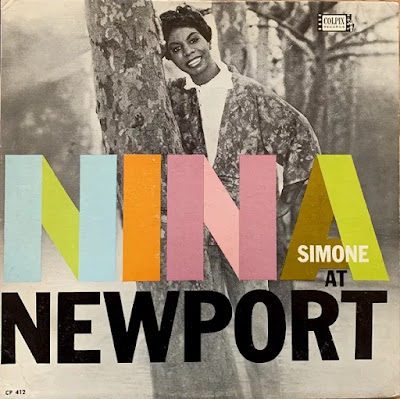
The 1960 festival was not without conflict and controversy. On July 2, the day before Waters would play, drunken patrons caused a commotion during Ray Charles' evening performance, eventually spilling out onto the streets. The violence escalated when the police used teargas and high-pressure water hoses to try to quell the crowds. Eventually, the National Guard was called in to restore order.
The rioters were, for the most part, high-school and college-aged kids from the surrounding regions. According to Marc Myers, jazz journalist and historian, the youth were drawn to the festival because of the popularity of three films: Jazz On A Summer Day, Gidget and
A Summer Place. In his 2010 Wall Street Journal article, Riot At Newport, 1960, Myers outlined how each movie contributed to a rise in popularity of jazz and the "beach-bum" youth culture.

Jazz On A Summer Day,
a colour documentary released earlier that spring, glamorized the world of jazz and, inadvertently, created the impression that "the concerts were free with limitless seating".
A Summer Place starred Troy Donahue and Sandra Dee as young lovers rebelling against the hypocritical world of their parents, while Gidget, released a year earlier, established beaches "a teenage proving grounds", Myers observed.
The riot began mid-afternoon when thousands of young people who had been tanning and drinking on the nearby beaches began heading into town where the festival was taking place. Approximately 300 partiers ignited the riot when fistfights broke out near the gates. The melee intensified when the crowds began to swell outside the brick walls of the venue. Windows were broken, glass bottles thrown and the local police were overwhelmed. Eventually, at midnight, the Rhode Island National Guard arrived to quell the violence.
The festival was nearly shut down. In an overnight session, town councilors voted 4-3 to scuttle the remaining performances. However, concert promoter George Wein persuaded them to reverse the decision after explaining that the United States Information Agency (USIA) planned to film the festival to showcase American culture (sanitized without rioting, of course). As a result, Muddy Waters and his band took the stage about 12 hours later, and At Newport 1960 was recorded.
I enjoyed multiple listens to At Newport 1960 for this blog. It features Waters (born McKinley Morganfield) and his longtime bandmates ripping through a mix of older, popular blues standards and new material penned by Waters. The musicians on stage that July evening are well known to today's blues fans -- James Cotton (harmonica), Otis Spann (piano), Francis Clay (drums), Andrew Stevens (bass) and Pat Hare (guitar).
A plaque celebrating the life of James Cotton, near his birthplace in Mississippi
My appreciation of the performances grew when I realized the context in which the concert took place. One day earlier, the venue had been a battleground. Waters and his band had tried to attend the event on the night of the riot, but their vehicle was turned away outside town.

According to harmonica-player Cotton, who was driving the car with the band, they stopped when they saw a contemporary of theirs, blues-guitarist and singer John Lee Hooker, wandering toward them with only his guitar (sans case). Hooker, whose Ultimate Collection appears at position #377 on The 500 list, barely escaped the violence. It was he who advised Waters' band to turn around after he climbed in their vehicle.
Guitarist & Singer, John Lee Hooker
This is a terrific album. A veritable Rosetta Stone for the blues scene exploding in England several years after this performance in Newport, and led to the British Invasion. If you are a fan of The Beatles, The Rolling Stones, Yardbirds, The Kinks, The Who or Led Zeppelin, spend some time with the album that almost didn't happen.

Sunday, 8 August 2021

The 500 - #358 - Sketches Of Spain - Miles Davis

I was inspired by a podcast called The 500 hosted by Los Angeles-based comedian Josh Adam Meyers. His goal, and mine, is to explore Rolling Stone Magazine's 2012 edition of The 500 Greatest Albums of All Time. 


Album: # 358

Album Title: Sketches of Spain

Artist: Miles Davis

Genre: Third Stream, Orchestral Jazz

Recorded: Columbia 30th Street Studios

Released: July, 1960

My age at release: Not Born Yet

How familiar was I with it before this week: Not At All

Song I am putting on my Spotify Playlist: Concierto de Aranjuez 

(Selected by my friend James, who grew up in Spain & gave me a brief history of Flamenco music)

We all have "concert regrets". One of my biggest happened when I turned down an opportunity to see Miles Davis perform at Massey Hall in Toronto, Ontario. My good friend Jeff, with whom I have seen dozens of concerts and live music performances, called me in the autumn of 1989 to let me know he was getting tickets and asked if I wanted any. I can't remember the reason I declined. I suspect it was because of money. Which, in retrospect, seems ridiculous. The cost was $25. Perhaps, worse still, I dismissed the opportunity by saying: "I'll see him next time."
Miles Davis Ticket from the late 80s 
Jeff did attend the concert. He was glad he went, but said the performance wasn't great. The band was exceptional, but Davis seemed to be off. We would later learn that he was quite ill. As always, Davis rarely faced the audience, preferring to angle himself toward his bandmates. A decision that some have, mistakenly, attributed to arrogance or performance anxiety.
Miles Davis performing (1960s)
Over the years, he has given many reasons for his positioning. The answer that makes the most sense is that he is leading the band, like a conductor. When asked, he told a reporter: 
"Nobody ever asks classical orchestra conductors why they have their backs to the audience. The reason is that they're telling the orchestra what to play and when. You don't criticize them for doing it, so why do you criticize me for doing the very same thing."
Miles Davis didn't like his music referred to as Jazz. He preferred to call it Social Music because it reflected the sounds of his time. That makes a lot of sense when looking at the wide spectrum of styles he adopted over his five-decade career. Books, feature films, comprehensive blogs and web-pages (including the  immersive and interactive timeline, Scaled In Miles, from 2015), have documented Davis' complex career.
Screen Capture of the Scaled In Miles Website
From Bebop to the Birth Of Cool in the early 50s, he transitioned into Hard Bop a few years later, along with a heroin addiction. He kicked heroin in the late fifties, took up boxing and began to explore Modal Jazz. At the end of the decade, he recorded his most important record, Kind Of Blue (#12 of The 500).
While recording Kind Of Blue, Davis married Francis Davis (nee: Francis Elizabeth Taylor), who was the first African-American ballerina to perform with the Paris-Opera ballet and who had transitioned to work on several Broadway (and off-Broadway) shows. Francis insisted that Miles accompany her to a performance by flamenco dancer, Roberto Iglesias in New York. 
Francis Davis, featured on the cover of Miles Davis record
Someday My Prince Will Come (1961)
Miles was completely captivated by the performance and, rumour has it, bought every flamenco album available at his local record shop. This influence is first heard on 
Flamenco Sketchesthe final track of Kind Of Blue. However, it is fully explored on record #358 on The 500, Sketches Of Spain.
Davis recording Sketches Of Spain (November, 1959)
Sketches was recorded over three days with 34 of the top jazz and classical players of the time. It is considered Third Stream, a term coined by composer, musician, lecturer and historian Gunther Schuller in 1958. It is best defined as a fusion of improvisational jazz and European classical with influences from World Music.
Gunther Schuller
By the time I made the mistake of skipping Davis' performance in 1990, he had moved through many more phases, including an electric period. When he visited Massey Hall he had become enamoured with contemporary music. Indeed, half the songs he performed that night were covers from popular artists of the time, including Michael Jackson, Cyndi Lauper, Scritti Politti and Toto.
Davis died a little over a year later, on September 28. 1991, of complications from bronchial pneumonia. When I learned the news, I deeply regretted the choice I had made when Jeff called to invite me but, if I can borrow from Davis' philosophy of improvisational playing, "Do not fear mistakes, there are none."