Sunday, 3 March 2024

The 500 - #223 - War - U2

I was inspired by a podcast called The 500 hosted by Los Angeles-based comedian Josh Adam Meyers. His goal, and mine, is to explore Rolling Stone Magazine's 2012 edition of The 500 Greatest Albums of All Time. 


Album: #223
Album Title: War
Artist: U2
Genre: Post Punk, Rock
Recorded: Windmill Lane Studios, Dublin, Ireland
Released: February, 1983
My age at release: 17
How familiar was I with it before this week: Very
Is it on the 2020 list? No
Song I am putting on my Spotify Playlist:
 Sunday Bloody Sunday
Album cover for War, featuring Peter Rowan, the brother
of U2 singer Bono's friend Guggi.
Last week, I booked two plane tickets to England. My wife and I will arrive in Manchester and, after visiting my family, travel by train through Scotland. It will be my wife’s debut venture to her ancestral homeland, her mother being a Scot. Decades have passed since I was there, and we are looking forward to the trip with excited anticipation.
When I visited at age 12, I stayed for more than a month, touring plenty of locations throughout Britain. The adults in my world were generous with their time, energy and resources to make sure I saw the now-refurbished industrial centre of Manchester, the ancient city of York, the pastoral county of Kent, the seaside mecca of Blackpool in the northwest of England and, of course, London. The moorlands of the northern counties of Lancashire and Yorkshire offer locals and visitors alike with dramatic, ever-changing vistas as clouds billow above, casting shadows across the hills and dales below.
While visiting Manchester, I had my first encounter with "The Troubles" -- what has been described as an ethno-nationalist conflict in Northern Ireland – that started in the 1960s. Tension was high in large English cities because of the unpredictable threat of guerrilla terrorism by the Irish Republican Army (IRA), a paramilitary group that sought the end of British control over Ulster (Northern Ireland) and unification with the independent Irish Republic to the south.
My mom and I were in a department store in downtown Manchester when shoppers were ordered to evacuate the building after a telephone bomb threat. It was all new to me and I didn't understand the urgency and alarm in my mother's tone as she hurried me out to the streets. My regret was having been hauled from the record department where I had been flipping through album covers.
Manchester in 1977.
Over the next few years, I became more politically aware. By the time I was 13, I had started watching the nightly news. My parents played CBC Radio religiously, including the evening news program As It Happens. Crucially, it was a time when I realized that music – classic and contemporary – held valuable lessons in history through protest songs. I didn't always understand the message behind some of those songs, but the passion and emotion were undeniable.
Journalists Barbara Frum and Alan Maitland, hosts of
As It Happens in the late 70s.
War, the third record from Irish post-punk rock band U2, was released in February, 1983. The lead single, New Year's Day, was issued a month earlier and was getting some airplay on London, Ontario, radio stations, mainly CHRW broadcasting from what is now known as Western University. I was a late convert to the band even though U2 concert shirts were popular at my high school and albums clearly displayed at local music shops. Frankly, I wasn’t convinced the Irish band was worth spending my hard-earned dollars on.
Album cover for the single release of New Year's Day.
That summer, in 1983, U2 released their first live album, the soundtrack to a  film taken of their 1983 American concert tour. Shot at the Red Rocks Amphitheatre in Colorado, Under A Blood Red Sky elevated the band significantly in North America. Furthermore, the video of the protest song, Sunday Bloody Sunday, was clipped from the concert film. When it aired on television, I recorded it on the family VCR along with other rock videos. Ostensibly, I was crafting a mixed video cassette of songs, Saturday Night Live episodes and comedy bits. That summer, I probably watched that cassette 50 times.
The song, Sunday Bloody Sunday, relates to two events of sectarian violence between Catholics and Protestants that occurred in Ireland. The first was on Sunday, November 21, 1920, in Dublin during The Irish War of Independence. The tragedy began with an IRA assassination operation led by Michael Collins that killed 15 members and associates of the "Cairo Gang",  a group of undercover British Intelligence officers. In response, British forces raided a Gaelic football match, opening fire on spectators and players, killing or critically injuring an additional 15.
News Article about Bloody Sunday and Michael Collins.
The second event occurred on Sunday, January 30, 1972. Sometimes called The Bogside Massacre, British military forces shot 26 unarmed citizens during a protest march in the Bogside area of Derry, Ireland. The march, organized by the Northern Ireland Civil Rights Association,  protested the imprisonment without trial for Irish dissidents. Later, two British tribunals cleared the soldiers of any wrongdoing, a contentious decision that is still considered a whitewashing of these tragic events.
Irish Times article following the events of Bloody Sunday, 1972.
In the early 1980s, before information on the internet was at my fingertips, it was the music of protest artists who helped me better understand history and my place in the world. In addition to U2, others were The Clash, Bruce Springsteen, Pink Floyd, Peter Gabriel, John Lennon and Elvis Costello. They sparked important conversations with my friends. We didn't get everything right. It was tough to fact check opinion in 1983. However, it is not surprising that so many of those artists occupy spots on The 500 list. War is one of five U2 records on the 2012 list and, even though "The Troubles" came to a shaky peace agreement in 1998, the themes on that record still resonate today -- particularly in light of the horrific events currently unfolding in Gaza and the still-fragile Irish pact. I thought about The Troubles a lot as I reflected on the impactful lyrics from Sunday Bloody Sunday.

"The trenches dug within our hearts,
And mothers, children, brothers sisters torn apart.

How long, how long must we sing this song?
How long?
How long?"


Sunday, 25 February 2024

The 500 - #224 - The Neil Diamond Collection - Neil Diamond

I was inspired by a podcast called The 500 hosted by Los Angeles-based comedian Josh Adam Meyers. His goal, and mine, is to explore Rolling Stone Magazine's 2012 edition of The 500 Greatest Albums of All Time. 


Album: #224
Album Title: The Neil Diamond Collection
Artist: Neil Diamond
Genre: Rock, Soft Rock, Pop, Folk, Ballad
Recorded: 1968 - 1972
Released: November, 1999
My age at release: 34
How familiar was I with it before this week: Very
Is it on the 2020 list? Sadly, no Diamond albums made the 2020 list
Song I am putting on my Spotify Playlist:
 I Am, I Said
Album cover for The Neil Diamond Collection.
Every University town has at least one legendary bar. In London, Ontario, (home of Western University) that gathering place is the Ceeps. The restaurant/tavern has been a popular watering hole for students, professors, alumni and locals for more than 100 years. It gets its name from the Canadian Pacific (C.P.) railway tracks just north of its doors on Mill Street. During homecoming week in October the taps rarely stop flowing. The tavern is so staggeringly popular on that weekend a staffer has the sole job of replenishing kegs in the vast, walk-in fridge compartments behind the bar. Rumour has it a keg empties every 15 minutes.
The infamous Ceeps line. Circa 1988.
On my 23rd birthday in 1988, I found myself at the Ceeps with a group of friends. While there, I ran into Shawn Burk, whom I knew casually through a mutual friend, James Fast. As it turns out, it was Shawn's birthday, too. We downed a celebratory drink as we chatted about sports, theatre and music. When I inquired  about his favourite bands, he quickly replied: "Judas Priest and Neil Diamond."
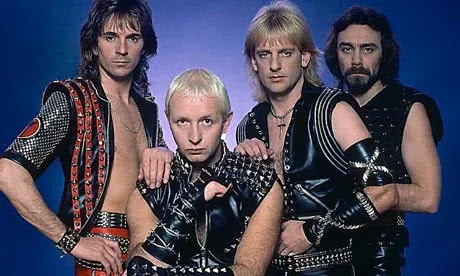
Judas Priest in their 80s heyday.
Back then, being a fan of leather-clad, British heavy metal groups was not unusual. Most of my friends, myself included, owned copies of Priest's seminal records, British Steel, Screaming For Vengeance and Sad Wings Of Destiny. However, admitting that you liked the music of uber-cheesy, soft-rock crooner Neil Diamond was bewildering to me.
Neil Diamond, performing in the 70s.
Fast-forward a few days and I found myself in Shawn's car as he blasted tracks from Hot August Night -- Diamond's 1972 live recording from The Greek Theatre in Los Angeles. By the time we got to the closing song, Soolaiman/Brother Love's Travelling Salvation Show, I was a fan. Sadly, there are no Diamond records on the 2020 edition of The 500. Hot August Night should be.
Album cover for Hot August Night, Neil Diamond (1972).
Shawn and I became terrific friends that summer. We both had a mischievous, theatrical streak. We got our hands on a video camera and started making silly, guerilla-style productions for our friends’ amusement. One afternoon, we set up shop in the hallway of a local mall, posing as representatives from the Kraft Food Company conducting a taste test. Curious mall patrons sampled marshmallows A and B -- and we dutifully noted their preferences on a clipboard. In truth, both "types" of the fluffy, white confectionary treats were the same. Regardless of the a volunteer's choice Shawn would proudly announce: "That's the Kraft Marshmallow!" It was harmless fun that lasted until mall security became suspicious and we scrammed.
Kraft Marshmallows - certainly London's favourite on that 1988 afternoon.
The Neil Diamond Collection is a compilation record released in 1999, containing Diamond's hits from 1968 - 1972. It contains most of the songs I heard on Shawn's car stereo. Diamond, born in 1941, lived a fascinating life even before deciding he wanted to become a songwriter and performer. Born
and raised, for the most part, in Brooklyn, New York, he attended high school with singer Barbara Streisand and chess grandmaster Bobby Fischer.
32 years after being classmates, Streisand and Diamond scored a hit with the duet You Don't Bring Me Flowers in 1988.
Diamond was a member of the school's fencing team with his best friend, future Olympic fencer Herb Cohen. Diamond was good enough to secure a fencing scholarship to New York University where he enrolled in a pre-med program with the goal of becoming a doctor. However, in his senior year and just 10 credits shy of graduation, he made the bold decision to quit medical studies for a job writing songs at Sunbeam Music Publishing. It paid $50 a week, the equivalent to $450 today.
Diamond in a recording studio in 1963.
I was fortunate to see Diamond at Maple Leaf Gardens in 1993 during his Love In The Round tour. Shawn was with me. The 30-song set was performed, without a break, by the then 52-year old entertainer on a circular stage in the centre of the legendary hockey rink. The performance and the Collection album were reminders of the impressive  number of hits the former medical student, known as “The Jewish Elvis”, has penned.
Thirty-eight of his songs have reached the top 10 on Billboard's Adult Contemporary Charts. He has been inducted into the Songwriters Hall Of Fame and The Rock And Roll Hall Of Fame, as well as receiving a Lifetime Achievement Award from The Grammys. As Josh Adam Meyers postulated on the accompanying episode of The 500 Podcast, "Diamond wrote a significant chapter in The Great American Songbook". I agree. Why is he not represented on the 2020 list?

Diamond entering the Songwriter's Hall Of Fame in 1984.
In January 2018, Diamond announced his retirement from touring due to a diagnosis of Parkinson's Disease. He lives in Basalt, Colorado, with his former manager, now wife Katie McNeil.

Diamond and McNeil in 2011 when he received the 
Kennedy Center Honors. 
I visit the Ceeps occasionally – typically in the summer when its expansive patio opens -- connected to its second bar, Barneys. Shawn moved to Toronto, but we remain friends. I am tremendously grateful to him for letting me couch surf at his apartment in 1991 when I first took an ill-fated restaurant job in Toronto. He was also a sympathetic ear in 1996 when my girlfriend, now wife, and I temporarily broke up. His decision to show me the film Swingers in order to help me shake my funk was an inspired decision.
When Shawn and I reconnect, it is easy to pick up where we left off – talking sports and music and laughing about our many videotaped hijinks. We still contact each other on our shared birthday to offer good wishes for another year. I am still a Neil Diamond fan because of him.

Monday, 19 February 2024

The 500 - #225 - American Idiot - Green Day

I was inspired by a podcast called The 500 hosted by Los Angeles-based comedian Josh Adam Meyers. His goal, and mine, is to explore Rolling Stone Magazine's 2012 edition of The 500 Greatest Albums of All Time. 


Album: #225
Album Title: American Idiot
Artist: Green Day
Genre: Punk Rock, Pop Rock, Concept Rock
Recorded: Three Studios in California
Released: September, 2004
My age at release: 39
How familiar was I with it before this week: Very
Is it on the 2020 list? Yes, at #248, dropping 23 places since the 2012 list.
Song I am putting on my Spotify Playlist: Jesus of Suburbia
Like many people of my vintage who did not have older siblings, my first record collection belonged to my parents. Nestled among the Nana Mouskouri, Elvis Presley and Mario Lanza records were a small assortment of soundtracks from movies and musicals. Some came from films I had seen -- The Sound Of Music, Oliver and Mary Poppins. Others were from unfamiliar sources -- Saturday Night Fever, Fiddler On The Roof and My Fair Lady.  Regardless, I loved them all and spent many Saturday afternoons doing school work or sorting hockey cards while listening to Chaim Topol as Tevye the Milkman sing If I Were A Rich Man.
Fiddler On The Roof album cover depicting Tevye the Milkman.
It's a bit of pop-psychology on my part, but I think this is where my love of concept albums, particularly those composed in the 1970s, was born. There is no consensus from music critics on the definition, but a "concept album" typically refers to a record that, much like the songs on a soundtrack to a musical, contains individual tracks that hold a larger meaning collectively than they do on their own. Generally, the meaning is communicated through a theme or central narrative.
An assortment of concept records, including a few of my favourites.
In 1979, as I was starting to develop my teenage taste in music, I discovered two records that supercharged my passion for the concept album and made me a fan for life of the respective creators. The first was 2112, a 1977 release from the Canadian progressive-rock trio Rush. Side one features a 20-minute, seven-part rock suite about a dystopian, collectivist future ruled by a cabal of virulent priests who outlawed individualism and creativity. It was the kind of content my 14-year-old brain craved.
Album cover for 2112 by Rush.
The other record was The Wall from British progressive-rock group Pink Floyd (#87 on The 500). At the time, this two-record epic meditation on war, loss, addiction, isolation, celebrity and fascism was almost too much for me to comprehend. In fact, I spent many hours throughout high school trying to understand all its subtleties. In retrospect, that time might have been better spent on my studies but I regret nothing.
Album cover for Pink Floyd's The Wall.
Throughout the ‘80s and early ‘90s, concept albums remained an important part of my audio diet. Others released before 1980 could be found in used record bins, such as The Lamb Lies Down On Broadway (Genesis, 1975), Thick As A Brick (Jethro Tull, 1972) or Tommy (The Who, 1969, at #96 on The 500). More were released as I hit my 20s, including Misplaced Childhood (Marillion, 1985) and Operation: Mindcrime (Queensryche, 1988). The complex musicianship and clever, political, emotional and socially charged lyrical content synced with my disaffected, socially-critical early-twenties mindset.
Album cover for Operation: Mindcrime, Queensryche.
Then, around 1990 and in my mid-20s my interest in concept albums waned. My appetite for themes of rebellion, unrequited romance, tragedy and social commentary, so robust in my youth, began to shift as my taste in music broadened and perspective matured. By 2004, when Green Day's American Idiot was released, I believed the concept album was a relic of the past. Moreover, with the release of the iPod and a variety of other digital music players, it seemed the "album" itself was dead as a standard packaging of tracks.
2nd Generation Nano iPod playing Jesus Of Suburbia,
from Green Day's American Idiot (2004)
Indeed, in 2004-05, I was teaching Grade 8 students, many of whom owned one of the small, digital music players on the market. Their focus was on individual songs rather than albums. These 13-year-old music fans regarded vinyl records and compact discs as prehistoric media of their parents' generation. Then along came American Idiot, the seventh studio record from California pop-punk trio Green Day, and changed everything for them...and me.
Green Day are (l-r) Mike Dirnt, Billie-Joe Armstrong & Tre Cool. 
Seemingly overnight, the fashion in my classroom shifted. Sure, there were many still sporting a hip-hop look, with closely cropped Eminem-styled haircuts, oversized baggy pants that hung below their boxer short waistbands and flat-brimmed baseball hats turned comically sideways on their heads. However, some (particularly the girls) began sporting skinny jeans, untucked black button-down shirts, beanie hats, studded chokers, red ties and Converse sneakers. And, of course, Green Day concert T-shirts -- especially after May, 2005, when the band performed at the John Labatt Centre in my hometown of London, Ontario.
Green Day Fashion for teens (circa 2005)
Rest assured, this then-39-year-old teacher did not adopt the punk-rock ensemble...mid-life crisis aside. However, like many of my students, I obtained a copy of the entire record, not just a few tracks, and for the first time in more than 15 years, I was emotionally invested in a concept record. In 2005, I even bought the CD and DVD, Bullet In A Bible,  featuring a live performance from their American Idiot U.K. tour.
The punk-rock opera features a narrative set in the shadow of 9/11, the Iraq War and the presidency of George W. Bush. The protagonist is a disillusioned teenage slacker, dubbed the Jesus of Suburbia. This anti-hero describes himself as "a son of rage and love", surviving on a "steady diet of soda pop and Ritalin", looking for meaning in a world where he feels he cannot trust the media or government.
In many ways, the themes on the record line-up nicely with those concept records I loved in my teens/early twenties -- 2112, The Wall, Misplaced Childhood, The Lamb and Operation:Mindcrime. However, listening to American Idiot when I was 39 failed to inspire the same revolutionary, nihilistic energy of my youth. The angry, romantic outsider that I used to be had been replaced by a calm, professional adult staring down his 40s. Regardless, I embraced the record and enjoyed seeing my young students connect  with its message of moral, political and social outrage. Most of all, I enjoyed watching them head toward their high-school years, inspired by art the same way I had been two decades earlier. That time when fascination with Fiddler On The Roof turned passe I discovered that music and lyrics could be complex narratives, shaping and lasting a lifetime.

Sunday, 11 February 2024

The 500 - #226 - Nebraska - Bruce Springsteen

I was inspired by a podcast called The 500 hosted by Los Angeles-based comedian Josh Adam Meyers. His goal, and mine, is to explore Rolling Stone Magazine's 2012 edition of The 500 Greatest Albums of All Time. 


Album: #226
Album Title: Nebraska
Artist: Bruce Springsteen
Genre: Folk, Heartland Rock, Lo-Fi Indie
Recorded: Springsteen's rented home in Colt's Neck, New Jersey
Released: September, 1982
My age at release: 17
How familiar was I with it before this week: Fairly
Is it on the 2020 list? Yes, at #150, moving up 76 places since the 2012 list.
Song I am putting on my Spotify Playlist: Nebraska
It was recently announced that Jon Stewart intends to return to The Daily Show (TDS) –.a half-hour satirical television newscast and interview program that has aired on Comedy Central since 1996. Originally hosted by Craig Kilborn for its first two years, comedian Stewart took the helm in 1999 and stayed with the program for the next 16 years. The following six years featured South African comedian Trevor Noah as host. When he departed in December, 2022, TDS decided to rotate guest hosts, among them Al Franken, Sarah Silverman and Roy Wood Jr.
The three longest serving hosts, (l-r) Kilborn, Stewart and Noah.
These days I watch TDS far less than I once did and although I enjoy the occasional episode, it is not the appointment viewing that had me riveted during Jon Stewart's tenure. In fact, on August 16, 2006, two days before I was married in New York City, my bride, her father, my pal Steve "Lumpy" Sullivan and I attended the taping of an episode. The guest was former New Jersey Governor Thomas Kean. During a Q&A session before the show, Lumpy was able to ask Stewart a question about his career in television.
Stewart behind the desk on The Daily Show.
On Monday, February 12, Stewart will return to the TDS desk and he plans to host Monday episodes for the remainder of the year -- a presidential election year in the United States. There is unlikely to be a shortage of comedic fodder for Stewart's biting satirical wit. His remarkable intelligence, coupled with his compassion and reasonable outlook on humanity and politics is compelling, engaging and highly entertaining. Additionally, Stewart isn’t just an armchair political critic. He is willing to engage in important political and social issues. In 2019, the longtime New York resident worked tirelessly to ensure 9/11 first responders were provided with funding for health care.
Stewart appearing in the U.S. Congress with 9/11 first responders.
If you  are wondering why I am prattling  on about a political comedian in a post about Bruce Springsteen's sixth studio record, Nebraska, it’s because  Stewart was asked to speak at the 2009 Kennedy Center Honors Award show when Springsteen was among the recipients.
Kennedy Award recipients, flanked by Michelle and Barack
Obama were - (l-r) Mel Brooks, Dave Brubeck, Grace Bumbry
Robert Di Nero and Springsteen.
Stewart's speech about Springsteen is one that my friends and I have watched many times. In typical Stewart fashion, his prose was brilliant, punctuated by insightful commentary and delightful wit. It is well worth the effort to watch the entire piece. There are a few lines that perfectly capture the spirit of Springsteen and his impact on contemporary music listeners. Listen to Stewart as he encapsulate the way I feel about music and about Springsteen's powerful impact:
"I didn't understand his (Springsteen's) music for a long time. Until I began to yearn. Until I began to question the things I was making and doing in my own life. Until I realized it wasn't just about the joyful parade on stage and the theatrics. It was about stories of lives that could be changed...When you listen to Bruce’s music, you aren’t a loser. You are a character in an epic poem...about losers. But that is not the power of Bruce Springsteen. It is that whenever I see Bruce Springsteen do anything, he empties the tank – every time...And we, on the receiving end of that beautiful gift, are ourselves rejuvenated, if not redeemed."
Stewart’s remarks galvanize the spirit and energy of Nebraska  – the fourth of eight records by Springsteen on the 2012 edition of The 500Nebraska deals with ordinary, down on their luck, blue collar characters who are facing a challenge or turning point in their lives. The songs are often bleak in theme and some deal with criminal activities. The tone is set immediately with the opening track, Nebraska, which is based on 19-year-old spree killer Charles Starkweather who, during the winter of 1957 and 1958, murdered eleven people. When he was arrested, he was accompanied by his 14-year-old girlfriend and accomplice Caril Ann Fugate. Their story was, in part, inspiration for the films Badlands, Natural Born Killers and Kalifornia. In fact, it was Badlands that inspired Springsteen to research the murderous pair and write the song.
Starkweather's arrest photos.
Springsteen recorded most of the record at his home studio in Colt's Neck, New Jersey, in a house he was renting following a successful tour promoting his 1980 record, The River. (#253 on The 500). Initially, he planned to be accompanied by his backing group, The E Street Band. However, it was decided to release the record in its original, stripped-down, acoustic form. The band did tinker with the tracks and Springsteen fans have long speculated whether those recordings, often dubbed Electric Nebraska, will ever be released. A few can be found on the internet, but a polished, official release seems unlikely.
A fan-made mock up of the Electric Nebraska album cover.
I'm content to stick with the original. Much like The Daily Show, I like the classic content best. Re-listening to Nebraska in preparation for this post, reminded me why I like Springsteen so much. He helps me understand my own yearning and reinforces the fact that just hearing his songs puts me on the "receiving end of that beautiful gift...and I am rejuvenated...and redeemed."