Monday, 6 March 2023

The 500 - #275 = The Slim Shady LP - Eminem

I was inspired by a podcast called The 500 hosted by Los Angeles-based comedian Josh Adam Meyers. His goal, and mine, is to explore Rolling Stone Magazine's 2012 edition of The 500 Greatest Albums of All Time. 


Album: #275

Album Title: The Slim Shady LP

Artist: Eminem

Genre: Hip Hop, Horrorcore

Recorded: Studio 8, Ferndale, Michigan

Released: February, 1999

My age at release: 33

How familiar was I with it before this week: A little

Is it on the 2020 list? Yes, at #352 (dropping 77 places since 2012)

Song I am putting on my Spotify Playlist: Brain Damage

In my last post, I wrote about my first year of full-time employment as a teacher. I had been hired as a music educator for Grade 4 - 8 students. To connect with my young charges, I would play music as each class entered or exited my music room. Posters of musicians from different eras plastered the walls diverse genres (Mozart, Miles Davis, Pink Floyd, Dave Matthews Band and Run DMC, to name a few).
The Miles Davis Poster I had in the music room
Additionally, I invited students to bring in compact discs to be played during the next period. Many of them came from challenging socio-economic situations and others were "street-smart" beyond their years. This was 2000, just as Eminem exploded into popular hip-hop culture with the release of his second studio album, The Slim Shady LP. Among the different grade cohorts were fans of the hip-hop and rap genre, and some even sported Eminem's closely-cropped "Caesar haircut".
Eminem (Marshall Mathers)
As you might have guessed, it wasn't long before a student produced a compact disc copy of Eminem's album and asked if we could play it in class.

"It's got a couple bad words though." he said in earnest.

"Let me give it a listen tonight," I replied.


If you are familiar with The Slim Shady LP, you already know where this story is going.  If you don't, check out  the lyrics to the first two tracks – My Name Is or Guilty Conscience – for a dose of anger, violence and misogyny. However, neither prepares you for the song '97 Bonnie & Clyde -- a fantasy scenario, complete with sound effects, where Eminem disposes of the corpse of his ex-wife, Kim Mathers, in a lake while their infant daughter is strapped into the car seat. He speaks as one might talk to a toddler:
Needless to say, I was aghast. However, I reminded myself that "every generation is shocked by the music of the next". 
After all, my mom wouldn't let me purchase KISS or Meat Loaf records because of the album covers, and I distinctly remember how horrified my grandfather was when the Sex Pistols and punk rock hit the scene while I was visiting England in 1977.
Article on Sex Pistols in U.K.'s Daily Mirror
Still, I determined this wasn't going to be played in music class and I returned the CD the next day with a few cautionary words.

"It's not the swear words," I said. "It's more the violence toward women that concerns me."

"He's just kidding about that, he doesn't mean it," came the reply.


I have since learned that this student wasn't entirely wrong with his assessment. The "Slim Shady character" is an alter-ego that represents Eminem's hyper-masculine, dark, troubled and evil side. The character is used within the confines of a sub-genre of hip-hop called “horrorcore”, which intentionally leverages dark, violent and transgressive lyrical content to court controversy. It is to music what slasher-flicks are to film and, much like the aggressive, over-the-top violence in Friday The 13th or Texas Chainsaw Massacre. It is not meant to be taken seriously.
A collection of horrorcore hip-hop artists including Eminem (top left)
There is good reason that Eminem, born Marshall Bruce Mathers III, has a dark, troubled persona lurking within him. Like many students I have worked with over the years, his early life was shaped by abandonment, poverty, physical and mental abuse, as well as frequent housing insecurity.

Born in 1972 in St. Joseph, Missouri, to Marshall Bruce Mathers Jr. and Deborah Rae "Debbie" Nelson, Eminem’s father, soon abandoned the family in order to return to California and his other two children. Debbie, shuttled her son between Missouri and Detroit, Michigan, trailer parks and low-income homes for most of his childhood. Among the places they lived was the Continental Mobile Village near 8 Mile Road in Warren, Michigan -- the setting for his 2002 semi-autobiographical film.
Growing up in predominantly black communities he was treated as an outsider and badly bullied including an assault in elementary school that hospitalized him. He recounts the events in the song Brain Damage from The Slim Shady LP.
Social service investigators were regularly involved in his unstable and traumatic life, with one social worker describing his mother, Debbie, as having addiction issues and a "suspicious, almost paranoid personality". In his song, Cleaning Out My Closet, Eminem reveals that his mother put prescription medications in his food to make him feel ill, ostensibly to keep him home where she could protect him. Often dubbed Munchausen Syndrome By Proxy -- this condition is a mental illness and form of child abuse where a care-giver causes symptoms that make a child feel unwell, often to isolate the victim from the outside world.
As Oscar Wilde famously said: "There is only one thing in life worse than being talked about, and this is not being talked about." The polarizing Eminem has certainly been talked about over his 25-year career. He is loved and loathed by many.

Eminem has courted controversy for decades while simultaneously rising to fame as one of the greatest rappers of all-time. Sometimes dubbed "The King Of Hip-Hop", he is the best-selling solo-rapper ever. His 2002 record, The Marshall Mathers LP (#244 on The 500) sold 11 million copies in the U.S. alone.

I'm at a bit of a crossroads here.

  • My exploration into the world of hip-hop has led me to recognize that Eminem is a gifted wordsmith who deeply understands the interplay between beats and bars. I intend to explore his clever use of multi-syllabic, internal rhyme in a future blog.
  • I also understand that, like a blood-soaked gun battle in a Tarantino film, his horrorcore lyrics are not to be taken seriously.
  • I also know he suffered mightily in his childhood, which led to addiction issues and mental health struggles, exacerbated by an autism diagnosis that was missed until adulthood..
However, I continue to think back to that 12-year-old in my Grade 8 music class who first brought me The Slim Shady LP. He was a bright chap and, clearly, he could separate the messages on this record from reality. Is that the case for the millions of young boys, with their Caesar haircuts, who worshipped and emulated either Eminem or the Slim Shady character who has...
  • Elevated verbal abuse and degradation, particularly of women, to an art form?
  • Amplified and glorified the image of a hyper-masculine male, who casually drops homophobic slurs, while perpetuating the notion that women are attracted to insensitive men who do not respect them?
  • Portrayed a semi-fictional version of themselves as a sympathetic underdog who rebelled against impossible odds? One who not only should be forgiven, but lionized for offensive and warped utterances?
Which takes me back to the same spot I was at when I first listened to this record in 2000. With one exception (I’ve put a track on my Spotify 500 Playlist) I've heard enough to know I’m not going to play it anymore.

This week I talked to several twenty and thirty-somethings who reported that they liked or even loved this record – some admitting they memorized every word while in elementary school.

I thought back to my teenage fascination with Black Sabbath, Dio or the aforementioned Sex Pistols. The music did not make me a satanist or an anarchist. I too understood that "they didn't mean it". So, in the words of The Who: “The Kids Are All Right”.

As my friend’s 30-year-old son put it: “I don’t listen to the Slim Shady LP often, although revisiting it is a guilty pleasure – his later material is far superior, after he got off the drugs”.

We’ll find out soon enough, I get to The Marshall Mathers album in 30 weeks.


Sunday, 26 February 2023

The 500 - #276 - Mothership Connection - Parliament

I was inspired by a podcast called The 500 hosted by Los Angeles-based comedian Josh Adam Meyers. His goal, and mine, is to explore Rolling Stone Magazine's 2012 edition of The 500 Greatest Albums of All Time. 


Album: #276

Album Title: Mothership Connection

Artist: Parliament

Genre: Funk, Funk Rock, Black Prog

Recorded: United Sound (Detroit) Hollywood Sound (L.A.)

Released: December, 1975

My age at release: 10

How familiar was I with it before this week: Somewhat

Is it on the 2020 list? Yes, at #363 (dropping 87 places since 2012)

Song I am putting on my Spotify Playlist: Handcuffs

When I graduated from Teachers' College in 1996, I struggled to get full-time employment. I was fortunate in being hired as an occasional teacher by the London School Board (now Thames Valley) in Ontario. However, I continued bartending evenings and weekends to supplement my income. Cash was tight back then. In fact, I seriously considered moving to another country where teaching jobs were plentiful. At the time, the city of Las Vegas was booming and the state offered a generous package to Canadian teachers in an effort to lure them. I stayed put.
In July, 2000, after four financially difficult years, I finally got my shot. I was interviewed for a position at Lorne Avenue Public School. Half my day would be with a split Grade 5/6 class and the other half would be teaching music to Grades 4-8. I was cautiously optimistic. I had built a good relationship with the two principals interviewing me, but I did not have a music degree. I was upfront, pitching myself as an average saxophone player and hobby guitarist who was willing to take on the challenge.
Me (left) sitting in with my friends' band in 2007
To my delight, I got the gig. However, it didn't take long for reality to set in. How did I go about preparing for a split class and another in which I had no formal music training? Fortunately, I had the summer to plan and I registered for several music teaching workshops. To do that I had to drive 200 km round trip to a neighbouring city to learn a well-regarded approach to music education pedagogy called the Kodály method.

September was rocky. Many of the instruments in the music room were in need of repair, so we had to start the year with singing and theory. My naïveté and inexperience was obvious to my young charges, many of whom had difficult backgrounds and who were already jaded about the educational experience – particularly the arts.

The former Lorne Avenue Public School (demolished in 2016)
Recruiting help was a good start. Fortunately, I played hockey with a group of local musicians and, throughout the year, they generously donated their time to come to my music classes and perform. My thinking was simple. Inspire a love of music by showing the students what was possible. Eventually, I persuaded a few of the braver students with some music knowledge to join the bands on stage. I was most proud of an arrangement of Stray Cat Strut I taught to a group of saxophone, clarinet and trumpet players so they could accompany my pals’ group, Reverend Freddie and The Distillers, when they visited the school the following April.

Promotional poster from the Reverend Freddie & The Distillers 
performance at Lorne Avenue (April 6, 2001)
At the same time, my wife (girlfriend at the time) was working in a Blues and Jazz bar called Boomerz in our hometown of London and we had become friends with an award-winning Funk and Soul group dubbed LMT Connection.
LMT Connection (l-r) - Mark Rogers, Leroy Emmanuel and John Irvine 
One evening, as we all sat for drinks following a blistering set by the Niagara Falls-based trio, I asked how much it would cost to bring them in to play for my students. Rogers suggested reaching out to the Central Ontario Musicians Union for a grant. A plan was hatched. When the band was next booked to play Boomerz on a Friday night, they would perform at the school in the afternoon.
Beyond his exceptional musicianship, Emmanuel is also an incredible front man and story-teller. That afternoon, he captivated 150 cross-legged Lorne Avenue music students with his light-hearted and funny banter. Born in Atlanta, but raised in Detroit, Michigan, the now 76-year-old Emmanuel has been playing live music since he was 12, touring and performing with Gladys Knight, Marvin Gaye, Stevie Wonder and Al Green.
The students loved every story and performance and were literally rocking in their places when the band broke into legendary funk hits from George Benson, James Brown, The Commodores and this week's featured artist, Parliament.
Parliament in the early 70s
Mothership Connection is the fourth album released by the legendary American funk collective, Parliament. Recorded between March and October, 1975, it was the first to feature saxophonist Maceo Parker and trombonist Fred Wesley who had been in James Brown's band. The record was produced by bandleader, singer and founder, George Clinton.
George Clinton
Known for his outrageous outfits and outlandish fashion sense, Clinton originally formed The Parliaments as a doo-wop group while working in a barber shop in Plainfield, New Jersey. For a short time, the group moved to Detroit and Clinton worked as a staff songwriter for Motown records. The Parliaments had a hit in 1967 with the song (I Wanna) Testify for Detroit- based Revilot Records. Shortly after, the record company ran into financial trouble and Clinton refused to record any more material until he received a settlement. While this legal/financial battle was ensuing, Clinton was not able to use the name The Parliaments.
Clinton's exploration into the world of psychedelia and his fascination with science fiction and surreal humour were a catalyst for a change in musical direction. Consequently, he recorded new material with the same group under the name Funkadelic (See Maggotbrain, #479 on The 500 Blog in May, 2019).
Later that year, he regained the right to use the name The Parliaments but wanted to switch to a different genre and combine elements of contemporary musicians he admired, including Jimi Hendrix, James Brown, Sly and the Family Stone, and Frank Zappa. The result was an eclectic, psychedelic form of funk that can be heard on Mothership Connection and the 10 records Parliament recorded between 1970 and 2018, as well as the 15 studio releases from Funkadelic or, as they are often grouped, P-Funk.
Partial discography for Parliament and Funkadelic
Funk music always puts me in a good mood and the sound of P-Funk is a favourite. However, hearing it always makes me think of a small gymnasium full of 9-14 year-olds bopping to the sound of Leroy Emmanuel and LMT Connection. I wish I had some photos or a video from that day, but this video from a performance in 2009 provides a taste of their work

Post Script: The 2000-2001 school year was the only year I worked as a music teacher. I moved to a Grade 6 classroom full-time the next year and my replacement was an exceptional educator named Joe Lee. He and I continued to bring musicians into the school and, over the next decade, he shaped the music program at Lorne Avenue into one of the best in the city. We even brought an Elvis tribute act in to perform for the school with our students backing on horns -- but that is a story for album #56 on The 500 -- Elvis Presley. Meet you there in about 4 1/4 years.

Thanks for reading -- all the blogs can be found here (just scroll down).


Sunday, 19 February 2023

The 500 - #277 - Rhythm Nation 1814 - Janet Jackson

I was inspired by a podcast called The 500 hosted by Los Angeles-based comedian Josh Adam Meyers. His goal, and mine, is to explore Rolling Stone Magazine's 2012 edition of The 500 Greatest Albums of All Time. 


Album: #277

Album Title: Rhythm Nation 1814

Artist: Janet Jackson

Genre: Pop, R&B, New Jack Swing

Recorded: Flyte Time (Minneapolis, Minnesota)

Released: September, 1989

My age at release: 24

How familiar was I with it before this week: Quite

Is it on the 2020 list? Yes, at #339 (dropping 63 places since 2012)

Song I am putting on my Spotify Playlist: Black Cat

Janet Jackson was the tenth-born and youngest member of the famous Jackson family. Born in 1966, she was16 years younger than the oldest member, Maureen and her mega-famous brother, Michael, was eight years her senior. In fact, Michael was already performing with his four brothers in The Jackson 5 in 1964, two years before Janet was born.
Promotional poster & photo from Jackson 5 (1965)
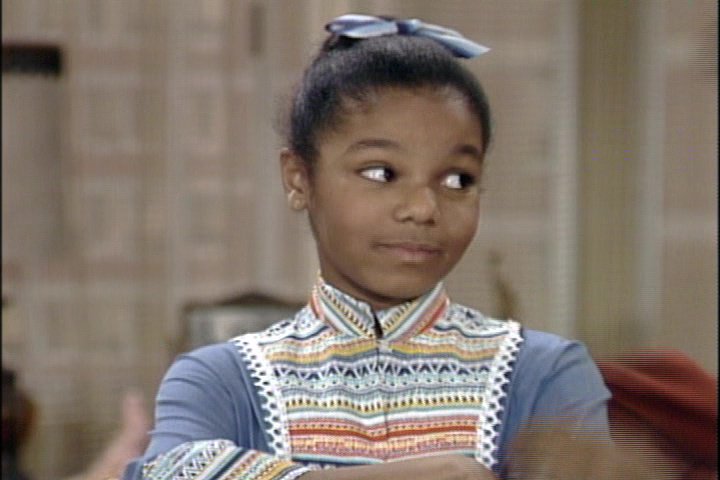
Janet made her entertainment debut in 1976, appearing on the weekly variety television program, The Jacksons, with her multi-talented family. She went on to appear in many other television roles in the late ‘70s and early ‘80s, including Diff’rent Strokes, The Love Boat and Fame. However, it was the program Good Times that brought her to my attention.
Janet Jackson in varous television roles (70s & 80s)
Good Times was an American situational comedy that ran from 1974 until 1979. Developed by legendary producer Norman Lear (All In The Family, Sandford & Son, One Day At A Time, The Jeffersons), it was a spin-off from another Lear project, Maude.
Norman Lear Television Programs from the 70s
Good Times aired during when my friends and I were discovering, and ravenously devouring, prime time television (ages 8-14). The previous evening's television was the “water-cooler topic” at my school playground and being out of the loop on the latest plots, dialogue and catch-phrases of ‘70s TV could socially isolate you, making you a pop-culture pariah. By today’s metric, missing a new episode of popular television would be the equivalent to being oblivious to the latest viral TikTok trend or lacking knowledge of the hippest meme lingo.
“Meme man” with stocks intentionally misspelled was required knowledge
among my 7th graders a few years ago. (
Know Your Meme history here)
Good Times was a dramatic comedy (dramedy) set in a poor, black housing project in inner-city Chicago. The series centred on the Evans’ family who collaborated to overcome the social challenges faced by many African American families in the 1970s – poverty, job loss, inflation, crime, gang activity, pregnancy, sexually transmitted diseases and drug use.
The Evans Family from Good Times 
Janet Jackson joined the cast in Season Five (1977), playing the role of Millicent “Penny” Gordon, an abused girl who was abandoned by her mother and, eventually, adopted by the Evans’. The addition of adorable, 11-year-old Jackson as a sympathetic character was intended to re-energize the show following the departures of veteran actors John Amos (James Evans) and Esther Rolle (Florida Evans).
Jackson as Millicent "Penny" Gordon
Introducing a new, cute and younger child to a cast is often called “The Cousin Oliver Strategy”. The term references the addition of cousin Oliver to the cast of The Brady Bunch in their fifth season. In both cases, by bringing in (Cousin Oliver and the adopted Penny Gordon), series producers were hoping to reverse declining ratings and connect each series with a younger audience.
Cousin Oliver (centre) between the two youngest Brady kids
In both cases, the casting was short-lived and both series were cancelled within two years. I was never a fan of Cousin Oliver, but I really liked Jackson’s Penny – not just the precocious, funny, sympathetic character, but also Jackson who was charming and pretty. Granted, I was 12 going on 13, I think I had a crush on nearly every female aged 12-30 on television.
Rhythm Nation 1814 exploded onto the music scene in fall of 1989. It was Jackson’s fourth studio album but only the second since she became an adult and wrested control of her artistic image and sound from her manipulative, abusive and controlling father, Joe. Three years earlier, Janet had teamed up with producers Jimmy Jam and Terry Lewis to release her third studio album, Control, an unconventional record that fused R&B, rap, funk, disco and synthesized percussion. The aptly named Control was a massive success, going to the top of multiple charts and selling 10 million copies worldwide.
Album cover for Control (1986)
For obvious reasons, record executives hoped that Rhythm Nation 1814 would simply replicate the chart-busting formula of Control and the seven hit-singles it generated. However Jackson and producers Jam and Lewis had different plans. Much like the storylines on Good Times, Jackson's fourth project a concept album with overarching themes of social justice and equality weaved throughout. Jackson drew inspiration from the tragedies of poverty, racism and substance abuse in contemporary news stories, and presented the sociopolitical utopia of a "Rhythm Nation" as an alternative.
Chorus of Rhythm Nation - the second single from the album
When asked about the concept of a Rhythm Nation, Jackson said: 
"I thought it would be great if we could create our own nation." She added that it would be "one that would have a positive message and that everyone would be free to join." She based the idea on the prevalence of various youth groups and organizations that are formed as a means of creating a common identity. The number "1814" represents the year the U.S. national anthem, The Star-Spangled Banner, was written. Some noticed that "R" (Rhythm) and "N" (Nation) are the eighteenth and fourteenth letters of the alphabet, though Jackson said this was a happy coincidence. (Pity, I would totally have taken credit for that bit of cleverness).
Jackson in the Rhythm Nation video
The video that accompanied the title track was a critical and commercial juggernaut and can be seen here. Shot in black and white, it featured 23-year-old Jackson decked out in stylistic, unisex military garb performing a mesmerizing choreographed dance sequence in what is best described as a post-apocalyptic warehouse setting. 

The video went on to receive two MTV video music awards for “Best Video” and “Best Choreography”, as well as a Grammy for “Best Long Form Video”. It is also cited as an influence by numerous contemporary artists, including Lady Gaga, Britney Spears, Beyonce, Pink and Rihanna.
Rhythm Nation video
Rhythm Nation 1814 also received numerous award nominations and, because it dominated the charts from August, 1989, to March, 1991, it was the first album to produce number one hits on the chart in three calendar years. Jackson also became the first woman to be nominated for a Producer of the Year award by The Grammy Awards committee.
Jackson cleaned up at the 1990 Billboard Music Awards
I did not purchase this record, but it was omnipresent for two years and certainly part of the soundtrack of my life in my early twenties. At the time, I was 24 and investigating a career as a restaurant manager. A cassette version of RN-1814 was a staple on the kitchen sound system, especially early in the morning when the prep-team was hard at work. Revisiting it this week was a delight. I was amazed at the number of lyrics I still knew from memory. It also reinforced my sentiment that, despite Michael’s massive global fame and impressive musical catalogue, Janet is still my favourite Jackson. After all, adolescent crushes have staying power.

Thanks for reading -- all the blogs can be found here (just scroll down).