Sunday, 3 July 2022

The 500 - #310 - Blood Sugar Sex Magik - Red Hot Chili Peppers

I was inspired by a podcast called The 500 hosted by Los Angeles-based comedian Josh Adam Meyers. His goal, and mine, is to explore Rolling Stone Magazine's 2012 edition of The 500 Greatest Albums of All Time. 


Album: # 310

Album Title: Blood Sugar Sex Magik

Artist: Red Hot Chili Peppers

Genre: Funk-Rock, Rap-Metal, Funk-Metal, Alternative

Recorded: The Mansion, Los Angeles, California

Released: 1991

My age at release: 26

How familiar was I with it before this week: Very

Is it on the 2020 list? Yes, at #186, Moving up 124 spots

Song I am putting on my Spotify Playlist: Breaking The Girl

In the spring of 1992, I was finishing my degree at Western University in London, Ontario, while working six or seven days a week at East Side Mario’s restaurant. The Canadian- based chain of casual restaurants "specializes" in Italian-American "cuisine". It is to Italian food what Taco Bell is to Mexican fare -- it's not authentic, or particularly good, but it is inexpensive and acceptable. The location where I worked was wildly popular and busy with crowds of all ages from lunch until close.  
It was an exhausting pace, but was one of the most financially lucrative times of my life. In fact, it was one of those economic bubbles of youth that one intuitively knows is unsustainable. Like any bull market you just know the phase will pass.  Making hay while the sun shines, I managed the restaurant four nights a week for a decent salary, free food and beer and picked up shifts on profitable Friday and Saturday evenings as bartender.
By far, the most exhausting day was Sunday, when I was scheduled, twice monthly, to open the restaurant and run the bar for Sunday Brunch. I needed to arrive by 7 a.m. to let the cooks into the building. Often, I had closed the restaurant five hours earlier. Yes, I debated sleeping there to steal a few extra minutes of shut-eye.
Much like custodial staff and administrative assistants are essential to the smooth operation of a school, cooks are the engine of any restaurant. Without cooks, the doors can’t open. 

Gratitude works.

For night cooks, liquid lubrication at the end of a shift – usually ice-cold beer.

For groggy-eyed and sometimes hungover Sunday morning prep cooks – fresh hot coffee and letting them play their music loud, until the restaurant opened for business.

That spring (1992) their track selection was my introduction to an eclectic mix of genres that would grow in popularity over the next five years. It was on those groggy but hectic mornings that I first heard grunge, rap-rock and funk-metal. Much of it was loud, raw, fuzzy, unkempt and honest. Not unlike the punk rock movement of 15 years earlier, this music was both alarming and refreshing. Every Sunday, the restaurant vibrated to sonic booms I had never heard before – Alice in Chains, Pearl Jam, Mother Love Bone, Green River, Soundgarden, Babes in Toyland, Mr. Bungle and Mudhoney.
One of the early-morning prep-cooks was an 18-year-old, long-haired skateboarder nicknamed “Boog” – a seemingly unfortunate moniker, but one that he embraced like a rare jewel. Boog blasted many cassette-tape selections through the kitchen boom-box, but was particularly keen on Blood, Sugar, Sex, Magik, the fifth release by Los Angeles-based funk-metal rockers Red Hot Chili Peppers.
Red Hot Chili Peppers (1992) (l-r) John Frusciante (guitars)
Chad Smith (drums) Flea (bass) and Anthony Kiedis (vocals)
I was already a “Peppers” fan. As I wrote in an October, 2020, blog post, I was introduced to them in the mid-80s by my good friend Paul Dawson. I had purchased most of their discography, but that November, 1991 , release had thus far escaped my attention. There was something markedly different about the record and it went quickly into heavy rotation during study and workout sessions.
Peppers performing at Lollapalooza (1992)
Later that spring, I bought Funky Monks on video-cassette, a documentary filmed during the making of the record.  Significant changes had been made to create Blood Sugar Sex Magic. In order to achieve the re-shaping after several commercial failures, legendary producer and Def-Jam Records co-founder Rick Rubin agreed to work with the band. Rubin suggested that the group cohabitate for one month at his four-bedroom studio, The Mansion, during production.
The Mansion is an iconic house in the Laurel Canyon area of Los Angeles. Built in 1918, it was originally the home of Golden Age Hollywood star Errol Flynn. Magician/escape artist Harry Houdini had also used the pool area to rehearse his illusions and escape-routines while living nearby.
Errol Flynn
It is also rumoured to be haunted. In the summer of 1918, the son of a wealthy furniture store owner pushed his lover to her death from the balcony. The grisly lore reportedly troubled Pepper’s drummer, Chad Smith, so much that he refused to spend the nights there with Rubin and band mates. Smith has denied this claim, saying he preferred to go home to his wife. However, his chums, particularly guitarist John Frusciante, continue to lightheartedly needle him.
The Mansion Recording Studio
The record was completed at a rapid pace compared to previous efforts. Lyricist and singer Kiedis focused much of his writing on sexual references and bawdy innuendo, but the album’s biggest hit, Under The Bridge, was a dirge about his heroin addiction. The song told the story of Kiedis’ lowest moments, when he literally lived under a bridge in downtown Los Angeles.
Under The Bridge - Single Cover
Blood Sugar Sex Magic went on to achieve worldwide popularity and critical acclaim and is recognized as a seminal record in the alternative rock movement that swept the early 90s – an evolution that a skateboarding dishwasher named Boog recognized far earlier than I.

Sunday, 26 June 2022

The 500 - #311 - The Sun Records Collection - Various Artists

I was inspired by a podcast called The 500 hosted by Los Angeles-based comedian Josh Adam Meyers. His goal, and mine, is to explore Rolling Stone Magazine's 2012 edition of The 500 Greatest Albums of All Time. 


Album: # 311

Album Title: The Sun Records Collection

Artist: Various Artists

Genre: Various - Blues, Country, Gospel, Rockabilly, Early Rock & Roll

Recorded: Sun Studios - Memphis, Tennessee

Released: 1994

My age at release: 28

How familiar was I with it before this week: Somewhat

Is it on the 2020 list? No

Song I am putting on my Spotify Playlist: Rocket 88

As I have mentioned in previous posts, I am not a fan of greatest hits or compilation records being placed on The 500 list. However, much like the album Anthology by The Temptations (#400), The Sun Record Collection serves as a historical document, capturing an influential period in the evolution of music and, more specifically, the birth of Rock and Roll.
Sun Records was an independent record label established in February, 1952. It was housed within the Memphis Recording Service Studio, which was opened by producer Sam Phillips in January. 1950. Sun Records was the first studio to record Elvis Presley, Johnny Cash, Roy Orbison, Carl Perkins and Jerry Lee Lewis.
Memphis Recording Service Studios (1950s)
The second track on this anthology is Rocket 88, a song with an interesting history, having a reputation for being possibly the first Rock and Roll record produced.  It was recorded in March, 1951 by Jackie Brenston and his Delta Cats -- who were actually Ike Turner and his Kings of Rhythm. Yes, that Ike Turner, Tina's former, abusive husband.
Ike Turner and his Kings of Rhythm
The song was written to celebrate the production of the Oldsmobile Rocket 88. Some automobile enthusiasts claim it was the first "muscle car", boasting a powerful V8 engine that could reach 60 miles per hour in 13 seconds. It had a top speed of nearly 100 mph – a remarkable feat for an automobile built at that time.
Rocket 88 (the song, not the car) was the first successful track recorded at the Memphis Recording Studio and was produced by the aforementioned Sam Phillips. Sales hit #1 on the Billboard charts that June and helped finance the creation of Sun Records.
Rocket 88 is also the track I am putting on "The 500" Spotify Playlist that I have been building since this marathon blog series started in January, 2019. My partiality reaches back to a period when I began learning to play the song in order to perform with my friend Vince Braca's band, The Black Holes. Vince's group has played an up-tempo mix of 50s era Rockabilly, Rock and Roll and 60s Surf Rock around the London, Ontario, area for more than 20 years.
Vince (forefront) and The Black Holes (2007) 
One Friday in 2007 the band was booked to play at The Brass Door, a popular pub in Downtown London. A few weeks earlier, Vince invited me to join him on stage for a set. I had been playing the saxophone since Grade 6, but I was rusty and needed to prepare for a performance and have sheet musician on hand. How I envy players who can spontaneously join in a jam session.  A mutual friend, Cole Benjamin, who is also a talented guitarist, singer and saxophonist,  helped me chart the songs and practice. To top it off, he joined the performance with his tenor sax. 
Me, Marc Hodgkinson,clowning around with Cole Benjamin (foreground) pre-show
I was familiar with most of the songs on the setlist for the performance but one that stood out was Rocket 88. I told Cole and he popped with excitement. "It's a great song, it's just a 12-bar blues with this easy boogie-woogie shuffle we get to play -- it has a sax solo, too." Minutes later, we were practising and I was hooked. Cole was right, it is a delightful song and the shuffle is so much fun.
Sheet music for Rocket 88 - the shuffle circled in red
As you might have guessed, the more talented Cole took the solo, although later in the set I had a short one of my own. Since that time, Rocket 88 has been one of my favourite songs – a reminder of that terrific night.
Cole and me, playing with The Black Holes
Perhaps in retirement I will pull my sax out of its dusty case and recover my playing chops; maybe join an amateur band in town. Heck, I might even become a spontaneous jammer.

MORE

Check out this performance of Thirteen Women by The Black Holes from 2009.


Monday, 20 June 2022

The 500 - #312 - Nothing's Shocking - Jane's Addiction

I was inspired by a podcast called The 500 hosted by Los Angeles-based comedian Josh Adam Meyers. His goal, and mine, is to explore Rolling Stone Magazine's 2012 edition of The 500 Greatest Albums of All Time. 


Album: # 312

Album Title: Nothing's Shocking

Artist: Jane's Addiction

Genre: Alternative Rock, Alternative Metal

Recorded: Eldorado Studios - Los Angeles, California

Released: August, 1988

My age at release: 23

How familiar was I with it before this week: Very

Is it on the 2020 list? No

Song I am putting on my Spotify Playlist: Mountain Song

Two years ago, I wrote a post about the album Pink Flag -- the debut release by the band Wire. Artists and music critics who love it consider it to be part of the post-punk movement (which arrived in the early 80s). Therein lies the conundrum:
How could an album released at the outset of British punk in the seventies be influenced by the genre it was helping to create?
After all, Pink Flag was released in 1977, just as punk was gaining a foothold. Wire arrived on the British music scene along with the three most important punk bands of the era, The Damned, The Clash and Sex Pistols.
Pink Flag - debut record by Wire (1977)
Nothing's Shocking, the debut studio record from Los Angeles alternative-rock band Jane's Addiction is similarly perplexing. It was released in 1988, but sounds much more like the alternative rock that would become popular in the early 90s.

The late 80s were a time when the charts were dominated by hair metal -- a sub-genre of heavy metal that was influenced by the glam rock of the 70s. Popular bands included Bon Jovi, Poison, Motley Crue, Twisted Sister and Def Leppard.

The members of these groups were dressed in spandex, denim and leather, with long and teased coiffed hair. The music featured catchy riffs, "gang-vocal" harmonies, virtuoso-level guitar solos with a big drum sound. Most hair metal songs were hard-pounding anthems that invited audience participation, but every album contained at least one soft, heartfelt ballad. These songs were often the "hits" that, alongside each group's pretty-boy appearance, attracted a loyal female following.
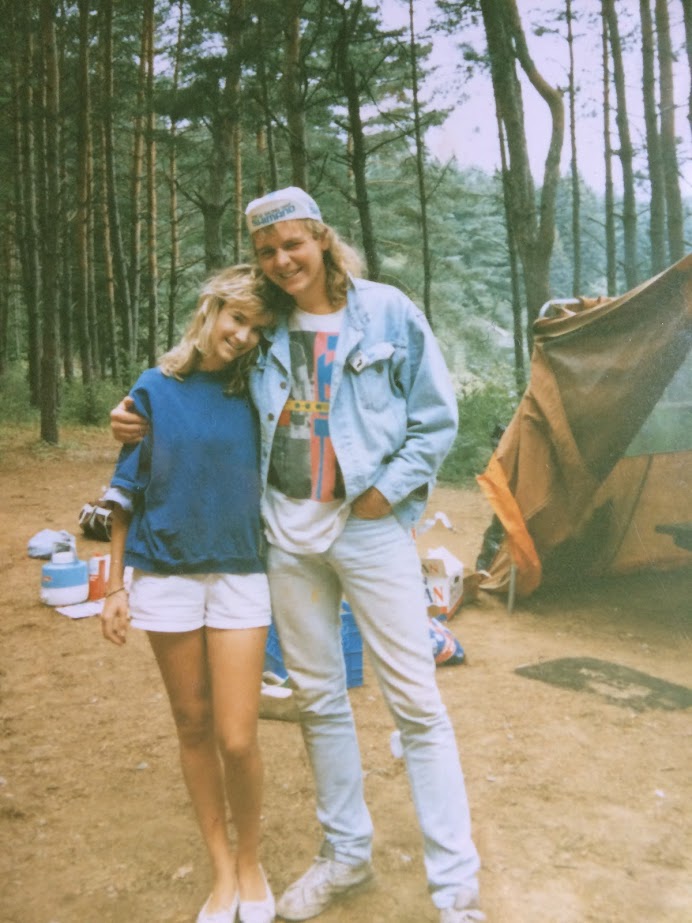
I was more of a Progressive Rock fan in the late 80s. My favourite bands were Rush, Marillion, Queensryche, Genesis, Yes and Peter Gabriel. However, I certainly liked some hair rock - Def Leppard in particular - and I had adopted some of the fashion choices (see below).
With my future wife, Summer 1988 Algonquin Park
Little did we (or the hair metal bands we loved) know that things were about to change. In 1991, Grunge hit the mainstream. It was a sudden revolutionary groundswell in the landscape of music that, unless you experienced it, is hard to quantify.

Almost overnight, hair-metal was dead or at least comical and tragically dated. In November, 1991, I watched the band Skid Row perform on Saturday Night Live. I felt connected to popular music -- with my finger clearly on the pulse. This was my generation of sound on television's biggest stage.

Just a few weeks later, Nirvana appeared and everything shifted. Suddenly, I felt like a dinosaur, a member of a bygone generation. There was a new sound taking over -- and I didn't understand it...yet.
However, according to Vice writer Jason Heller, "if grunge was the nail in the coffin of 80s hair metal, then alternative metal built that coffin". At the forefront of that coffin-building movement was Jane's Addiction. Formed in 1985, they are Perry Farrell (vocals), Dave Navarro (guitars), Steven Perkins (drums) and Chris Chaney (bass).
Jane's Addiction promotional photo - 1987
(l-r) Navarro, Chaney, Perkins, Farrell
I can't remember who first played Jane's Addiction for me. At the time, I was working at a restaurant called Mother Tucker's Food Experience so I am pretty sure it was one of the cooks. I do remember that it was the song Jane Says from Nothing's Shocking.
I was fascinated by the inclusion of steel drums in the song and, and wondered about the band's name. Who was Jane?

Years later I learned that Farrell picked the name to honour his roommate and muse, Jane Bainter, who had originally pitched the name "Jane's Heroin Experience" -- no relation to my former place of work.
Bainter (1988)
Then, some time later, I saw a broadcast of a blistering performance of the band’s Mountain Song from the MTV studios. It reminded me of Led Zeppelin, but there was a grittier, androgynous and slightly dangerous quality about it. Written by Farrell before the group's formation, it chronicled the challenges of a heroin addict who climbs a mountain of euphoria when using, only to come crashing down to a painful reality.
Farrell (right) performing with Navaro and Jane's Addiction
Farrell, who lost his mother to suicide at age three, struggled with heroin addiction through the late 80s and early 90s. Despite this monkey on his back, he was a force in the music industry. Not only did he front Jane's Addiction and the side project, Porno For Pyros, he also conceived and created the Lollapalooza Music Festival in 1991.
Poster for Lollapalooza - Toronto (1991)
Unlike other music festivals that took place over several days in a single venue, Lollapalooza toured across the United States and Canada through the summer of 1991. Taking its name from a 19th Century expression meaning "an extraordinary and unusual thing, person or event", the festival featured artists from a number of musical genres (rock, folk, hip-hop, electronica) and non-musical performance artists, including the Jim Rose Circus Side Show – the  modern-day version of a carnival side-show, complete with strongmen, contortionists and the fully-tattooed "Lizardman". There was even Zamora - The Torture King who ate fire, swallowed swords and punctured himself with electrified skewers.
Zamora - adding weights to a sword swallowing stunt
The festival was a massive success and expanded to become a series of international tours, each featuring the biggest acts of the day. Now, the event is now held annually in Chicago's Grant Park. It is a four-day affair held in late July. This year's iteration features 150 bands on nine stages, including headliners Metallica, Dua Lipa, J. Cole and Green Day.
The event has made Farrell an incredibly rich man, but he still performs. He will be fronting his band Porno For Pyros on the final night of the 2022 Lollapalooza on July 31.

Thirty-seven years after forming, Jane's Addiction announced a multi-city tour supporting The Smashing Pumpkins. They will hit my region in Southwestern Ontario in late October. 
The band that was once ahead of its time is now a nostalgia act, playing songs from their four-album catalogue -- mainly hits from their first two records -- for fifty-somethings like me. However, the ever-creative Farrell has hinted that recording new material may be in their future. Who knows -- maybe there are more coffins to build.

Sunday, 12 June 2022

The 500 - #313 - MTV Unplugged In New York - Nirvana

I was inspired by a podcast called The 500 hosted by Los Angeles-based comedian Josh Adam Meyers. His goal, and mine, is to explore Rolling Stone Magazine's 2012 edition of The 500 Greatest Albums of All Time. 


Album: # 313

Album Title: MTV Unplugged In New York

Artist: Nirvana

Genre: Alternative Rock, Grunge

Recorded: Sony Music Studio (Live) - New York

Released: November 18 , 1993

My age at release: 28

How familiar was I with it before this week: Very

Is it on the 2020 list? Yes, #279 - moving up 34 spots

Song I am putting on my Spotify Playlist: Pennyroyal Tea (Selected by my brother (in-law) and Nirvana fan, Dan


Earlier this year, the Grade 7 students and I spent some time discussing leadership. I kicked off the conversation with a fascinating, three-minute TED talk video, featuring musician, author and entrepreneur, Derek Sivers.
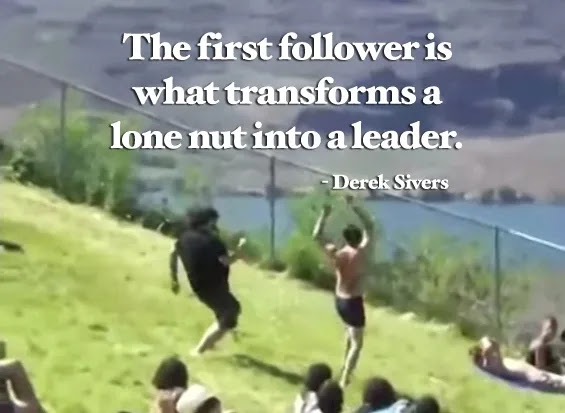
Sivers speaks on the topic of "How To Start  A Movement '', while a grainy video of a young, shirtless, dancing man begins playing on a screen behind him. Although unseen, it seems likely that the "dancing man" is at a musical performance, gesticulating wildly and comically.
Eventually, he is joined by his "first follower" and it is here that Sivers advances his notion that "the first follower is actually an underestimated form of leadership in itself. It takes guts to stand out like that. The first follower is what transforms a lone nut into a leader."
As the video continues, two more people join the duo and are immediately embraced as equals by both the dancing man and his first follower. Quickly, they are joined by four more and suddenly there is a tide of recruits. "This is the tipping point", states Sivers, "as more people join in, it's less risky. So those that were sitting on the fence before, now have no reason not to. They won't stand out, they won't be ridiculed, but they will be part of the in-crowd if they hurry."
By the end of the video, less than three minutes after being introduced to our shirtless, dancing man there are literally hundreds of people participating. Sivers makes his final point:
"Leadership is over-glorified. Yes, it was the shirtless guy who was first, and he'll get all the credit, but it was really the first follower that transformed the lone nut into a leader. So, as we're told that we should all be leaders, that would be really ineffective."
I have used this video with students for more than a decade and it provides a wonderful launching pad for rich discussions about their interpretation of, and comfort with, leadership. Invariably, a student will ask a key question:
"What do you call someone who doesn't want to lead or follow?" 
I love this moment, because it organically transitions to a conversation about "The Contrarian". Instead of framing this reluctant individual as an antagonist or adversary to progress, I instead offer examples of people who took a contrary stance that propelled them to greatness:
  • Former World Boxing Champion Muhammad Ali's decision to abstain from participation in the Vietnam War, despite its resultant heavy fine, potential jail time and a ban from boxing.
  • India’s Mahatma Gandhi's opposition to tyranny through non-violent protest.
  • Astronomer Nicolaus Copernicus risking death by contradicting the Catholic Church's 15th Century belief that the earth, not the sun, was the centre of our solar system. 
Although not on the same scale, MTV Unplugged in New York is a ready-made example of a contrarian spirit.
Nirvana guitarist and singer Kurt Cobain
In 1993, Nirvana was the biggest band in the world. The three-piece alternative rock group from Seattle, Washington, were Kurt Cobain (guitar, vocals), Krist Novoselic (bass) and Dave Grohl (drums). Their second studio release, Nevermind, (#17 on The 500) had been selling over 300,000 copies weekly since its release two years earlier. It had also transformed the world of popular music. The hair-metal and stadium rock of the late 80s had been replaced by grunge. In a nutshell, grunge is a musical sound (murky, punk-influenced, and bleak), an attitude (cynical and non-conformist) and aesthetic (loose flannels, androgynous oversized shirts often cobbled together from thrift shops).
Nirvana is typical grunge apparel ]
(l-r Cobain, Novoselic & Grohl)
MTV (Music Television) was also wildly popular in the 1990s and their Unplugged Series had enjoyed tremendous success. The popular series showcased well-known artists performing their greatest songs in a stripped-down acoustic format. These were then released as audio versions which sold briskly, generating massive profits for the network.  The biggest, Eric Clapton's 1992 Unplugged performance,  sold 26 million copies worldwide.
All this information is important context. It can't be understated how monumental the Nirvana performance was to the world and how important it was to the executives at MTV -- executives who had not factored in the difficult and contrary nature of this cynical, frustrated group, who were on the verge of breaking up permanently.
  • Cobain was struggling with a heroin addiction, and rehearsals had gone poorly. There was grave concern that the performance would not meet expectations. The day before filming, Cobain refused to play as he struggled with symptoms of withdrawal.
  • The band rebuffed executive requests to play their biggest hit, Smells Like Teen Spirit, and instead peppered their set with lesser-known songs written by other artists including an obscure Scottish alternative rock band, The Vaselines.
  • The band had teased an appearance by special guests and speculation among the fan base was rich. Would it be one of the group's famous colleagues from the Seattle music scene? Eddie Vedder of Pearl Jam or perhaps Chris Cornell from Soundgarden? No. It was another obscure band from Arizona, The Meat Puppets. Moreover, Nirvana chose to play three songs from that group's second record, Meat Puppets II, ostensibly promoting it more than their own recent release, In Utero.

Meat Puppets II by Meat Puppets
  • Although his amplifier was slightly disguised on-stage, Cobain broke with Unplugged tradition by performing the David Bowie song The Man Who Sold The World as an electric performance.
  • After being denied permission to play their controversial song Rape Me, the band slipped in an even more disturbing song, Polly. This track, from their album Nevermind, is about a 1987 incident in Tacoma, Washington, where 14-year-old was abducted, raped and tortured with a blow-torch. The unidentified girl, named Polly, but only in the song, escaped. Her captor is still serving a life sentence.
Portion of the article from the Spokane Chronicle
  • Finally, when asked to return to the stage for an encore, the band flatly refused.
However, despite their contrarian approach to this recording, the performance received critical acclaim. Tom Hibbert of Q Magazine raved about the record, saying; it "possessed a ragged glory", while Rolling Stone writer Barbara O'Dair called it "stirring and occasionally brilliant" with "spare and gorgeous spots everywhere".

It was also a commercial juggernaut, selling over 310,000 copies in its first week, a record for Nirvana. It would go on to be certified 8x platinum (8 million copies sold) in the United States, with millions more sold world wide. It received a Grammy Award in 1994 and sits on The 500, at position #313 -- the only Unplugged record to make the list. After all, sometimes a contrary stance can launch you to greatness.